TL;DR:
- Process optimization involves systematically analyzing and redesigning processes to maximize efficiency within existing constraints. It employs structured frameworks like Six Sigma, Kaizen, and process mining to identify bottlenecks, eliminate waste, and improve outcomes. Prioritizing high-impact processes, fixing root issues before automation, and establishing ongoing monitoring are critical for sustained performance gains.
Process optimization is defined as the systematic analysis and redesign of business processes to maximize efficiency, reduce waste, and improve outcomes within existing operational constraints. The recognized industry term is business process optimization (BPO), and it sits at the intersection of methodology, measurement, and organizational change. Frameworks like Six Sigma, Kaizen, and process mining give teams structured paths to identify bottlenecks, eliminate non-value-adding steps, and sustain performance gains over time. For business professionals and analysts, understanding what process optimization actually means, and how it differs from adjacent concepts, is the prerequisite to applying it effectively.
What is process optimization in business?
Process optimization is the practice of improving a business process by analyzing its current state, identifying inefficiencies, and applying targeted changes to close the gap between current and desired performance. It operates within existing constraints rather than replacing entire systems, which distinguishes it from more disruptive approaches like business process reengineering. The goal is measurable: reduce cycle time, lower error rates, cut costs, or increase throughput without proportionally increasing resources.
The workflow optimization process applies across industries, from manufacturing lines managing temperature and pressure variables to software teams refining sprint delivery cycles. Six Sigma, one of the most widely adopted frameworks, sets a concrete quality target of 3.4 defects per million opportunities (DPMO). That figure illustrates how seriously structured optimization treats measurement: not “fewer errors,” but a statistically defined near-zero defect rate.
Process mining tools like Celonis and UiPath Process Mining add a data layer to this work. They extract event logs from enterprise systems to map actual process flows, not assumed ones, revealing where handoffs stall, where rework accumulates, and where automation would deliver the highest return. For analysts, this transforms optimization from a qualitative exercise into a data-driven discipline.
How does process optimization differ from process improvement?
These terms are often used interchangeably, but they describe different scopes of work. Understanding the distinction prevents teams from underinvesting or overengineering their efforts.
Business process improvement focuses on incremental enhancements to existing processes, while business process reengineering involves complete redesigns from the ground up. Process optimization sits between these two poles. It assumes the process is fundamentally sound but operating below its potential, and it applies analytical rigor to close that performance gap.
Here is how the key concepts relate to each other:
- Process improvement addresses specific pain points through targeted fixes, often without a formal measurement framework. It is reactive and scope-limited.
- Process optimization uses structured methodologies and performance metrics to systematically raise a process toward its theoretical maximum efficiency. It is proactive and data-driven.
- Business process management (BPM) is the broader discipline that governs how processes are designed, monitored, and governed across an organization. Optimization is one activity within BPM.
- Business process reengineering discards the current process entirely and rebuilds from first principles. It carries higher risk and longer timelines than optimization.
The practical implication: teams should not reach for reengineering when optimization will close the gap. Equally, applying optimization methods to a fundamentally broken process wastes effort. Diagnosis comes before prescription.
What are the main process optimization methodologies?
Several well-established frameworks give organizations structured approaches to optimization. Each has a distinct focus, making the choice of methodology a strategic decision rather than a default.

| Methodology | Primary focus | Best use case |
|---|---|---|
| Six Sigma (DMAIC) | Defect reduction and variance control | High-volume, quality-critical processes |
| Kaizen | Continuous incremental improvement | Culture-wide adoption, low-disruption change |
| Agile | Iterative refinement through short cycles | Knowledge work, software delivery, service design |
| Process mining | Data-driven bottleneck discovery | Complex, multi-system enterprise workflows |
| Lean | Waste elimination and flow efficiency | Manufacturing, logistics, operational workflows |
Six Sigma uses the DMAIC cycle (Define, Measure, Analyze, Improve, Control) to reduce process variance. Its DPMO quality target makes it the preferred framework for industries where defects carry high financial or safety consequences, such as pharmaceuticals, aerospace, and financial services.
Kaizen takes the opposite approach in terms of scale. Kaizen promotes small, continuous improvements made by all levels of the organization, not just process engineers or consultants. This makes it an accessible entry point for teams that need to build an optimization culture before committing to heavier methodologies.
Process mining tools like Celonis, Minit, and UiPath Process Mining analyze event log data from ERP and CRM systems to reconstruct actual process flows. This removes the guesswork from process mapping and surfaces deviations that manual audits routinely miss.
Pro Tip: Before selecting a methodology, audit your data availability. Six Sigma and process mining require reliable event data. Kaizen works even when data infrastructure is thin. Matching the method to your data maturity prevents false starts.
How to identify and prioritize processes for optimization
Not every process deserves equal attention. Misallocating optimization effort toward low-impact processes is one of the most common and costly mistakes organizations make.
Prioritization criteria should focus on four dimensions: volume (how often the process runs), error rate (how frequently it produces defects or rework), cycle time (how long it takes end to end), and revenue exposure (how directly it affects customer outcomes or financial results). Processes that score high across multiple dimensions are the highest-priority candidates.
A useful benchmarking tool is Process Cycle Efficiency (PCE). PCE reveals that 60% of process cycle time is often non-value-adding, meaning only 40% of elapsed time actually produces output the customer cares about. This benchmark reframes the optimization conversation: the question is not “how do we work faster?” but “how do we eliminate the 60% that adds no value?”
The signals that a process needs optimization include:
- Frequent rework loops or error corrections that consume staff time without producing new output
- Cycle times that consistently exceed benchmarks for the industry or internal targets
- High handoff counts between teams or systems, each representing a potential delay or information loss
- Customer complaints concentrated around a specific stage of delivery
- Staff workarounds that bypass the official process, indicating the documented flow does not reflect operational reality
Focusing on the loudest complaints is a trap. Complaints surface symptoms, not root causes. A structured assessment using PCE and the four prioritization criteria identifies where optimization effort will generate the highest return, independent of organizational noise.
Pro Tip: Map your top five processes by revenue exposure before running any optimization workshops. This single step prevents teams from spending months optimizing a low-volume internal process while a high-revenue customer-facing workflow continues to underperform.
What does implementing process optimization actually involve?
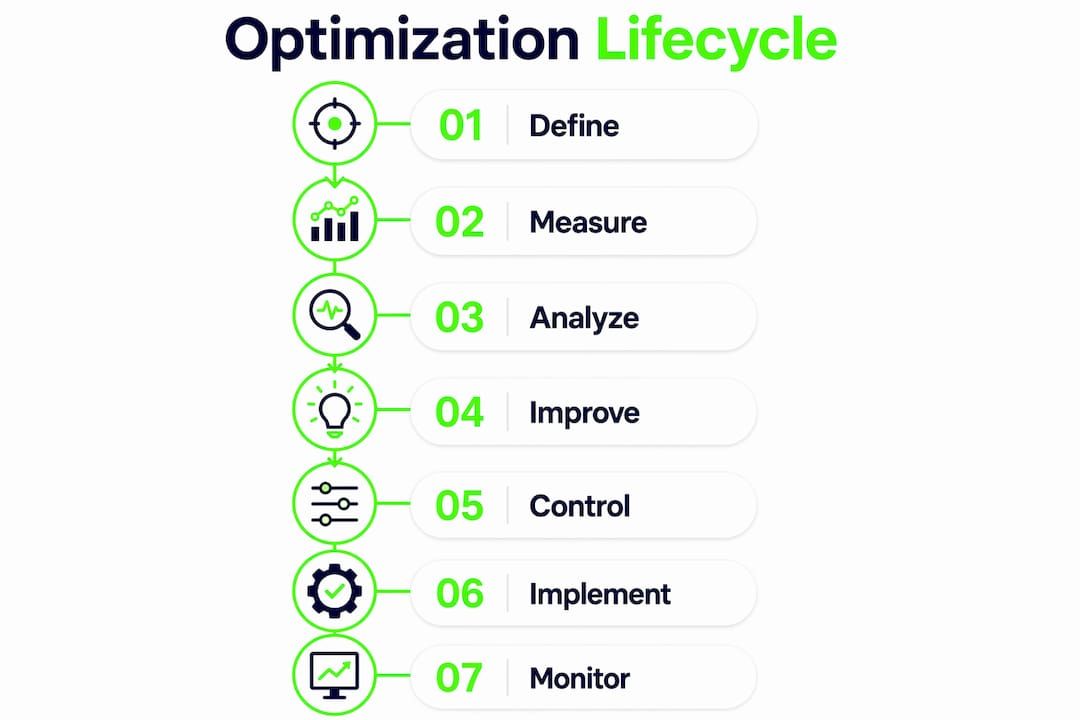
The 7-phase optimization lifecycle moves from defining scope and goals through analysis, redesign, piloting, implementation, training, and continuous monitoring. Each phase builds on the previous one, and skipping phases, particularly training and monitoring, is the most common reason optimization gains erode within 12 months.
The most critical principle in implementation is sequencing. Automating a broken process scales inefficiency faster rather than fixing root causes. Organizations that deploy robotic process automation (RPA) or AI-driven workflow tools on top of flawed processes discover this quickly: the automation executes the wrong steps reliably and at scale. Fix the process logic first, then automate.
Change management is the other underestimated variable. Technical redesigns fail when the people running the process do not understand why the change was made or how to operate the new workflow. Training must be specific to the redesigned process, not generic. And resistance is predictable: staff who have built expertise in the current process perceive optimization as a threat to that expertise. The Kaizen philosophy addresses this directly by making incremental improvement a shared practice rather than a top-down mandate.
Continuous monitoring closes the loop. Processes drift over time as volumes change, staff turns over, and system integrations evolve. A monitoring cadence, whether weekly dashboards, monthly PCE reviews, or quarterly DMAIC cycles, keeps performance visible and creates the feedback mechanism that separates sustained optimization from a one-time project.
Common pitfalls that derail process optimization efforts
Even well-resourced optimization programs fail. The failure modes are consistent enough to treat as predictable risks rather than surprises.
- Poorly tuned control loops: Over 35% of control loops in industrial processes are poorly designed or tuned, creating inefficiencies that basic workflow audits never surface. This is not limited to manufacturing; any process with automated decision triggers or escalation rules carries the same risk.
- Automating before fixing: Deploying automation on an inefficient process does not eliminate the inefficiency. It embeds it into the system architecture, making it harder to remove later.
- Absent metrics: Optimization without a defined baseline and target metric is opinion-driven, not data-driven. Teams argue about whether the process improved rather than measuring it.
- Scope creep: Starting with a well-defined process and expanding mid-project to adjacent workflows dilutes focus and delays results.
“Resistance to formal optimization often stems from perceptions of disruption. Kaizen offers a low-barrier introduction through incremental change.” — Teamwork.com
The IT infrastructure optimization context adds another layer: technology dependencies between processes mean that optimizing one workflow can create unexpected load or latency in connected systems. Cross-functional impact assessment before implementation prevents these downstream failures.
Key takeaways
Process optimization delivers measurable performance gains only when teams fix foundational process issues before applying automation or advanced tooling.
| Point | Details |
|---|---|
| Definition clarity | Process optimization is systematic redesign within constraints, distinct from improvement and reengineering. |
| Methodology selection | Match the framework to data maturity: Six Sigma for high-volume quality work, Kaizen for culture-building. |
| Prioritization discipline | Use volume, error rate, cycle time, and revenue exposure to rank processes, not complaint volume. |
| Sequence matters | Fix process logic before automating; automation scales whatever the process currently does. |
| Continuous monitoring | Optimization gains erode without a defined monitoring cadence and feedback mechanism. |
Why process optimization thinking has shifted in 2026
From Bitecode’s vantage point, the most significant shift in process optimization over the past few years is not methodological. It is attitudinal. Organizations that treat optimization as a project, something with a start date, a deliverable, and a close-out report, consistently underperform compared to those that treat it as an operating discipline.
The tools have improved dramatically. Process mining platforms now surface bottlenecks in hours that previously took weeks of manual mapping. AI-assisted workflow analysis can flag deviation patterns before they become systemic. But tool adoption without the underlying discipline of measurement, prioritization, and structured change management produces the same outcome it always has: a technology investment that does not translate into sustained performance improvement.
The other observation worth sharing: incremental change compounds. Teams that implement Kaizen-style micro-improvements across a 12-month period often outperform teams that execute a single large-scale redesign. The reason is cultural. Incremental improvement builds the organizational muscle for continuous refinement. Large redesigns build dependency on external consultants and create change fatigue that makes the next optimization cycle harder to initiate.
For organizations considering where to start, the business process automation guide at Bitecode offers a practical framework for sequencing automation investments alongside process fixes, which is the combination that actually moves the needle.
— Bitecode
How Bitecode supports process optimization in practice
Organizations that have completed the diagnostic and redesign phases of process optimization frequently face the same next question: how do we sustain these gains at scale without rebuilding our technology stack from scratch? Bitecode addresses this directly through modular, pre-built components that integrate into existing enterprise environments without lengthy development cycles.
The AI assistant module automates repetitive workflow steps and surfaces process deviations in real time, giving operations teams the monitoring layer that most optimization programs lack after go-live. For organizations managing customer-facing workflows, Bitecode’s custom CRM solutions provide the process governance layer that keeps optimized workflows from drifting back to their previous state. With up to 60% of the baseline system pre-built, teams can move from optimization design to working software in weeks rather than quarters.
FAQ
What is the process optimization definition in simple terms?
Process optimization is the practice of analyzing a business process and making targeted changes to improve its efficiency, quality, or speed within existing constraints. It uses structured methodologies like Six Sigma or Kaizen to close the gap between current and target performance.
How does process optimization differ from process improvement?
Process improvement addresses specific pain points through incremental fixes, while process optimization applies structured measurement frameworks to systematically raise a process toward its maximum efficiency. Optimization is more data-driven and proactive than general improvement efforts.
What are the most effective process optimization techniques?
Six Sigma (DMAIC), Kaizen, Lean, Agile, and process mining are the most widely used techniques. The right choice depends on data availability, process type, and organizational readiness for change.
Why is it important to fix processes before automating them?
Automating a broken or inefficient process scales the inefficiency rather than eliminating it. Fixing process foundations before adding automation technology prevents organizations from embedding flawed logic into their systems architecture.
What is Process Cycle Efficiency and why does it matter?
Process Cycle Efficiency (PCE) measures the proportion of total cycle time that adds value for the customer. A PCE benchmark of 40% productive time means 60% of elapsed process time produces no customer value, making it the primary target for optimization effort.