TL;DR:
- Advanced tech integration involves embedding modern technologies like AI, automation, and cloud platforms into existing systems to boost efficiency. Organizations that treat integration as a core architectural discipline achieve faster deployment times, improved compliance, and scalable workflows compared to ad hoc approaches. Building standardized abstraction layers and observability from the outset is essential for sustainable, high-impact digital transformation.
Advanced tech integration is defined as the deliberate embedding of modern technologies, including AI, automation, cloud platforms, and multi-agent systems, into an organization’s existing operational infrastructure to drive measurable efficiency gains and digital transformation. This is not a greenfield rebuild. It is a surgical process of connecting new capabilities to existing business logic without discarding what already works. Firms like Advanced Technologies Integration, Inc. have built entire practices around this discipline, and the evidence from 2026 deployments confirms that organizations treating integration as a core competency, rather than a one-time project, consistently outperform those that treat technology adoption as isolated tool purchases.
What is advanced tech integration: core components and technologies
Advanced tech integration, known in enterprise architecture circles as enterprise technology integration, covers the full stack of connections between modern digital tools and the systems organizations already operate. The components span AI-powered automation engines, cloud platforms such as AWS and Azure, API gateways, data integration layers, and increasingly, multi-agent orchestration pipelines that coordinate multiple AI models toward a single business outcome.

The technical architecture matters as much as the technology itself. Effective integration is about surgical connection and middleware management rather than complete rewrites. This means building abstraction layers that sit between your application logic and the underlying AI or cloud providers. Airbnb’s internal tool, Airchat, is a documented example: a standardized abstraction layer that decoupled engineering teams from specific AI model dependencies, allowing the organization to swap providers without rewriting application code.
Key technical components that define a mature integration architecture include:
- Provider-agnostic API calls that route requests through a centralized middleware layer rather than hardcoding vendor-specific SDKs throughout the codebase
- Cost-aware middleware that tracks token usage, latency, and per-request spend in real time, preventing runaway cloud costs as usage scales
- Streaming response handling for AI features that require low-latency output, such as chat interfaces or real-time document analysis
- Graceful degradation logic that falls back to a simpler response or cached result when an upstream AI service is unavailable
- Modular MCP (Model Context Protocol) servers that expose standardized tool interfaces to agentic AI systems, enabling plug-and-play agent composition
The IT role has shifted from building custom AI models to managing integration layers, middleware, cost controls, and security. AI providers handle model creation. Your team’s competitive advantage now lives in how well those models are connected to your specific business context.
Pro Tip: Avoid scattered API calls embedded directly in application controllers. Centralize all AI provider interactions in a single middleware service. This gives you one place to enforce rate limits, log requests, rotate API keys, and swap providers without touching business logic.
How advanced tech integration accelerates operational efficiency
The efficiency gains from mature integration architectures are not theoretical. A 400-engineer SaaS company reduced its PR-to-production lifecycle from 4.2 days to 6.4 hours by deploying Claude Code in a multi-agent DevOps pipeline. That is not a marginal improvement. It represents a structural change in how software delivery operates, compressing a week of coordination into a single business morning.
Airbnb’s integration results are equally instructive. By deploying a standardized abstraction layer, the company scaled agentic coding adoption to 60% of its engineering workforce within 12 months. The abstraction layer did the heavy lifting: it removed the friction of individual engineers configuring AI tools independently, and it gave the platform team centralized control over cost, compliance, and capability rollout.
Compliance outcomes are equally significant. Multi-agent AI systems document every deployment decision in immutable logs, enabling SOC 2 compliance without additional audit tooling. This matters because compliance overhead is one of the largest hidden costs in enterprise software delivery, and integration architecture that bakes in auditability from the start eliminates a category of manual work entirely.
| Metric | Traditional workflow | Advanced integrated workflow |
|---|---|---|
| PR-to-production time | 4.2 days | 6.4 hours |
| Engineering AI adoption | Ad hoc, individual | 60% workforce, standardized |
| Compliance documentation | Manual audit logs | Immutable automated logs |
| Provider flexibility | Vendor-locked | Provider-agnostic via abstraction |
| Deployment risk management | Manual review gates | Canary rollouts with automated rollback |
The pattern across these examples is consistent. Advanced tech integration in business does not just speed up existing processes. It restructures the underlying workflow so that the bottlenecks that previously required human coordination are handled by the architecture itself. For more on how AI transforms enterprise finance, the efficiency gains follow the same structural logic.
Comparing integration approaches: build vs. integrate
The central strategic question for any organization is whether to build custom AI models or integrate pre-built AI services through APIs. The answer, in nearly every enterprise context, is to integrate. Building a custom large language model requires hundreds of millions of dollars in compute, specialized research talent, and years of training cycles. Integrating OpenAI, Anthropic, or Google Gemini via API delivers comparable capability in days, with the complexity relocated into the vendor relationship rather than internal infrastructure.
That said, the integration approach itself has meaningful architectural variants worth comparing:
| Approach | Best for | Key trade-off |
|---|---|---|
| Direct API integration | Small teams, single use case | Fast to deploy, hard to maintain at scale |
| Abstraction layer pattern | Multi-team organizations | Higher upfront architecture cost, lower long-term friction |
| Modular MCP server architecture | Agentic, multi-step workflows | Maximum flexibility, requires orchestration expertise |
| Low-code integration platforms | Non-technical teams, rapid prototyping | Limits customization, relocates complexity to vendor |
For organizations managing enterprise software integration at scale, the abstraction layer pattern consistently delivers the best balance of speed and maintainability. It accelerates work without accelerating chaos, because every new AI capability plugs into a known interface rather than introducing new dependencies.
The challenges in advanced technology implementation cluster around three areas. Managing streaming responses requires different infrastructure than standard request-response APIs. Cost-aware middleware demands real-time spend tracking that most existing observability stacks do not provide out of the box. Error handling for AI services is non-deterministic in ways that traditional exception handling was not designed for, because a model returning a plausible but incorrect answer is harder to catch than a 500 error.
Pro Tip: Implement human-in-the-loop thresholds at decision points where the cost of an automated error exceeds the cost of a human review. Canary rollouts with automated rollback are the production-grade version of this principle.
Practical steps for successful advanced technology implementation
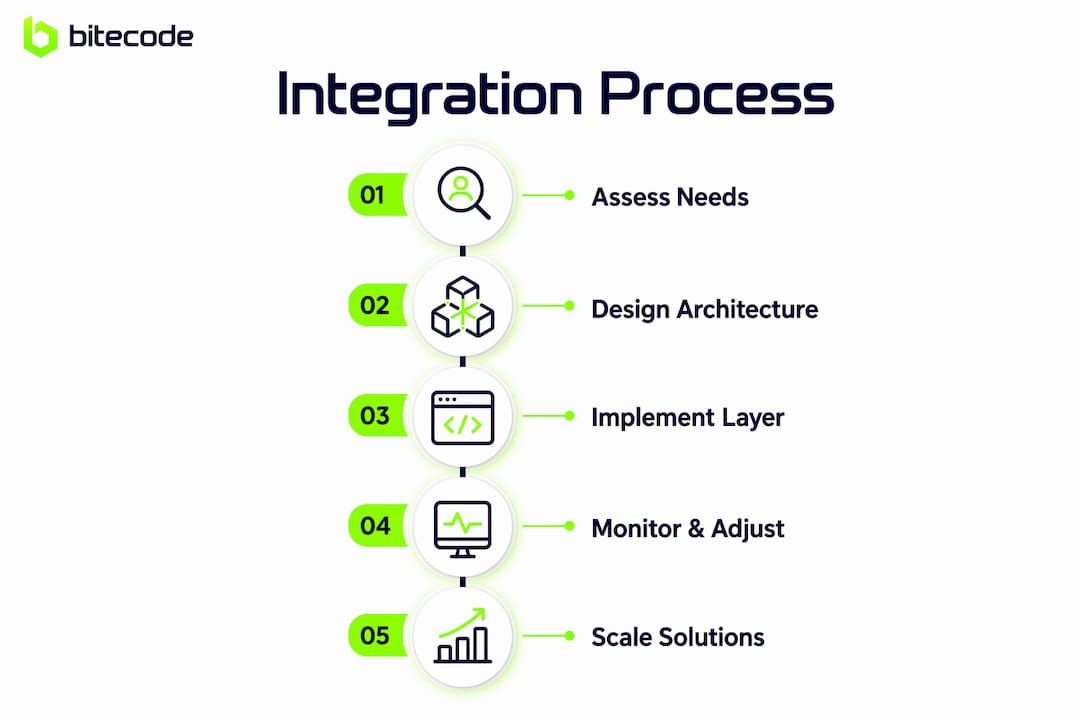
Understanding tech integration at a conceptual level is straightforward. Executing it without accumulating technical debt or disrupting existing workflows requires a structured approach. The following sequence reflects what organizations that have scaled integration successfully actually do.
-
Conduct a needs assessment aligned to business outcomes, not technology availability. The ALIGN framework makes this explicit: technology integration must serve organizational goals rather than operate as a standalone capability. Map the specific workflows where latency, error rates, or manual effort represent the largest cost, then identify which integration capabilities address those gaps directly.
-
Design the abstraction layer before writing integration code. Define the interface your application will use to call AI or automation services before choosing a provider. This single architectural decision determines whether you can swap providers in a day or a quarter. Shared infrastructure and layered architectures are what enable organization-wide adoption rather than isolated team experiments.
-
Build observability into the integration layer from day one. Log every request, response, latency measurement, and cost event at the middleware level. Agentic AI systems require architectural design that includes durable session management and harness separation from the execution sandbox, so that failures are observable and reproducible rather than opaque.
-
Deploy using canary rollouts with defined error thresholds. Automation pipelines must incorporate layered validation agents and fallback mechanisms. A canary release that routes 5% of traffic to the new integration before full rollout catches production failures at a cost that is manageable rather than catastrophic.
-
Plan for user training and iterative refinement as a budget line, not an afterthought. Effective technology integration supports existing workflows and business logic rather than displacing them. Teams that receive structured onboarding and feedback loops during the first 90 days of a new integration sustain adoption. Teams that do not revert to previous tools within six months.
For organizations evaluating the ROI of these steps, the strategies, ROI, and pitfalls analysis from Bitecode provides a detailed financial framework for prioritizing integration investments.
Key takeaways
Advanced tech integration succeeds when organizations treat it as an architectural discipline, not a procurement decision, building abstraction layers, observability, and human oversight into the foundation before scaling adoption.
| Point | Details |
|---|---|
| Define integration before selecting tools | Map business workflow gaps first; choose AI or automation providers that fit the abstraction layer you design. |
| Abstraction layers enable scale | Airbnb’s standardized layer drove 60% engineering adoption in 12 months by removing per-team configuration friction. |
| Efficiency gains are structural | Multi-agent DevOps pipelines cut PR-to-production from 4.2 days to 6.4 hours by restructuring workflow, not just speeding it up. |
| Compliance is an architecture output | Immutable audit logs from multi-agent systems deliver SOC 2 compliance without separate manual tooling. |
| Human oversight is a design requirement | Canary rollouts and human-in-the-loop thresholds are not optional safeguards. They are the mechanism that makes autonomous pipelines reliable. |
Bitecode’s perspective on what integration actually demands
The organizations that struggle with advanced tech integration share a common pattern: they treat it as a technology selection problem when it is actually an architecture problem. They choose a vendor, deploy a tool, and then discover that the real work, connecting that tool to existing data, workflows, access controls, and compliance requirements, was never scoped into the project.
From Bitecode’s experience building modular enterprise systems, the most expensive integration failures are not technical. They are organizational. A team that deploys an AI assistant without defining what data it can access, what decisions it can make autonomously, and what triggers a human review has not integrated a capability. It has introduced a liability.
The organizations that get this right invest in the middleware and abstraction layer first, even when that feels slower than shipping a feature. They treat workflow automation as infrastructure, not a shortcut. And they build in observability before they need it, because by the time a production failure makes observability feel urgent, the cost of retrofitting it is already high.
Is advanced tech worth it? The evidence from 2026 deployments is unambiguous. The question is not whether to integrate, but whether your architecture can sustain the integration at the scale your business requires. The teams that answer that question before they start deploying are the ones that end up with a competitive advantage rather than a maintenance burden.
— Bitecode
How Bitecode accelerates your integration from day one
Bitecode’s AI Assistant Module is a production-ready integration component designed for organizations that need AI-powered workflow automation without building the middleware layer from scratch. The module ships with provider-agnostic API routing, cost tracking, streaming support, and audit logging already configured, covering the infrastructure that typically consumes the first two months of an integration project.
Because Bitecode starts projects with up to 60% of the baseline system pre-built, teams connect the AI Assistant Module to their existing business logic rather than constructing integration plumbing from zero. Provider flexibility is built in, so organizations are not locked into a single AI vendor as the market evolves. For decision-makers evaluating AI readiness before committing to a full integration program, the module provides a concrete, low-risk starting point with measurable outputs from the first deployment.
FAQ
What is advanced tech integration in simple terms?
Advanced tech integration is the process of connecting modern technologies, such as AI, automation, and cloud services, to an organization’s existing systems and workflows. The goal is to improve operational efficiency without replacing the business logic that already works.
How long does advanced technology implementation typically take?
Timeline depends heavily on architecture decisions made before deployment begins. Organizations that design abstraction layers and observability infrastructure upfront typically reach production-grade integration within three to six months. Teams that skip this phase often spend that same time troubleshooting failures.
What are the biggest risks in tech integration projects?
The primary risks are vendor lock-in from direct API dependencies, cost overruns from unmonitored AI service usage, and compliance gaps when audit logging is not built into the integration layer. Canary rollouts and human-in-the-loop thresholds address the reliability risk directly.
What is the difference between tech integration and digital transformation?
Digital transformation is the organizational strategy. Advanced tech integration is the technical execution layer that makes transformation concrete. Transformation without integration architecture produces vision documents. Integration without transformation strategy produces disconnected tools.
Is advanced tech integration worth the investment for mid-size companies?
The efficiency data from 2026 deployments, including a reduction in deployment cycles from 4.2 days to 6.4 hours, indicates that the ROI is positive when integration is treated as infrastructure rather than a feature. Mid-size companies benefit most from modular, pre-built integration components that reduce the upfront architecture cost.