TL;DR:
- AI transformation involves embedding intelligence into business workflows to enable new ways of operating and creating value. Most organizations see limited impact because they focus on technology without redesigning processes or investing in human capabilities. Strategies aimed at innovation and revenue growth outperform cost-cutting approaches for sustained success.
Artificial intelligence transformation is defined as the process of embedding intelligence directly into business workflows so that organizations can operate, decide, and create value in fundamentally different ways. The role of AI in digital transformation goes far beyond automating repetitive tasks. It repositions AI as a strategic enabler that reshapes operating models from the ground up. Global AI investment exceeded $250 billion in 2025, yet only 25% of companies report achieving a truly transformative impact. That gap between spending and results is the central challenge every business leader and digital strategist must solve.
How does AI enhance organizational efficiency and business value?
AI’s most direct contribution to organizational efficiency is its ability to compress time. Tasks that once required hours of human processing, from data entry to customer triage to financial reconciliation, now complete in minutes. That compression compounds across an enterprise, freeing teams to focus on judgment-intensive work that machines cannot replicate.

Adoption has accelerated sharply. Approximately 7 in 10 businesses across major markets now use AI regularly, with daily usage more than doubling since 2024. That figure signals a shift from experimentation to operational dependency. AI is no longer a pilot program in most mid-to-large enterprises. It is infrastructure.
The productivity gains are measurable and specific:
- Shorter workdays without output loss, as AI handles scheduling, drafting, and data aggregation
- Revenue growth from faster customer response cycles and more personalized service delivery
- Workforce expansion rather than cuts, as AI-enabled daily use creates capacity for new business lines
- Early wins in marketing and admin, where content generation, campaign analysis, and document processing yield the fastest returns
The pattern across high-performing organizations is consistent. They deploy AI where the workflow is already well-defined, measure the output, and expand from there. The mistake most teams make is deploying AI broadly before they have established what “good” looks like in a given process. Measurement must precede scaling. For a closer look at how these gains show up in financial operations, the AI applications in enterprise finance breakdown is worth reviewing.
Why does AI transformation depend more on people than technology?
The technology is rarely the limiting factor. BCG research shows that 70% of the value from AI-driven transformations comes from people-related actions rather than technology-related ones. That finding reframes the entire conversation. Buying better models or deploying more compute does not move the needle if managers have not redesigned the workflows those models operate within.
The human factors that determine AI success include:
- Workflow redesign: Managers must actively rebuild processes around AI capabilities, not simply insert AI into existing steps
- Employee buy-in: Teams that distrust AI outputs either ignore them or over-rely on them, both of which destroy value
- Domain expertise: Field experiments at MIT Sloan show AI boosts revenue by 15% for high performers but reduces it by nearly 10% for low performers who cannot filter AI output effectively
- Change management: Organizations that treat AI rollout as a technology project rather than an organizational change program consistently underperform
The MIT Sloan finding deserves emphasis. AI amplifies existing capability gaps. It does not close them. A team with weak analytical judgment will make worse decisions faster when AI is in the loop. That is the opposite of the intended outcome.
Pro Tip: Before deploying any AI tool across a team, assess whether team members can critically evaluate the outputs that tool produces. If they cannot, invest in domain training first. The tool is only as useful as the judgment applied to its results.
For teams building the organizational foundation before scaling AI, the enterprise digital transformation tips resource covers the people-side prerequisites in practical terms.
Do innovation-focused AI strategies outperform cost-cutting models?
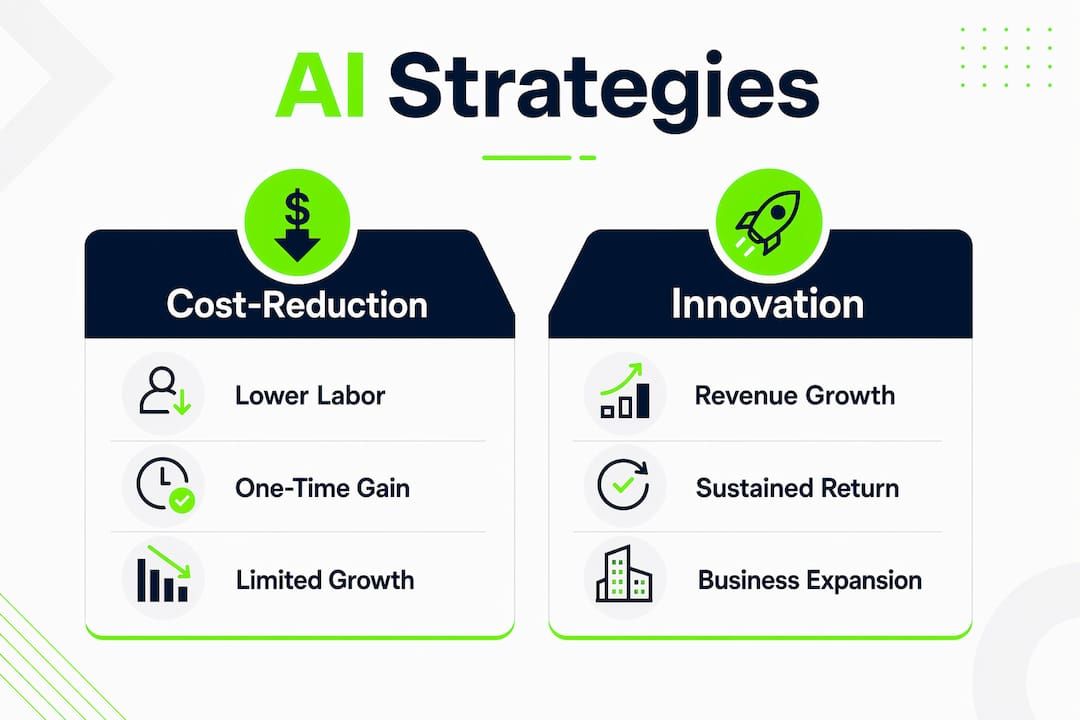
The evidence is clear: innovation-focused AI strategies generate stronger returns than approaches centered on labor reduction. Organizations that deploy AI to reduce headcount capture a one-time efficiency gain. Organizations that deploy AI to create new revenue streams, reduce cycle times, and deliver premium services build compounding advantages.
The contrast between the two approaches is sharp:
| Approach | Primary goal | Typical outcome |
|---|---|---|
| Cost-reduction model | Lower labor costs | One-time savings, limited growth |
| Innovation model | New revenue and faster delivery | Compounding returns, workforce growth |
The innovation model works because it aligns AI deployment with business growth rather than business contraction. When AI reduces a product development cycle from six weeks to two, the organization can serve more clients, launch more products, and respond faster to market shifts. None of that value appears on a headcount reduction spreadsheet.
Specific use cases where the innovation model outperforms include premium service delivery (AI-assisted personalization at scale), cycle time compression in product and service development, and capacity expansion that allows smaller teams to serve larger client bases without proportional hiring. The AI automation trends for 2026 article documents how leading organizations are structuring these innovation-first deployments.
What are the key challenges in implementing AI for digital transformation?
The most common implementation failure follows a predictable pattern: an organization buys AI tools before redesigning the workflows those tools will operate within. AI amplifies organizational weaknesses such as poor data hygiene and unclear process ownership. It does not correct them. The result is that inefficiencies accelerate rather than disappear.
Avoiding that failure requires a sequenced approach:
- Audit workflows first. Map every process targeted for AI integration. Identify who owns each step, what data it consumes, and what a correct output looks like. If you cannot define “correct,” you cannot evaluate AI performance.
- Clean the data. AI models trained on or operating within dirty data produce unreliable outputs. Data quality is not a technical prerequisite. It is a business prerequisite.
- Redesign before deploying. Restructure the workflow around AI’s actual capabilities before introducing the tool. Inserting AI into a broken process produces a faster broken process.
- Apply probabilistic governance. Unlike traditional rule-based digital systems, AI requires new governance approaches including output drift monitoring and human approval thresholds for high-stakes decisions. A model that performed well in January may degrade by March without any code change.
- Monitor continuously. Set performance baselines at deployment and review them on a fixed schedule. AI outputs shift as underlying data patterns shift.
The governance point is where most enterprise AI programs underinvest. Traditional digital transformation operates on deterministic logic: if the rule is correct, the output is correct. AI operates probabilistically. The output is usually right, but “usually” requires active oversight to remain true. Building that oversight into the operating model from day one is the difference between a controlled deployment and a liability.
Pro Tip: Assign a named owner to every AI-assisted workflow. That person is responsible for reviewing output quality on a regular cadence and escalating anomalies. Ownership without accountability is the fastest path to output drift going undetected.
For teams mapping out the full deployment sequence, the step-by-step AI automation guide provides a structured framework that addresses each of these prerequisites. The shift toward agentic AI workflows and autonomous decision-making also raises the stakes on governance, as AI systems increasingly act without direct human instruction at each step.
Key Takeaways
AI transformation delivers lasting value only when organizations redesign workflows, invest in human capability, and govern AI outputs with the same rigor they apply to financial controls.
| Point | Details |
|---|---|
| Investment alone does not produce results | Only 25% of companies achieve transformative impact despite massive global AI spending. |
| People drive AI value | BCG data shows 70% of AI transformation value comes from people-related actions, not technology. |
| Innovation beats cost-cutting | AI deployed for revenue growth and cycle time reduction outperforms labor-reduction strategies. |
| Workflow redesign must come first | Deploying AI into unclean or poorly defined workflows amplifies inefficiencies rather than solving them. |
| Governance requires continuous oversight | AI outputs drift over time and require probabilistic monitoring, not one-time rule-based checks. |
What Bitecode has learned from moving AI from pilots to operating models
The organizations that struggle most with AI are not the ones that lack ambition. They are the ones that treat AI as a product purchase rather than an operating model decision. A pilot succeeds in a controlled environment because someone is watching it closely. Scaling that pilot across an organization without rebuilding the surrounding processes is where value evaporates.
What I have observed consistently is that the most effective AI deployments share one structural feature: they make organizational weaknesses visible before they make them worse. A team that deploys AI in accounts payable and suddenly sees a 30% error rate in invoice matching has not created a new problem. They have surfaced an existing one. That transparency is uncomfortable, but it is the starting point for real improvement.
The shift toward agentic workflows, where AI systems make sequences of decisions without human instruction at each step, raises the stakes on this considerably. Organizations that have not yet established clean data ownership and clear output standards are not ready for agentic AI. They are ready for the preparatory work that makes agentic AI safe. Balancing automation with human judgment is not a philosophical question in 2026. It is an engineering and governance question with measurable answers.
The leaders who get this right are the ones who treat AI integration as a continuous design process, not a deployment event. They empower their teams to identify where AI is producing noise rather than signal, and they act on that feedback quickly. That feedback loop is the actual competitive advantage, not the model itself.
— Bitecode
Bitecode’s approach to AI-driven business software
Building AI into enterprise operations requires more than selecting the right model. It requires a software foundation that can support AI workflows, connect to existing data systems, and adapt as requirements change.
Bitecode builds custom AI automation systems for organizations that need AI embedded into their actual business processes, not bolted onto the side of them. Projects start with up to 60% of the baseline system pre-built through modular components, which means teams reach a working system in weeks rather than months. For organizations that need a full custom platform to support AI-driven operations, Bitecode’s custom business software development service covers the full build, from workflow design through deployment and governance integration.
FAQ
What is the role of AI in digital transformation?
AI’s role in digital transformation is to embed intelligence into business workflows so that organizations can automate decisions, accelerate processes, and create new value at scale. It shifts digital transformation from process digitization to operating model redesign.
Why do most AI transformation efforts fall short?
Only 25% of companies achieve transformative AI impact despite significant investment, primarily because they deploy tools without redesigning workflows or addressing data quality issues first.
How important are people compared to technology in AI transformation?
BCG research shows that 70% of AI transformation value comes from people-related actions, including workflow redesign, change management, and building employee capability to evaluate AI outputs.
What governance does AI require that traditional digital systems do not?
AI requires probabilistic governance, including continuous monitoring for output drift and defined human approval thresholds for high-stakes decisions, because AI outputs shift over time even when the underlying code does not change.
Should organizations focus AI on cost reduction or revenue growth?
Innovation-focused AI strategies that target cycle time reduction and premium service delivery generate stronger and more sustainable returns than strategies centered on labor cost reduction, according to research from the Belfer Center.