TL;DR:
- Effective software risk management involves continuous identification, assessment, and mitigation across all development stages.
- It categorizes risks into technical, project management, operational, security, and business types to prevent blind spots.
Software risk management is the systematic process of identifying, assessing, mitigating, and monitoring threats to software projects throughout the entire development lifecycle. Unmanaged software risk is the leading cause of project overruns, security breaches, and failed deployments. The discipline draws on structured frameworks, objective scoring methods like the Security Quality Score (SQS), and continuous integration practices to keep risk visible at every phase. For IT professionals and organizational leaders, treating risk management as a continuous process rather than a pre-launch checklist is the single most consequential shift they can make.
What are the main types of software risk?
Software risk falls into five distinct categories, and missing any one of them creates blind spots that compound over time.
- Technical risks include architectural flaws, poor code maintainability, dependency vulnerabilities, and inadequate test coverage. These are the risks most teams see first, but they are rarely the most damaging on their own.
- Project management risks cover scope creep, unrealistic timelines, resource shortfalls, and unclear requirements. A technically sound codebase can still fail delivery if the project structure is broken.
- Operational risks involve deployment failures, infrastructure outages, and inadequate monitoring after go-live. Many organizations treat operations as a post-development concern, which is exactly when these risks surface.
- Security risks include injection vulnerabilities, authentication weaknesses, exposed secrets, and unpatched third-party libraries. Security risk is not a subset of technical risk. It deserves its own register entry and its own remediation timeline.
- Business risks encompass regulatory non-compliance, vendor lock-in, and misalignment between software capabilities and market needs.
Identifying risks early requires both qualitative and quantitative methods. Brainstorming sessions, technical architecture reviews, and threat modeling surface risks that automated tools miss. Risk registers document each identified risk with a probability rating, an impact score, and an assigned owner. Risk management is a continuous process of identification, analysis, prioritization, monitoring, and mitigation throughout the software lifecycle. Fragmentation in this process leads directly to a poor security posture.
Pro Tip: Assign every risk register entry to a named individual, not a team or role. Shared ownership is no ownership.
How is software risk assessment performed?
Modern risk assessment combines automated scanning with structured scoring to produce objective, repeatable results. The goal is to move beyond gut-feel estimates and produce numbers that leadership can act on.

The Security Quality Score (SQS) is a 0–100 metric that aggregates severity of security flaws and business criticality into a single application risk rating. A low SQS does not just mean “fix more bugs.” It signals that the application needs a defined remediation period tied to its business criticality before it can be considered production-ready.
Automated assessments now cover six key dimensions of software quality: maintainability, security, AI readiness, reliability, performance efficiency, and portability. Objective assessments across six dimensions can be delivered in as little as 24 hours, benchmarked against a dataset of 30,000+ real-world systems. That benchmark context matters. A raw score without industry comparison tells teams very little about where they actually stand.
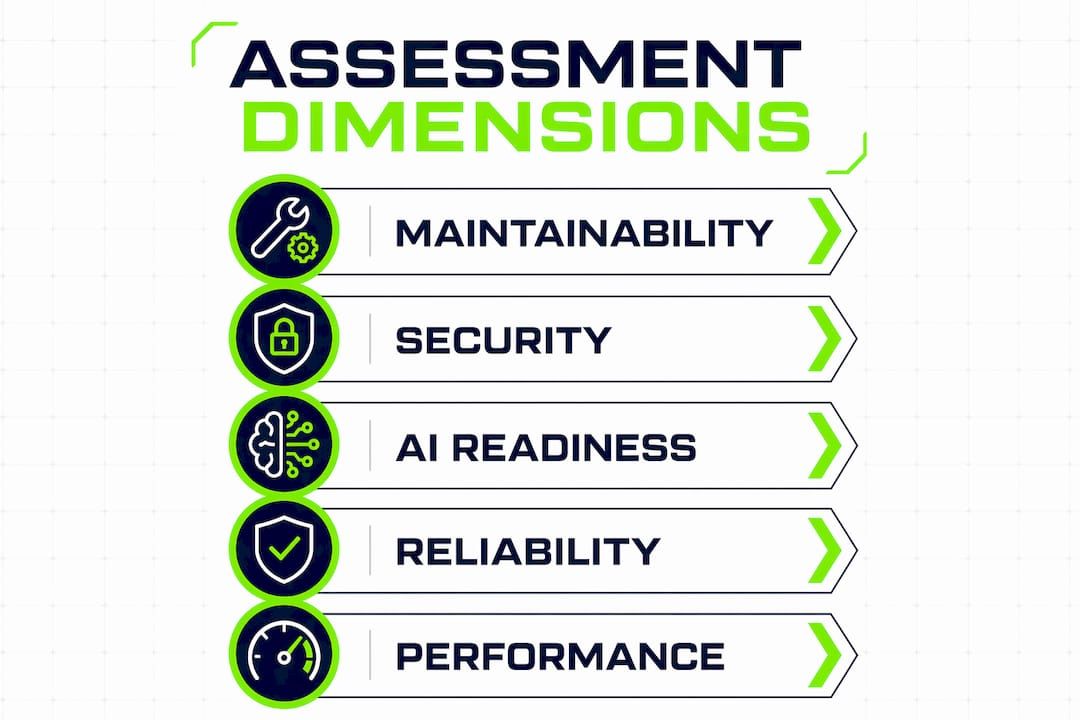
| Assessment dimension | What it measures | Primary method |
|---|---|---|
| Maintainability | Code complexity, duplication, unit size | Static analysis (SAST) |
| Security | Vulnerability severity and density | SAST, SCA, DAST, pen testing |
| AI readiness | Codebase structure for AI-assisted development | Automated structural analysis |
| Reliability | Fault tolerance and error handling | Automated testing, code review |
| Performance efficiency | Resource usage under load | Dynamic analysis (DAST) |
| Portability | Dependency on specific environments | Software composition analysis (SCA) |
Combining SAST, SCA, DAST, and manual reviews reduces false negatives and produces a more accurate picture of the security posture. Each method catches a different class of vulnerability. SAST finds logic flaws in source code. SCA identifies vulnerable open-source components. DAST tests the running application from the outside. Manual pen testing catches what automated tools miss entirely.
Pro Tip: Aggregate scores like SQS are useful for executive reporting, but always review individual severity findings. A single critical vulnerability can be masked by an otherwise healthy overall score.
What are effective risk mitigation strategies for software projects?
Mitigation is where risk management produces measurable value. Four core strategies apply across all risk categories.
- Avoidance means changing the project plan to eliminate the risk entirely. Dropping a third-party integration with a poor security track record is avoidance. It is the most effective strategy when the cost of the risk exceeds the value of the feature.
- Transfer shifts the financial consequence of a risk to another party. Cyber liability insurance and vendor SLAs with penalty clauses are transfer mechanisms. For IT firms, balancing protective investments against business value is a core part of risk governance.
- Acceptance is a deliberate decision to tolerate a risk because the mitigation cost exceeds the expected impact. Acceptance requires documentation. An undocumented accepted risk is just an ignored one.
- Contingency planning prepares a response for risks that materialize despite other controls. Rollback procedures, incident response playbooks, and disaster recovery plans all fall here.
Embedding these strategies into the software development lifecycle (SDLC) is what separates reactive teams from resilient ones. Embedding risk-aware practices directly into the SDLC improves early defect detection and reduces project failure probability. This means risk identification starts at the requirements phase, not after the first sprint review.
Agile teams have a specific framework available: Agile Architecture Risk Management combined with Continuous Risk Management. Combining these two approaches enables early identification of architectural flaws before they reach production, where fixes are exponentially more expensive. Design issues found late in the system lifecycle cost far more to correct than those caught during sprint planning.
Risk registers need continuous updates, not quarterly reviews. Assign a risk review cadence to each sprint or release cycle. When a risk’s probability or impact changes, the register changes with it. Teams that treat the register as a living document catch emerging threats before they become incidents.
Pro Tip: Schedule a 15-minute risk review at the start of every sprint retrospective. It takes almost no time and keeps the register current without requiring a separate meeting.
How does AI affect software risk management?
AI introduces a new risk dimension that most assessment frameworks are only beginning to address: AI readiness. This is not about whether a team uses AI tools. It is about whether the codebase is structured to benefit from AI assistance or whether AI tooling will accelerate existing problems.
The critical distinction is between code built for AI-assisted development and code burdened with technical debt that worsens with AI tooling. Applying AI code generation to a system with high coupling, low test coverage, and undocumented dependencies does not reduce risk. It compounds it. AI accelerates output, and on a fragile codebase, that means accelerating chaos.
Key AI-related risks teams need to track include:
- AI-generated code quality: AI tools produce code that passes syntax checks but may introduce subtle logic errors or security gaps that standard SAST tools do not flag.
- Data poisoning and model integrity: Applications that consume AI model outputs inherit the risk of those models being manipulated or degraded.
- Compliance exposure: AI-generated code may inadvertently reproduce licensed material or violate data protection regulations.
- Dependency drift: AI tools frequently suggest third-party libraries. Each suggestion is a new SCA entry that needs vetting.
Understanding how AI transforms risk management for enterprises requires separating the genuine efficiency gains from the new risk surface AI creates. Teams that adopt AI tooling without updating their risk registers are trading short-term velocity for long-term exposure.
Key Takeaways
Effective software risk management requires continuous identification, objective scoring, and lifecycle-embedded mitigation rather than point-in-time audits.
| Point | Details |
|---|---|
| Risk has five categories | Technical, project management, operational, security, and business risks each need a separate register entry and owner. |
| SQS quantifies application risk | The Security Quality Score aggregates flaw severity and business criticality into a 0–100 rating for objective decision-making. |
| Multi-method scanning reduces blind spots | Combining SAST, SCA, DAST, and manual pen testing catches vulnerabilities that any single method misses. |
| Agile and risk management integrate | Agile Architecture Risk Management identifies design flaws before production, where remediation costs are lowest. |
| AI readiness is a new risk dimension | Codebases with high technical debt worsen under AI tooling; assess AI readiness before adopting AI-assisted development. |
The uncomfortable truth about risk management maturity
After working with organizations across industries, one pattern repeats: teams invest heavily in risk tools and almost nothing in risk culture. They buy scanning platforms, configure dashboards, and generate weekly reports. Then a critical vulnerability ships because the developer who found it assumed someone else would escalate it.
The tools are necessary. They are not sufficient. A Security Quality Score of 85 means nothing if the team does not understand what the remaining 15 points represent in business terms. Risk management balances the cost of protective measures against the value of what those measures protect. That calculation requires human judgment, not just automated output.
The organizations that handle risk well share one trait: they make risk visible to everyone, not just the security team. Developers see their code’s maintainability score. Product managers see the risk register before sprint planning. Executives see SQS trends, not just feature velocity. When risk is everyone’s concern, it stops being a compliance exercise and becomes part of how the team thinks.
The other uncomfortable reality is that AI is changing the risk calculus faster than most frameworks can track. Teams that adopted AI coding assistants in 2024 and 2025 without updating their secure software integration practices are now discovering the debt those tools created. Accelerating work without accelerating chaos requires deliberate architecture decisions, not just faster tooling.
— Bitecode
How Bitecode approaches software risk from the start
Building secure, maintainable software is not a post-launch concern at Bitecode. Risk is addressed at the architecture level before a single line of custom code is written.
Bitecode’s custom software development service starts projects with up to 60% of the baseline system pre-built using modular, vetted components. That foundation has already passed maintainability and security reviews, which means teams inherit a lower-risk starting point rather than a greenfield codebase with unknown exposure. For organizations that need to reduce operational risk through process efficiency, Bitecode’s AI automation service replaces error-prone manual workflows with auditable, monitored automation. Fewer manual steps mean fewer failure points, and fewer failure points mean a smaller risk surface.
FAQ
What is software risk management?
Software risk management is the continuous process of identifying, assessing, prioritizing, and mitigating threats to software projects throughout the development lifecycle. Its goal is to reduce project failure probability and improve the security and quality of delivered software.
What is a Security Quality Score (SQS)?
The SQS is a 0–100 metric that aggregates the severity of security flaws and an application’s business criticality into a single risk rating. It draws on results from SAST, SCA, DAST, and manual pen testing to produce a comparable, objective score.
How does risk management fit into Agile development?
Agile Architecture Risk Management combined with Continuous Risk Management embeds risk identification into each sprint cycle. This approach catches architectural flaws before production, where remediation costs are significantly higher than early-stage fixes.
What risks does AI introduce to software projects?
AI tooling introduces risks including logic errors in generated code, dependency drift from suggested libraries, compliance exposure from reproduced licensed material, and accelerated technical debt on codebases that are not structured for AI-assisted development.
How often should a risk register be updated?
A risk register should be reviewed and updated at least once per sprint or release cycle. Treating it as a living document rather than a quarterly report keeps risk visibility current and prevents known threats from being overlooked between formal reviews.