A sales tax integration connects your checkout or order system to a tax engine, so rates are calculated and recorded automatically on every transaction. If you sell remotely, cross state nexus thresholds, or run several sales channels, you likely need one. Start by auditing your channels and mapping each SKU to a precise tax code.
TL;DR:
- Many states use $100,000 in sales or 200 transactions, while 10,000 to 12,000 local jurisdictions complicate rates; track nexus by entity because rules vary.
- Before connecting systems, standardize SKU tax codes, exemption scope and expiration, invoice dates, refund data, and entity codes across commerce, accounting, payment, and order systems.
- Map highest revenue SKUs first, compare tax engine results with real invoices, then test address changes, exemptions, partial refunds, and marketplace orders before launch.
- Start with a pilot on one channel and a handful of states, test line by line, then expand gradually while reviewing daily reconciliations after launch.
Why do sales tax integrations matter for U.S. sellers?
Since South Dakota v. Wayfair in 2018, states can require remote sellers to collect and remit tax. The GAO reports that many states use economic nexus thresholds such as $100,000 in sales or 200 transactions, though thresholds and counting rules vary. The result is a patchwork, and you cannot assume one state’s rules apply in the next.
Complexity compounds at the local level. Sales tax is transaction-based and collected by states and localities, and estimates put U.S. tax jurisdictions at roughly 10,000 to 12,000. Manual rate tables cannot keep pace with that.
A well-built integration gives you:
- Real-time rate calculation at checkout, down to the local jurisdiction
- Continuous nexus monitoring as sales volume shifts by state
- Fewer manual errors in invoices and returns
- Audit-ready records, since advanced automation and validation workflows now produce clean, traceable data
Which systems need to connect, and what data must they share?
Most integrations touch several system types. Each one owns a different slice of the data the tax engine needs, and a gap in any of them shows up later as a reconciliation break.
- Ecommerce platform: cart lines, SKU identifiers, ship-to address, discounts, shipping charges, and marketplace indicators so facilitator sales are handled correctly
- Accounting software: invoice date, posted amounts, tax lines, and general ledger mapping, which together make reconciliation possible
- Payment processors: settled amounts, partial captures, refunds, and chargebacks, so tax adjusts when money moves after the sale
- ERP or order management: entity codes, inventory classification, multi-entity routing, and jurisdiction assignments
Vendor documentation makes this concrete. The AvaTax setup guide for an order management system lists company codes, tax product codes, communication settings, and tax date handling as required configuration. If your systems cannot supply these fields consistently, fix that before you write any connector code.
What belongs on your integration checklist?
Most failed rollouts trace back to setup errors, not to the tax engine itself. Work through these items during scoping:
- Map SKUs to precise tax product codes. Generic categories fail because state taxability differs for the same item. The GAO found that product mapping is among the most labor-intensive start-up tasks.
- Store and validate exemption certificates. Record the exemption ID, the issuing state, its scope, and its expiration date, and block expired certificates from applying.
- Configure nexus per legal entity. Track each state’s economic nexus threshold against actual sales, and note whether that state counts gross, retail, or taxable sales.
- Set sourcing and tax date rules. Decide origin versus destination sourcing for each transaction type, and whether tax is dated by order or by invoice.
- Log, version, and retain everything. Keep the request, the response, the rule version, and the final posted tax so an auditor can replay any transaction.
Pro Tip: Run your highest-revenue SKUs through mapping first, then compare engine output against a few real invoices before touching the long tail.
For a deeper testing framework, our financial process automation checklist covers validation steps that carry over well to tax work.
How do you implement a sales tax integration step by step?
Treat the project as a series of phases, each with a clear exit condition.
- Plan. Inventory every sales channel, identify where you have nexus exposure, and decide between a dedicated tax engine and your platform’s built-in tax function.
- Map. Classify products and define exemption handling. Start with your highest-volume SKUs so early results carry the most weight.
- Connect. Choose between real-time API calls, batch files, or middleware. Authenticate and scope every rate lookup call, and keep customer personal data out of requests that do not need it. If you sell on WooCommerce, these pre-launch ecommerce checks show how to think about platform-specific test cases.
- Validate. Build test cases for address variations, exempt buyers, partial refunds, and marketplace orders. Confirm that tax in the engine matches tax posted in accounting, line by line.
- Go live. Roll out by channel or by state rather than all at once. Review daily reconciliations in the first weeks.
- Monitor. Set up a workflow for tax notices and returns, and review nexus status on a schedule. Our guide to automated compliance workflows shows how to route notices and keep audit trails intact.
What does a sales tax integration cost, and how long does it take?
Cost tracks effort, and effort concentrates in a few places. The GAO identified product mapping and system integration as typically the most expensive start-up activities, and integration cost depends heavily on whether you run common business systems or custom ones that need bespoke connectors.
The main drivers:
- Product mapping labor, which grows with catalog size and category ambiguity
- Custom connector engineering for non-standard platforms
- Tax engine licensing, often priced per request or by transaction volume
- Consulting and validation work before go-live
As a planning estimate, the timeline for a pilot or full rollout depends on the number of channels and how much custom work your stack needs. Treat these as our planning estimates, not market data. Budget for ongoing costs too: law changes require maintenance, and new SKUs need periodic remapping.
Why modular components change the economics of tax integration
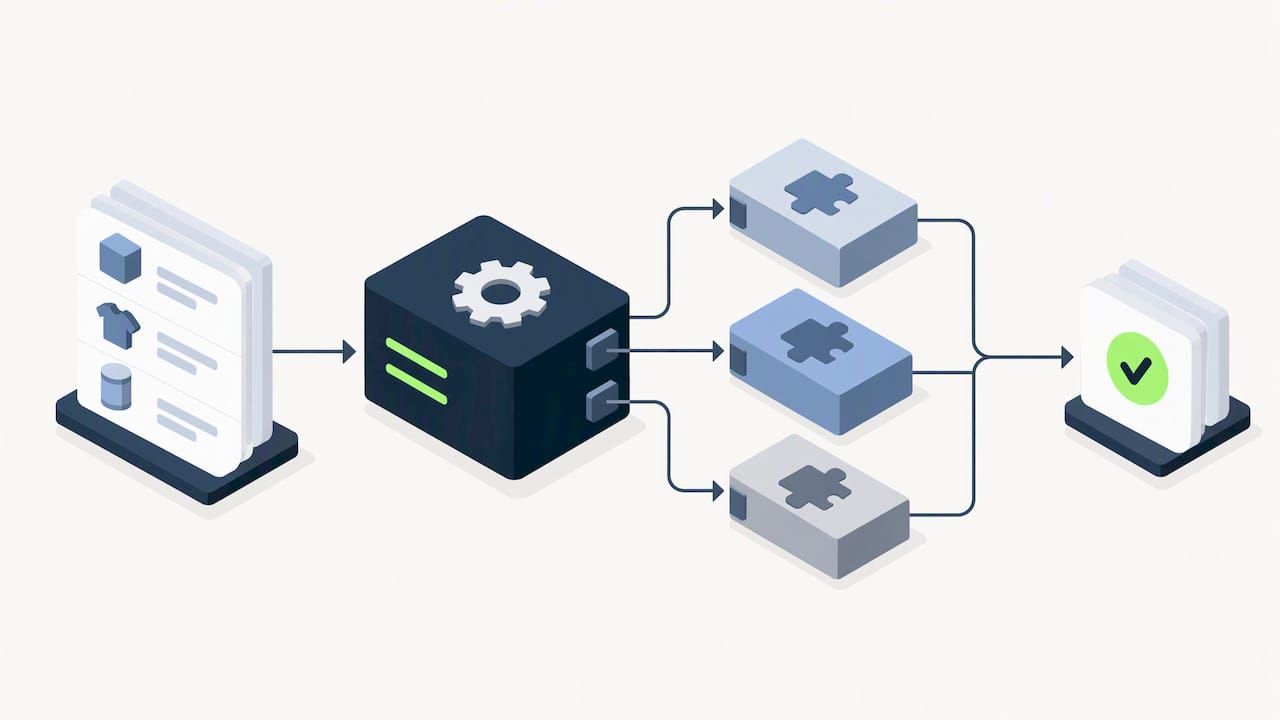
Most of the time on a tax integration goes to work that repeats from client to client: connectors, field mappings, reconciliation checks. We start projects with part of the baseline system pre-built, so engineering effort goes to what is unique about your catalog and entities rather than to rebuilding plumbing.
Our view is that the real risk in tax projects is rarely the rate lookup. It is the unglamorous data layer around it. Reusing tested validation and reconciliation workflows shortens testing and leaves a cleaner trail for auditors. For most teams, we recommend a scoped pilot on one channel and a handful of states, proving the data flow before widening scope.
— Bitecode
How we can help with your sales tax integration
If your stack mixes an ecommerce platform, a ledger, and a payment processor, we build the connective layer. Our Financial Module, Automation Module, and related components give you building blocks, and our custom business software work covers bespoke connectors when your systems are unusual.
You get a shorter path to production, audit-ready data, and lower integration risk. Our AI business process automation workflows also support your processes once you are live.
Ready to scope it? Request a consultation or pilot and we will map your channels and propose a first phase.
FAQ
How is sales tax calculated in the US?
Sales tax is calculated per transaction by applying the combined state and local rate for the buyer’s jurisdiction to the taxable amount. Taxability depends on the product and the state. Forty-five states and the District of Columbia levy sales taxes, so rates and rules differ widely.
Who pays 37% tax in the USA?
That figure relates to income tax, not sales tax. It is the top federal individual income tax bracket, which applies only to the highest slice of a taxpayer’s income. Sales tax is a separate, transaction-level tax collected by sellers.
Does the US use a value-added tax system?
No. The United States has no federal VAT. States and localities impose sales taxes collected at the point of sale to the final buyer, which is why integrations must handle thousands of local jurisdictions rather than one national rate.
What triggers a sales tax collection obligation for remote sellers?
Crossing a state’s economic nexus threshold creates a duty to register, collect, and file. The GAO notes that many states use $100,000 in sales or 200 transactions, though each state sets its own limit and counting method.
Sources
- Taxfoundation
- Remote Sales Tax: Federal Legislation Could Resolve Some Uncertainties and Improve Overall System | U.S. GAO
- Avalara AvaTax Setup