Revenue recognition automation means software that ingests contract, billing and usage data, applies your documented ASC 606 rules, and produces recognition schedules, journal entries and an audit trail without spreadsheet handoffs. It speeds up the close and reduces manual error. It does not make the accounting judgments for you, and the teams that get the most from it are the ones that design for that limit from day one.
This guide covers what to automate, what to leave to people, how to handle deferred revenue and contract changes, and how to decide between configuring an off-the-shelf product and building on a modular foundation.
TL;DR
- Automation executes accounting conclusions; it does not reach them. Performance obligations, variable consideration and standalone selling prices still need documented human judgment.
- The most reliable design is contract-to-ledger traceability: every journal entry traces back to a source contract, a rule version and an approval.
- Contract modifications, refunds and late usage data are where most implementations break. Test them before go-live, not after.
- The right architecture depends on your operating model: billing-platform-native, ERP-suite or specialized subledger tools each trade speed for flexibility.
- Treat budget and timeline as discovery outputs. Effort varies with contract complexity, entities, integrations and migration.
Why revenue recognition is an automation target
Revenue is usually the largest line on the income statement, which is why its accounting draws so much scrutiny. AICPA guidance on revenue recognition notes that it is an area where improper recognition can signal problems, and where significant estimates and judgments can materially affect both amounts and disclosures. That is a risk argument for automation as much as an efficiency one.
The manual version of the process is familiar. Someone exports invoices, someone else reads contracts, a spreadsheet computes the schedule, and a journal entry is keyed in at month end. Each step is a place where a renewal gets missed, a credit memo is applied to the wrong period, or a formula is overwritten and nobody can say when.
Automation changes the shape of the work. Instead of rebuilding the schedule every month, finance defines the rules once, the system applies them to every contract, and people spend their time on exceptions.
What ASC 606 asks the system to do
In the United States, ASC 606 applies a five-step model, which Deloitte’s roadmap walks through in detail:
- Identify the contract with the customer.
- Identify the performance obligations in the contract.
- Determine the transaction price.
- Allocate the transaction price to the performance obligations.
- Recognize revenue when, or as, each obligation is satisfied.
The point is that revenue follows the transfer of promised goods or services, not the invoice date or the cash receipt. That single idea explains most of what a recognition system has to model: deferred revenue when cash arrives early, unbilled receivables when work runs ahead of invoices, and schedules that stretch across months or years.
The model is principle-based. Even for an apparently simple point-in-time sale, SEC-filed accounting policies describe a transfer-of-control assessment in which factors such as the right to payment, title, possession and customer acceptance inform a conclusion that still requires judgment. No mechanical checklist eliminates it.
What automated revenue recognition actually covers
A well-scoped system handles a chain of tasks, not a single calculation.
| Stage | What the system does | Where people stay involved |
|---|---|---|
| Ingest | Pulls contracts, billing, usage, payments, refunds, discounts and amendments from source systems | Approving data mappings and source-of-truth decisions |
| Apply rules | Applies ASC 606 (or IFRS 15) logic to each contract | Defining and approving the rules, SSP evidence, variable consideration estimates |
| Schedule | Builds recognition schedules and deferred revenue waterfalls | Reviewing unusual contracts |
| Post | Creates journal entries and syncs to the general ledger | Approving postings and period locks |
| Reconcile | Ties subledger to ledger, flags differences | Resolving exceptions |
| Report | Produces disclosures, rollforwards and audit evidence | Reviewing and signing off |
Common deployment scope includes subscriptions, one-time charges, usage-based and hybrid pricing, upgrades, downgrades, prorations, refunds and disputes. Practitioner guidance on automation frames this as a control loop rather than a one-time batch: integrate sources, capture transactions, apply documented rules, process changes, report, retain audit trails, update compliance logic and alert on discrepancies. That framing is the useful one. A system you configure once and forget will drift away from your contracts.
Where judgment stays human
The hardest ASC 606 work is not arithmetic. It sits in four places:
- Distinct performance obligations. Is implementation a separate obligation from the subscription, or part of one bundle?
- Variable consideration. Rebates, credits, usage tiers and performance bonuses require estimates.
- Transfer of control. Over time or at a point in time, and on what evidence?
- Standalone selling prices. Allocation depends on SSP evidence that someone has to gather and defend.
The right design preserves these judgments, their approvals and their supporting evidence inside the system rather than hiding them behind a rule engine. When an auditor asks why a bundle was allocated a certain way, the answer should be a record with an author, a date and a rule version, not a recollection.
Deferred revenue automation
Deferred revenue is the most common starting point because the pattern is repetitive: cash or an invoice arrives before delivery, a liability is booked, and the balance releases as obligations are satisfied.
A dependable deferred revenue process does four things:
- Creates the liability at the right moment, based on the contract and billing terms rather than on whenever the invoice was exported.
- Releases on a schedule tied to the obligation: ratably over a service term, on milestones, or as usage occurs.
- Handles changes cleanly: upgrades, downgrades, prorations, cancellations and renewals regenerate the schedule with a visible history.
- Reconciles every period to the general ledger, so the balance sheet figure is something you can demonstrate rather than assert.
For teams that already run automated bank and payment matching, the reconciliation habits transfer directly. Our piece on financial reconciliation automation examples shows how matching rules and exception queues work in practice, and the same discipline applies between a revenue subledger and the ledger. For a close-focused view of payment application, see our guide to cash application automation.
Contract modifications: the usual failure point
Most demos use clean contracts. Real portfolios contain amendments, mid-term upgrades, co-terminated add-ons, credits and renegotiated pricing. A robust implementation has to decide, based on the facts, whether a change is treated prospectively or through a cumulative catch-up, and it has to handle refunds, rebates, credits, cancellations and renewals as variable consideration where appropriate.
The design rule that matters: late operational data must not silently rewrite a closed period. If a usage file arrives after the books lock, the system should route the difference to the current period or into a controlled reopening workflow with approval, never overwrite history. Test this with real examples from your last four quarters before you sign anything.
Contract-to-ledger traceability
The most reliable implementation pattern connects CRM, quoting, billing, usage, payment and ERP data end to end. It retains source documents, applies versioned rules, reconciles subledger output to the general ledger and maintains an exception queue.
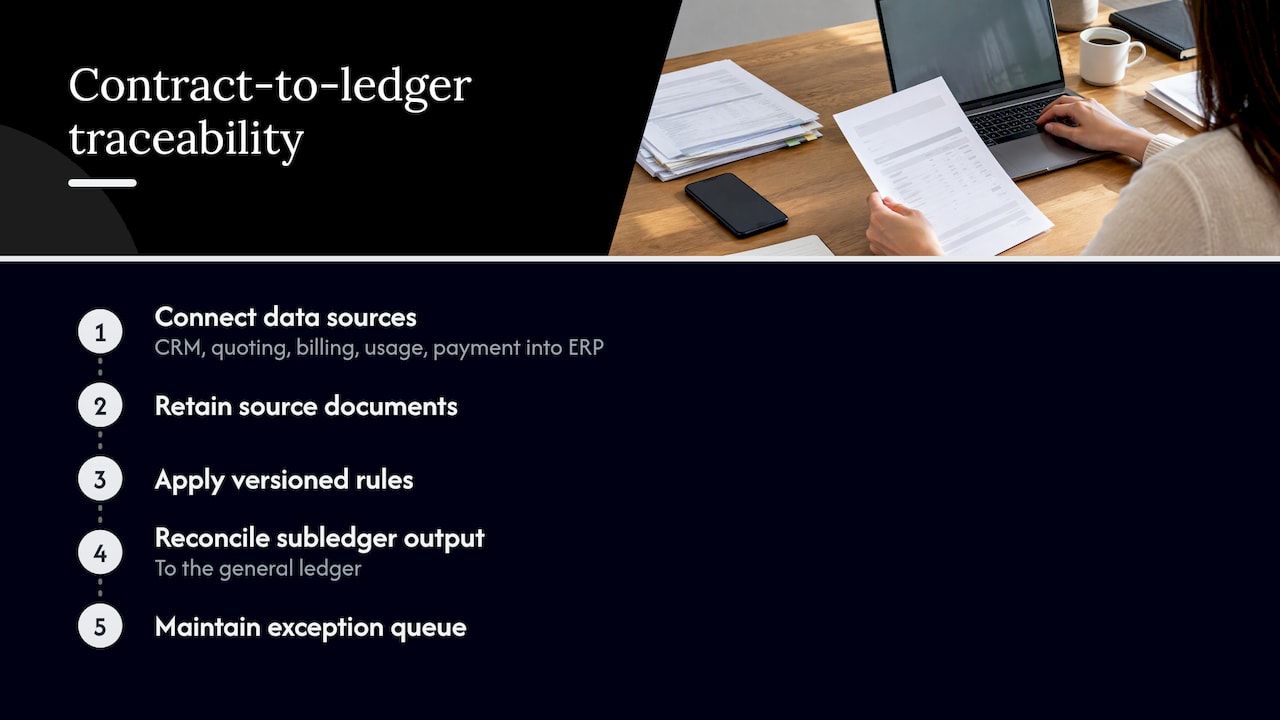
Auditability is an operating requirement, not a report added at the end. If you ever have to explain a number, you want to click from the ledger entry to the schedule, from the schedule to the rule version, and from the rule to the contract clause. That is also how you prepare for a revenue audit. Auditors test contract existence and terms, performance obligation identification, transaction price estimates, allocation, timing, modifications, cutoff, journal entries, reconciliations and disclosures, and they look for sufficient evidence rather than a match between invoices and cash, as the AICPA audit and accounting guide describes. A system that stores that evidence as it goes makes the audit a retrieval exercise instead of an excavation.
If your books are not in shape to automate yet, fix that first. Duplicate customers, inconsistent product codes and unreconciled balances will be faithfully automated along with everything else, and professional accounting cleanup services are a sensible prerequisite when the ledger carries years of manual patches. Likewise, the habits of an audit-ready reconciliation workflow apply well beyond payroll: documented steps, named approvers and retained evidence.
Choosing an approach: three architectures
There is no universal best tool. The right choice depends on your operating model, and it helps to think in types rather than brands.
| Approach | Fits best when | Trade-off |
|---|---|---|
| Billing-platform-native recognition | Revenue flows mostly through one billing platform and pricing is standard | Speed to launch, but rules outside the platform’s model need workarounds |
| ERP or financial-suite module | You want contracts, billing, recognition, accounting and collections in one environment | Fewer handoffs, but heavier platform and implementation dependency |
| Specialized recognition subledger | Complex pricing or multiple billing sources feeding one ledger | Flexible rules, but another system to integrate and govern |
| Custom build on a modular foundation | Your rules, entities, data residency or workflows do not fit a packaged model | More design responsibility, but you own the logic and the data |
The ERP-suite option is worth testing in demos for a specific reason. Buying recognition as part of a broader financial-management architecture may reduce system handoffs, but it can also lock your processes into that platform. Ask what happens to your custom rules when the vendor changes its data model.
Enterprise buyers should put these questions to every option:
- Can it handle multiple legal entities and multiple books? See our guide to multi-entity accounting structure and controls.
- Can finance edit rules without a vendor ticket, and is every change versioned?
- How are contract modifications and closed periods handled?
- What does the integration with CRM, billing and the ledger look like, and who maintains it?
- Can you export the full audit trail, including rule history and approvals?
What it costs and how long it takes
Be skeptical of any universal figure. The research we reviewed does not establish a reliable price or timeline for recognition software. Vendors commonly require a scoped quote because effort depends on contract complexity, number of integrations, entities, data migration, controls and reporting. For reference, the 2022 AICPA revenue recognition guide was listed at $255 to $335, but that is the price of a publication, not of software or implementation.
Treat budget and schedule as outputs of a discovery phase. A short discovery that inventories contract types, pricing models, source systems and exceptions will tell you more than any benchmark. For building the business case once you have scope, our article on finance automation ROI explains how to frame savings and risk reduction.
A rollout sequence that holds up
- Document current conclusions. Write down your policy for each revenue stream: obligations, timing, SSP method, variable consideration.
- Inventory contract patterns. Classify by pricing model, amendment frequency and exception type.
- Clean the data. Align customer IDs, product catalogs and billing records.
- Automate the repeatable core first, typically standard subscriptions or fixed-fee services.
- Add complexity in waves: usage, bundles, modifications, multiple entities.
- Run parallel closes. Compare automated and manual output for at least a couple of periods and explain every difference.
- Lock the controls. Approvals, period locks, access rights, rule versioning and alerts.
The financial process automation checklist covers the broader control questions that surround steps 3 to 7.
Our perspective: modular foundations over black boxes
We build finance systems for organizations whose revenue logic does not fit a packaged template: multi-currency flows, subscriptions mixed with one-time charges, token-based settlement, or strict self-hosting and audit requirements. From that vantage point, the recurring mistake is treating revenue recognition as a product purchase rather than a design decision.
Packaged tools are a sound choice when your model is standard. The cost shows up when it is not. A black-box platform relocates complexity into the vendor relationship: every unusual contract becomes a support request, and every rule change waits on someone else’s roadmap.
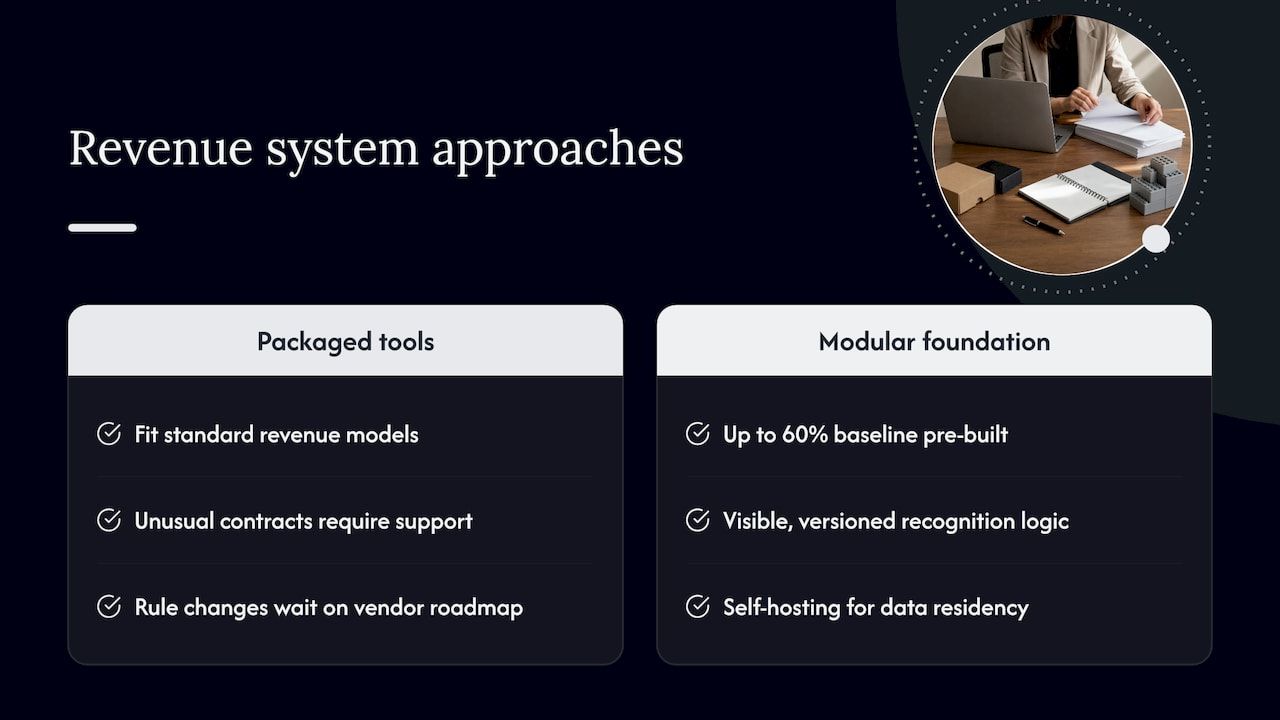
Our approach is to start from a modular foundation. Projects can begin with up to 60% of the baseline system pre-built, including financial processing, workflow automation and audit-ready structures, so the team’s effort goes into the business-domain rules that are truly specific to you. That is how we try to accelerate work without accelerating chaos. The recognition logic stays visible, versioned and under your control, and modules can be self-hosted when data residency or security policy demands it.
We also hold a firm line on scope. Software should carry out your accounting policy and preserve the evidence for it. It should not be asked to invent the policy. Bring your controller and your auditors into the design early.
— Bitecode
When a custom build makes sense
A custom or semi-custom build is worth considering when at least two of the following are true:
- You bill from several systems, or through channels a packaged tool does not integrate with.
- Your pricing mixes subscription, usage, milestones and services in ways that need bespoke rules.
- You operate multiple entities, currencies or books with different requirements.
- Policy or customers require self-hosting, or tight control over audit data.
- Recognition must connect to other internal workflows such as approvals, CRM or settlement.
If none apply, a packaged option is usually the faster path, and we would tell you so in discovery.
Build your revenue automation with Bitecode
If your requirements point toward a tailored system, our Financial Module provides an accounting, audit and subscription foundation we extend to your recognition rules. For the surrounding workflow, such as approvals, exception queues and ERP synchronization, see our AI business process automation services. Pricing is scoped per engagement, so the first step is a conversation about your contract types and source systems. You can start at bitecode.tech.
FAQ
What is the difference between revenue recognition and billing?
Billing is when you invoice a customer; revenue recognition is when you record revenue because you have satisfied a performance obligation. Under ASC 606 the two often diverge, which is why deferred revenue and unbilled receivables exist. Automation keeps the two timelines linked without forcing them to match.
Does automation make us ASC 606 compliant?
No. Compliance depends on your accounting conclusions and the evidence behind them. Software applies the rules you define consistently and retains the trail, but your team and auditors still own the judgments on obligations, variable consideration and standalone selling prices.
How do you conduct a revenue audit?
Start from the entity’s specific ASC 606 conclusions and revenue streams, then test contracts, performance obligations, transaction price estimates, allocation, timing, modifications, cutoff, journal entries, reconciliations and disclosures. The goal is sufficient appropriate evidence, not an invoice-to-cash comparison. AICPA guidance covers each stage.
What does revenue recognition mean in basic accountancy?
It means recording revenue when it is earned, meaning goods or services have been delivered, rather than when cash is collected. In the US, public and private companies apply this through ASC 606 and its five-step model. Syllabi differ by jurisdiction, so check your own course framework.
Sources
- Deloitte: A roadmap to applying the revenue recognition standard
- SEC filing: accounting policies on revenue and estimates
- AICPA: Revenue recognition audit and accounting guide (2021 edition text)
- Revenue recognition automation best practices
- AICPA & CIMA: 2022 Revenue Recognition Audit and Accounting Guide