Cash application automation identifies the payer, captures remittance detail, and applies incoming payments to open invoices without manual keying, and the payoff shows up fast: best-in-class setups reach touchless match rates of 85 to 92 percent, post straight-through payments in under four hours, and often clear payback within roughly nine months. Done well, it is a governance project as much as a technology one.
TL;DR:
- Track touchless posting and first pass yield alongside identification, proposed matches, exception age, and rework; a high match rate can hide incorrect or unposted payments.
- Native ERP automation fits reliable deposits with few exceptions; combined deposits, multiple entities, or heavy deduction volume often warrant a specialist platform or integration layer.
- Before launch, assign named owners to mapping, tolerance rules, exception queues, and write off approvals, then test real remittances, split payments, and short pays.
- Build the business case from your transaction volume and exception handling time, then validate expected savings in a pilot using one high volume remittance source.
How Cash Application Automation Actually Works
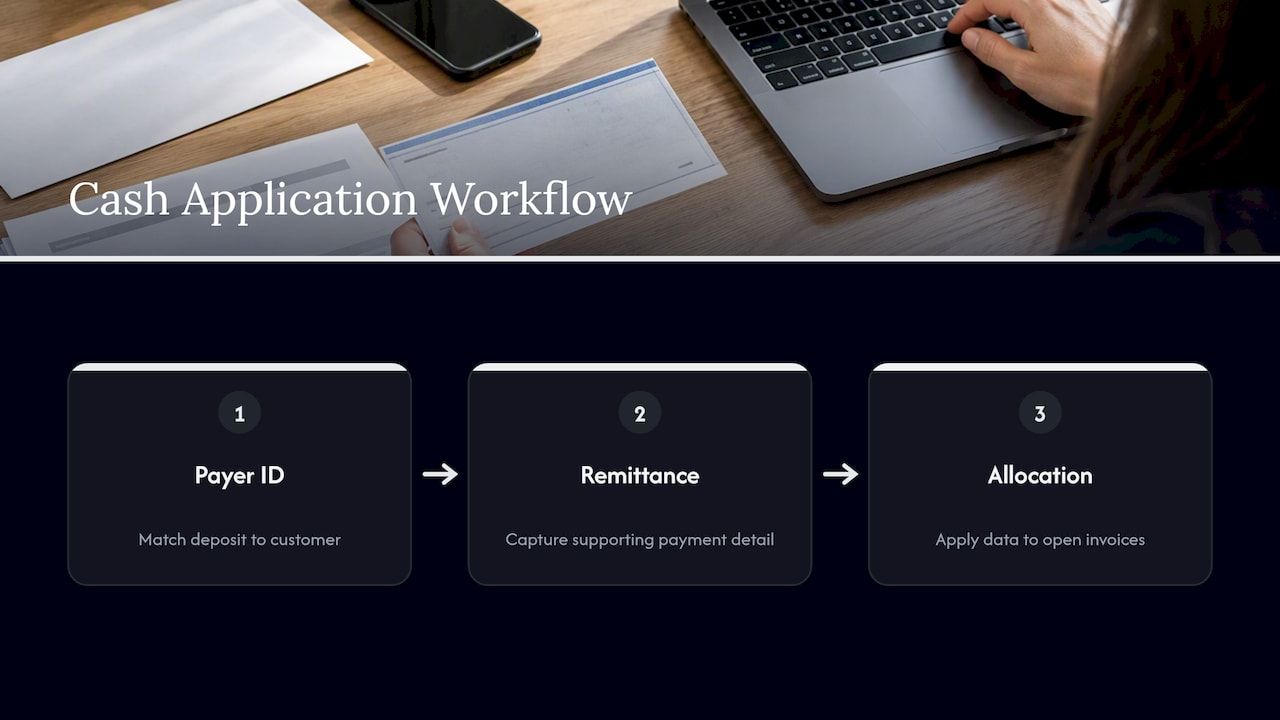
Cash application automation is not one function. It breaks into three separable jobs: identifying the payer, capturing remittance detail, and applying the payment to open invoices, and each deserves its own measured rate rather than a single blended success number.
Payer identification matches an incoming deposit to a customer record using bank account history, remittance metadata, or similarity scoring against open receivables. Remittance capture pulls the supporting detail, whether from an EDI 820 feed, a lockbox scan, a portal download, or a plain email attachment, and enriches it with invoice numbers, deduction codes, and short-pay reasons. Allocation and posting then take that enriched data and apply it against specific invoice lines, closing them or flagging a balance.
Processing typically sorts into lanes: exact matches that post automatically, preferred-mapping matches that follow a documented customer rule, partial matches that need a tolerance decision, and no-customer-found cases that drop into an exception queue. The distinction between a proposed match and a posted one matters more than most teams initially treat it. A system can propose a match with high confidence and still require a reviewer gate before it touches the ledger, which is what keeps reconciliation and financial reporting defensible.
Consider a few everyday cases: a single check covering multiple invoices across divisions, a combined deposit representing payments from separate customers, and a payment that is short of the invoice total with no stated reason. Each requires different logic, and conflating them under one “auto-match rate” is where many AR teams lose visibility into where the real exceptions live.
Core Components You Should Automate
A functional automation footprint covers five capabilities, and skipping any one of them tends to recreate manual work somewhere downstream.
- Remittance capture: OCR for scanned lockbox images, EDI 820 parsing for structured feeds, portal scraping for customer self-service payments, and email ingestion for PDF remittances, each suited to a different payer mix.
- Payer identification: customer mapping rules tied to bank account numbers plus similarity algorithms that catch new or inconsistent bank details.
- Invoice matching: logic that handles one-to-one, one-to-many, and many-to-many allocations across a single payment touching multiple invoices.
- Deductions and tolerances: reason codes, designated posting accounts, and approval levels tied to the size of the variance, following the four-parameter tolerance structure SAP documents for lockbox processing: a write-off threshold, a reason code, a ledger account, and an approval level.
- Case management: a queue for unresolved items with a full audit trail, so an exception never just sits in someone’s inbox.
Teams that automate capture and matching but skip structured case management usually end up with faster exception creation and the same slow exception resolution they started with.
Common Challenges and How Automation Fixes Them
Most cash application breakdowns trace to a handful of recurring patterns, and each has a specific fix rather than a generic “add AI” answer.
- Decoupled remittances, where the payment arrives separately from the remittance advice, need enrichment logic that reconnects the two using payer history and invoice-level pattern matching rather than waiting on a human to cross-reference email and bank feed.
- Varied remittance file types and lockbox image quality break OCR and EDI parsers in ways that only show up under real volume, which is why representative file samples belong in user acceptance testing before go-live rather than after.
- Short pays, split payments, and combined deposits need multi-parameter tolerance rules, not a single flat dollar threshold, because a $50 shortage on a $500 invoice behaves differently than the same shortage on a $50,000 one.
- High identification with low correct application is a quieter failure: the system correctly names the payer but misapplies the cash, which calls for gating auto-posting behind a confidence threshold and keeping an auditable record of every reviewer decision and override.
Pro Tip: Track exception causes by category before configuring automation rules; the distribution tells you which problems are actually costing you time.
Metrics and Trust Signals: The KPIs AR Teams Must Measure
A single number rarely tells the real story in cash application, and auto-match rate is the most commonly misread one. A high auto-match rate can mask poor accuracy if matches get proposed but never cleanly post, which is why auto-clear (touchless) rate and first-pass yield function as better indicators of real performance than match rate alone.
- Identification rate: percentage of payments correctly tied to a customer record.
- Auto-match rate: percentage of payments where the system proposes a confident invoice-level match.
- Auto-clear (touchless) rate: percentage of payments posted without any human touch.
- First-pass yield: percentage of transactions that post correctly on the first attempt, with no rework.
- Exception ageing and rework rate: how long unresolved items sit, and how often a posted item later needs correction.
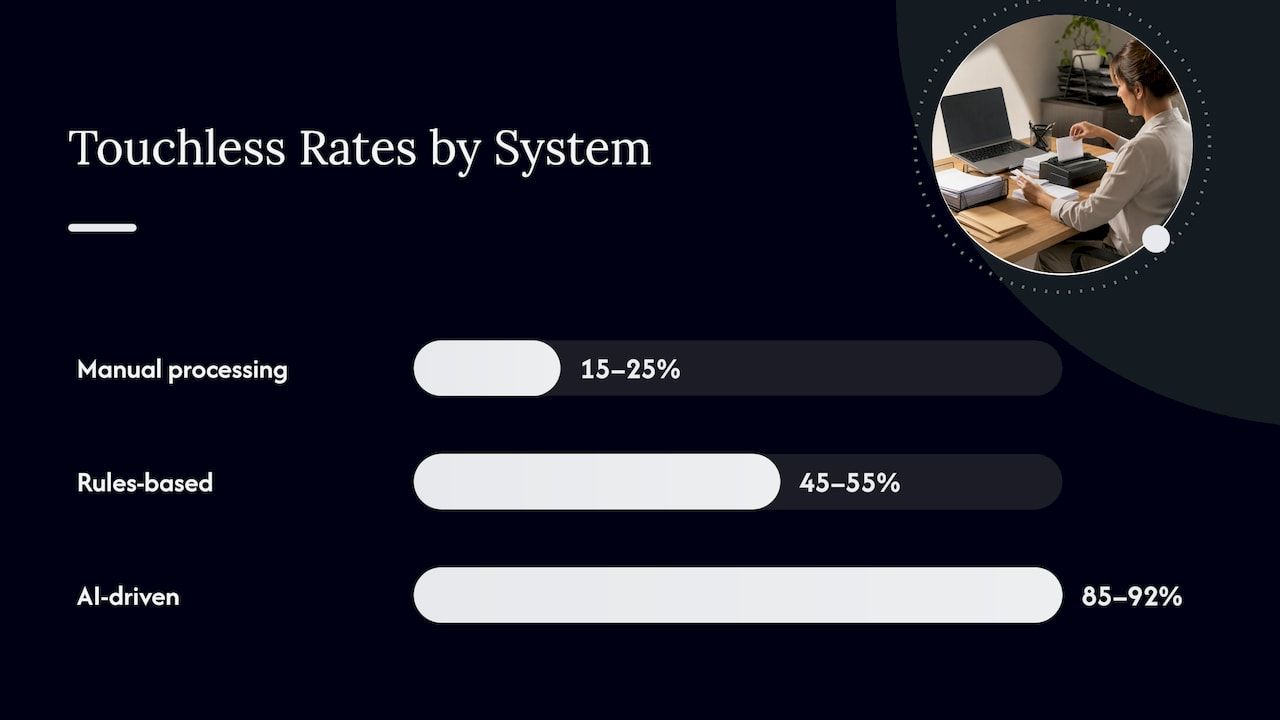
Benchmark figures show AI-driven cash application reaching touchless rates of 85 to 92 percent, compared to 45 to 55 percent for rules-based matching and 15 to 25 percent for manual processing, a gap wide enough to justify measuring your own baseline before comparing vendors against it.
Implementation and Governance Checklist
A defensible rollout follows a sequence, and skipping steps to reach “go-live” faster tends to cost more time later in rework and trust-rebuilding with the finance team.
- Baseline your current state: measure straight-through rate, exception causes by category, and reconciliation lag using your own transaction population rather than vendor-supplied averages, a step Transformance frames as the real starting point for a business case.
- Assign explicit owners: someone owns mapping rules, someone owns tolerance thresholds, someone owns the exception queue, and someone owns write-off approval limits, with names attached rather than a shared team inbox.
- Decide auto-post boundaries: set which match confidence levels post automatically and which require a reviewer, and configure approval tiers that scale with dollar exposure.
- Run UAT against real complexity: test with multi-invoice payments, cross-entity transfers, short pays, and combined deposits, not a clean demo dataset the vendor supplied.
- Retain the audit trail: keep a record of which rule fired, what evidence supported it, and who approved any deviation, since governance quality, not just matching speed, is what regulators and auditors actually evaluate.
- Schedule recurring KPI reviews: a monthly cadence catches drift in match rates before it becomes a quarter-end surprise.
Pro Tip: Build your exception-ageing report before launch, not after; a KPI with no baseline becomes a KPI nobody trusts six months later.
Our financial process automation checklist walks through the same sequencing in more depth for teams scoping a broader rollout.
ERP and Integration Considerations
Native ERP automated cash application, the kind built into platforms like NetSuite, works well when bank credits carry reliable per-customer evidence and exceptions stay rare. Where combined deposits, multi-entity allocations, or heavy deduction volume are routine rather than occasional, a dedicated integration layer or specialist platform usually earns its cost.
Rule ordering inside an ERP deserves scrutiny before go-live: some systems apply the first matching rule and silently skip better candidates further down the list, which can quietly consume a match that should have triggered review. Integration work also means mapping every remittance source into a single pipeline, setting clear posting permissions, and making sure the audit trail survives the handoff between systems rather than fragmenting across them.
ROI and Business Case
The benchmark gap between approaches is wide enough to build a conservative case on. AI-driven cash application cuts labor by roughly 70 to 85 percent and brings time-to-post under four hours for straight-through payments, with average three-year ROI near 3.1x and time to first measurable ROI around 9.2 months.
A simple calculation works for most finance teams: take your current monthly transaction volume, multiply by the average minutes spent per manually handled exception, and apply the expected reduction in exception rate from your pilot results rather than a vendor’s published average. Add the downstream effect on days sales outstanding and bad-debt write-offs, since faster, more accurate application tends to surface real disputes sooner instead of burying them in unapplied cash. Keep assumptions conservative and prove them with a pilot on one high-volume remittance source before committing to a full rollout. Our piece on automating financial transactions walks through a comparable efficiency case in more detail.
Best Practices for Scalable Automation Workflows
Scalability in cash application comes from decoupling rules from volume assumptions, not from throwing more compute at the same rigid logic. Design mapping rules at the customer-and-bank-account level rather than hardcoding file formats, so a new lockbox provider or EDI partner doesn’t require a rebuild. Keep tolerance and approval logic in a configuration layer separate from the matching engine itself, since finance policy changes more often than payment file formats do.
Build for multiple remittance channels from day one, even if only one is active now: email ingestion, portal capture, and EDI parsing should share the same enrichment and allocation pipeline rather than running as parallel, inconsistent systems. Version your matching rules the same way engineering teams version code, with a changelog that ties a rule change to the date and the approver, which saves significant time when a KPI shift needs investigating months later.
Finally, separate the proposal layer from the posting layer structurally, not just procedurally. A workflow that can pause a high-confidence match for review without touching the underlying rule logic is far easier to tune as your customer and payment mix evolves than one where confidence thresholds and posting actions are tangled together in a single step.
Security and Compliance Considerations
Cash application touches banking data, customer financial records, and general ledger postings, which puts it squarely inside the same compliance perimeter as the rest of accounts receivable. Role-based access matters here specifically: the person configuring mapping rules should not be the same person approving write-offs above a threshold, and that separation needs to be enforced in the system, not just in policy documents.
Data governance is what separates fast automation from accurate, auditable automation: every posted match should carry a record of which rule fired, what evidence supported the decision, and who signed off on any deviation. That trail is what an external auditor or a bank reconciliation review will ask for first.
Encryption in transit and at rest for remittance files, retention policies that match your regulatory obligations, and logging that captures both automated and manual actions all belong in the initial design rather than bolted on after an audit finding. For teams handling cross-border payments or multi-entity structures, confirm that currency handling and entity-level permissions are both explicit in the system configuration, not inferred from default settings.
AI and Machine Learning Techniques in Cash Application
The AI layer in cash application generally does three specific jobs rather than one vague “smart matching” function. Similarity scoring compares incoming payment metadata against historical payer patterns to suggest a customer match even when bank details differ slightly from prior transactions, which handles the common case of a customer switching accounts without notice.
Natural language processing extracts structured fields, invoice numbers, dates, deduction codes, from unstructured remittance text in emails or scanned PDFs, turning a free-text note into data the allocation engine can act on. Pattern learning on historical allocations helps the system propose likely multi-invoice splits for a partial payment based on how that customer has paid in the past, rather than treating every short pay as a fresh exception.
None of these techniques replace the tolerance and approval logic described earlier. They improve the quality of the proposed match; the governance layer still decides whether that proposal posts automatically or waits for a reviewer. Our overview of AI applications across finance functions covers how these same techniques apply beyond cash application specifically.
Post-Automation Monitoring and Continuous Improvement
Automation performance drifts, and the drift is usually gradual enough to go unnoticed without a monitoring cadence. New customers, new bank accounts, and new payment methods all introduce patterns the original rule set never saw, which is why a monthly review of auto-clear rate and exception causes catches problems while they are still small.
Track rework rate specifically, since a rising rework rate after a stable period usually signals a rule firing on the wrong condition rather than a genuine increase in payment complexity. When exception ageing starts climbing in one category, that’s the signal to revisit the specific rule or tolerance tied to it rather than adjusting the whole system.
Treat the rule set as a living document with a changelog, not a one-time configuration. Quarterly audits of which rules fire most often, which exceptions recur, and which reviewers override the system most frequently all point toward where the next round of tuning should focus. Our reconciliation automation examples walk through similar monitoring patterns for adjacent AR processes.
Industry Benchmarks for ROI and Efficiency Gains
The benchmark spread between manual, rules-based, and AI-driven cash application is wide enough to anchor a realistic business case without needing a bespoke pilot to justify the initial investment. Manual processing typically reaches touchless rates of only 15 to 25 percent, rules-based systems average 45 to 55 percent, and AI-driven setups reach 85 to 92 percent, with labor reductions of roughly 70 to 85 percent attached to the AI tier.
For a practical sense of scale beyond cash application alone, broader automation patterns across finance functions show comparable gains when exception handling and reviewer gating are built in from the start rather than added later. A curated list of business process automation examples illustrates similar patterns in adjacent back-office functions, useful context for teams scoping automation beyond AR specifically.
The consistent thread across these figures is that the gap between rules-based and AI-driven performance is large enough to justify a pilot, but the gap between a well-governed rules-based system and a poorly governed AI system can be smaller than the headline numbers suggest. Governance, not just the matching technology, tends to be the deciding factor in which benchmark tier a given implementation actually lands in.
Publisher Perspective: How We Approach Controlled Cash-Application Automation
We treat cash application automation as a governance project first and a matching-technology project second. Our modular finance components support financial workflows during rollout. Our usual sequence runs baseline measurement, then a scoped pilot on one high-volume remittance source, then phased rollout once match confidence holds up under real exception volume.
— Bitecode
How We Can Help You Build This
We build governed cash-application workflows using our modular Financial Module, Automation Module, and custom ERP integrations, so you get defensible matching logic without a multi-year build cycle.
- We start with a baseline assessment of your current match rates and exception causes.
- We pilot on one high-volume remittance source to validate rules before wider rollout.
- We phase the rollout once auto-clear rates and reviewer gates prove stable.
If you want to see what a scoped pilot looks like for your transaction volume, reach out through our AI business process automation page to start the conversation.
FAQ
What Is an Automated Payment System?
An automated payment system identifies the payer, captures remittance detail, and applies the payment to the correct invoices without manual data entry. In cash application specifically, it covers identification, remittance capture, and allocation as three distinct steps rather than one combined function.
What Are the Top Automation Tools for Cash Application?
The right tool depends on your remittance mix: native ERP automation, dedicated cash application platforms, and custom integration layers each fit a different combination of payment volume and exception complexity. Native ERP tools tend to work well when a single customer per deposit is the norm, while combined deposits and heavy deductions usually justify a specialist platform or integration layer.
What Are the Different Types of Cash Applications?
Cash application generally splits into exact matches that post automatically, preferred-mapping matches that follow a documented customer rule, partial matches that need a tolerance decision, and unidentified payments that fall into an exception queue. Each type carries its own expected resolution path and approval requirement.
How Do I Automate My Accounts Receivable Cash Processing?
Start by baselining your current straight-through rate and exception causes, then automate remittance capture, payer identification, and invoice matching as separate, measurable steps rather than one combined system. Gate auto-posting behind a confidence threshold, run UAT with real remittance file samples, and track auto-clear rate and first-pass yield as your primary success signals.
How Long Does It Take to See ROI from Cash Application Automation?
Time to first measurable ROI averages around 9.2 months, with three-year ROI averaging roughly 3.1x for AI-driven implementations. Results vary with remittance complexity and how quickly tolerance rules and reviewer gates get tuned during the pilot phase.
Sources
- Fintech
- Cash Application Automation: Matching and Control Design
- NetSuite Automated Cash Application: Rules and Controls | Houseblend
- AI Cash Application Automation Stats 2026: Touchless Rates & ROI