Quote-to-cash automation removes the manual handoffs between a sales quote and the cash landing in your account, and it does so with measurable results: faster cycle times, cleaner invoices, and materially better cash flow. Companies that optimize these flows cut Days Sales Outstanding by as much as 30%, and Bitecode’s own automation work with financial transactions has produced efficiency gains of 40% for clients moving off manual processes.
The single best next step isn’t a platform purchase. It’s a volume audit.
- Map where quotes, orders, and disputes pile up in inboxes rather than systems
- Identify the busiest manual stage, whether that’s RFQ intake, order entry, or dispute triage
- Pilot automation there first, then measure before expanding
Quick math: if your team processes 200 quotes a month and half require manual rekeying into your CRM or ERP, that’s roughly 100 touches a month you can eliminate before you touch pricing logic or contract terms.
Key Takeaways
Quote-to-cash automation works best as a targeted pilot in the busiest manual stage, not a full-cycle overhaul, and it requires clean pricing governance to deliver lasting ROI.
| Point | Details |
|---|---|
| Start with volume, not ambition | Pick the single busiest inbox or manual stage, often order entry or RFQ intake, for your pilot. |
| Baseline before you automate | Measure quote-to-order conversion, cycle time, DSO, and invoice accuracy for 30 days first. |
| Fix governance before scaling | Build a central pricing and entitlement catalog so automation doesn’t approve unbillable deals. |
| Expect a 30 to 90 day proof window | Most practitioners and vendors report measurable KPI movement within this range. |
| Bitecode shortens the build | Its prebuilt modular baseline and 40% efficiency benchmark support faster pilot-to-scale timelines. |
What Is Quote to Cash and How Does It Differ From Order to Cash?
Quote-to-cash (Q2C) covers everything from the moment a prospect requests pricing to the moment their payment clears and gets reconciled. Order-to-cash (O2C) is a subset. It starts later, at the point an order is confirmed, and skips the earlier commercial negotiation entirely. The order to cash vs quote to cash distinction matters because it tells you where your automation dollars should go first.
The full Q2C cycle runs through eight phases:
- Quote — sales generates pricing based on product, volume, and terms
- Configure and price — complex deals get configured, discounted, and approved
- Contract — legal and commercial terms get documented and signed
- Order — the deal converts into a formal, systemized order
- Fulfillment — goods or services get delivered
- Invoice — billing triggers and the invoice reaches the customer
- Collections — payment gets tracked, chased, and applied
- Reconciliation and renewals — books close, and renewal opportunities get flagged
Automation priorities depend entirely on where your manual work actually lives. A company selling standardized products often bleeds time in collections and reconciliation. A company selling configured, negotiated deals usually bleeds time earlier, in quoting and contract generation. Diagnosing that correctly before selecting tools saves months.
What KPIs Should You Track for Q2C Automation?
Five metrics tell you whether a quote to cash automation effort is working, and you should baseline all five before a pilot starts, not after.
- Quote-to-order conversion rate — how many quotes become paying orders
- Sales cycle time — days from initial quote to signed order
- Time-to-revenue — days from order to recognized revenue
- Invoice accuracy — percentage of invoices issued without correction
- Days Sales Outstanding (DSO) — average days to collect payment
- Reconciliation and error-handling time — hours staff spend fixing mismatches
The improvement ranges vendors and consultants cite are worth knowing, with appropriate skepticism. Optimizing Q2C and O2C flows can lower operating costs by 15% to 30% while cutting DSO by nearly a third. Vendor case studies commonly report 25% to 60% faster quote generation and 25% to 40% faster revenue recognition, and some consulting reports point to a 30% to 40% reduction in renewal quote processing time. Treat these as directional, not guaranteed, since your own baseline determines what’s realistic.
To measure a pilot properly, capture 30 days of pre-automation data on each KPI above, run the pilot for a defined window, then compare against that baseline rather than against industry averages. Success criteria should be set before launch, not negotiated after the results come in.
Where Does Automation Deliver the Highest ROI?
Structured work automates cleanly. Unstructured work is where most Q2C budgets get wasted trying.
Structured phases, meaning orders already entered into a system with defined fields, are relatively easy to automate because the data is already machine-readable. Unstructured phases, meaning RFQs arriving as emails, PDFs, or phone notes, create the real bottleneck because ERP and CPQ systems expect clean input and most inbound requests never arrive that way. This is the layer where the majority of manual labor actually hides.
Concrete automatable tasks include:
- Approval routing for discounts and non-standard terms
- Contract generation and e-signature triggers
- Automatic order entry from structured quote data
- Deduction and dispute classification for accounts receivable
- Billing triggers tied to fulfillment milestones
RevOps automation can handle quote creation, pricing approvals, contract generation, e-signatures, and internal notifications simultaneously, which is why deal close times shrink fastest when these tasks move off manual queues together rather than one at a time.
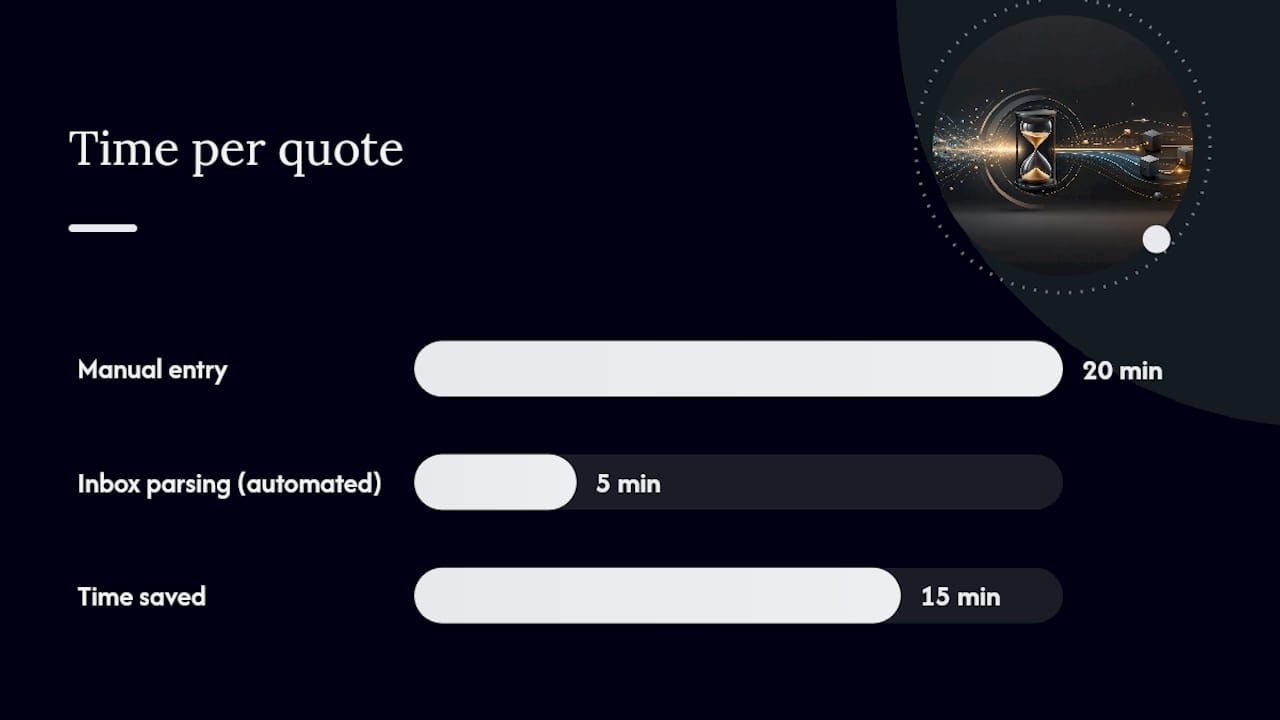
Consider a distributor receiving 150 RFQs a month by email. Before automation, a rep manually reads each request, checks pricing, and keys a quote into the CRM, a process taking 20 minutes per quote. After connecting an inbox parser to the CRM, the system extracts product, quantity, and customer data automatically, cutting rep time to five minutes of review per quote.
Pro Tip: Don’t try to automate contract negotiation or complex configuration first. Start with the highest-volume, most repetitive task in your funnel. It’s almost always intake or order entry, and it’s where the ROI proves itself fastest.
How Do You Roll Out Q2C Automation Step by Step?
A working rollout has three stages, and skipping the first one is the most common reason pilots stall.
- Assess. Map every Q2C phase, tag manual versus automated steps, and note process owners and data quality gaps. Pick the pilot area using one rule: start where the inbox is busiest, not where automation looks most impressive on a slide deck.
- Pilot. Define a narrow scope, set KPI targets against your baseline, and confirm which systems need to talk to each other, whether that’s your CRM, ERP, or billing platform. Assign a governance owner responsible for exceptions. Most practitioners see measurable results within 30 to 90 days when scope stays tight.
- Scale. Once the pilot proves out, harden your pricing and financial catalog as a single source of truth, then expand automation into adjacent phases. Build in ongoing monitoring rather than treating the rollout as a one-time project.
| Stage | Typical Duration | Primary Output |
|---|---|---|
| Assess | 1–3 weeks | Process map, volume data, pilot target |
| Pilot | 30–90 days | KPI improvement vs. baseline |
| Scale | Ongoing | Expanded automation, monitoring in place |
Integration considerations deserve real attention here. A pilot that automates quote intake but can’t write clean data into your existing ERP just moves the bottleneck instead of removing it. Bitecode’s approach to CRM workflow automation treats this connective layer as the actual deliverable, not an afterthought bolted on after the automation logic is built.
Change management matters as much as the technology. Sales and finance teams need training on new approval flows before launch, and a short internal FAQ covering “what happens when the system gets something wrong” heads off a lot of resistance in week one.
What Mistakes Derail Q2C Automation Projects?
Automating a broken process just breaks things faster. That’s the pitfall that sinks more Q2C projects than any technology limitation.
Common failure patterns include:
- Automating around inconsistent pricing rules instead of fixing them first
- Letting each department own its own version of the truth on discounts and entitlements
- Skipping approval-threshold design, so automation either blocks everything or approves too much
- Rolling out to the entire revenue cycle at once instead of testing in one phase
The fix starts with governance. A central financial catalog that defines pricing, discount limits, and entitlements as a single source of truth prevents sales from configuring deals that can’t actually be billed correctly, which is one of the most common and expensive automation failures. Staged testing, meaning one phase, one team, one measurement window, catches these gaps before they scale.
A short pre-launch checklist helps: confirm data quality in source systems, define approval thresholds in writing, assign a single governance owner, and set a 30 day review point before expanding scope.
Pro Tip: If your pricing approval process currently requires three people to sign off informally over email, automating that process without first defining clear thresholds will just create a faster, more confusing version of the same chaos.
What Does the Evidence Say About Q2C Automation Results?
The research consensus is narrower than vendor marketing suggests, and that’s useful information for anyone setting expectations internally.
External findings point consistently toward inbox-heavy, unstructured phases as the highest-value automation targets, because that’s where the actual manual labor concentrates before data ever reaches a structured system. The practical insight from that research is worth repeating: the goal isn’t replacing your CRM or ERP, it’s connecting the unstructured inbox to systems that already work well once they receive clean input.
Sales teams routinely configure deals that are mathematically impossible to bill correctly when there’s no single source of truth for pricing and entitlements. Automation without that governance layer doesn’t fail gracefully. It fails repeatedly, at scale.
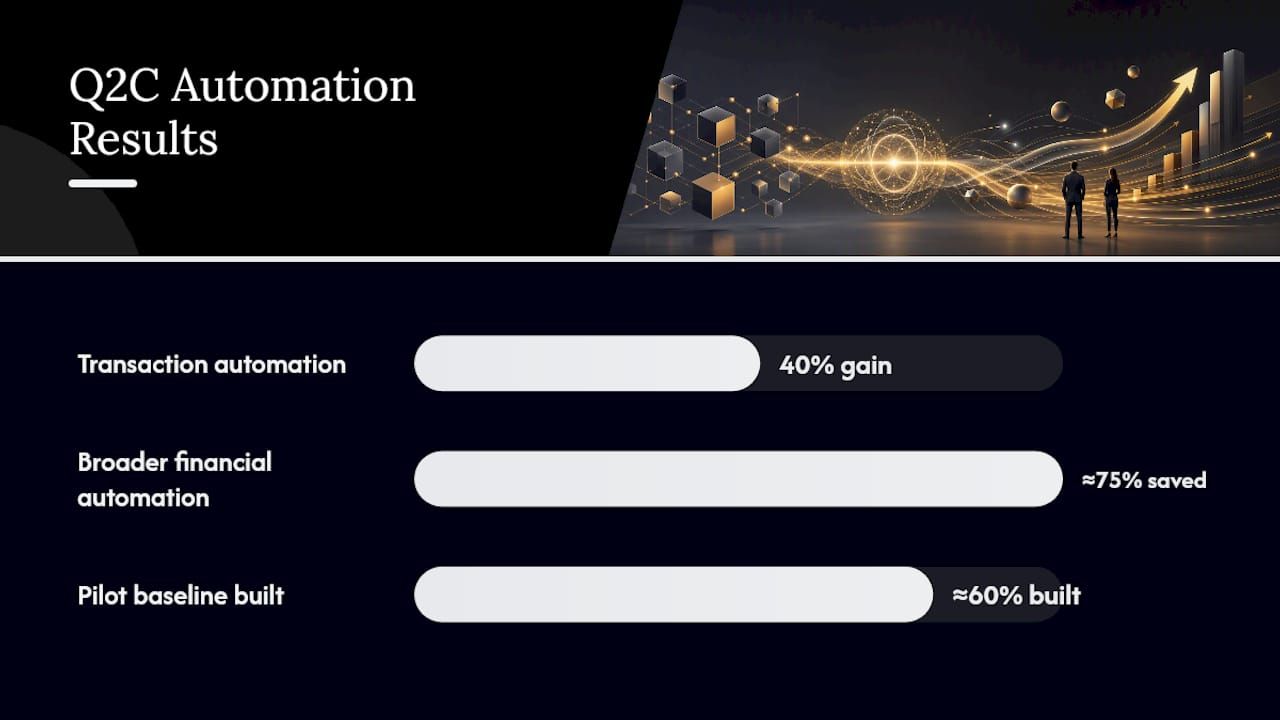
Bitecode’s own implementation data reflects this pattern. Financial transaction automation projects have produced 40% efficiency gains internally, and broader financial process automation strategies have delivered cost savings approaching 75% in specific engagements. What shortens pilot timelines isn’t a bigger team, it’s starting from roughly 60% of a working baseline system already built, rather than developing intake parsing, approval routing, and integration logic entirely from scratch.
Why Most Q2C Advice Skips the Governance Question
Most guidance on quote-to-cash automation focuses on which tasks to automate and undersells the harder question: what happens when the underlying pricing data is inconsistent to begin with. Automation amplifies whatever process it touches, good or bad, and a lot of the disappointment companies report after a Q2C rollout traces back to skipping the financial catalog work rather than choosing the wrong tool.
The conventional advice to “automate the whole quote-to-cash cycle” is where most projects overreach. A tighter, evidence-backed approach works better: pick the single busiest manual stage, usually order entry or RFQ intake, prove ROI there with real KPI data, and only then expand. That sequencing isn’t cautious for its own sake. It’s what actually produces the 30 to 90 day results that make the business case for scaling.
What should decision-makers prioritize first? Data governance, not feature comparisons. A modular foundation that already handles structured data intake and financial logic gets you to a working pilot faster than evaluating platforms for another quarter while the inbox keeps piling up.
— Bitecode
How Bitecode Builds Your Quote to Cash Automation Pilot
Bitecode starts pilots from roughly 60% of a prebuilt baseline system rather than a blank codebase, which is the difference between a working pilot in weeks and a specification document in month three.
The engagement model is straightforward: Bitecode’s custom business software development team scopes your highest-volume manual stage, whether that’s RFQ intake, approval routing, or invoice reconciliation, and builds the automation module against your existing CRM and ERP rather than asking you to replace them. Clients moving financial processes onto Bitecode’s automation modules have seen efficiency gains of 40% without a multi-quarter build cycle. Because the modular components already exist, most pilots reach measurable KPI data within the same 30 to 90 day window practitioners cite as the realistic ROI benchmark.
If your quoting or order-entry inbox is the bottleneck slowing revenue recognition, the next step is a scoping conversation with Bitecode’s automation service team to define pilot boundaries and integration requirements before committing budget to a full rollout.