Multi-chain integration means running an application across two or more independent blockchain networks, each with its own RPC endpoints, chain identifiers, and finality rules, without necessarily moving value or messages between them. The recommended approach for production systems is standards-first: adopt CAIP-2 for chain identification and CAIP-25 for wallet sessions, and default to isolated per-chain deployments unless a specific use case demands cross-chain orchestration through an audited general message passing protocol like Chainlink CCIP or IBC. Bridging adds attack surface that isolated multi-chain architecture avoids entirely.
TL;DR:
- Adopting standards like CAIP-2 and CAIP-25 from the start reduces chain-mismatch errors and simplifies chain identification and wallet session handling.
- Isolated multi-chain deployments are safer, as they avoid the attack surface of bridges, which are frequent targets for exploits and pose significant risks.
- Using native multi-chain setups is preferable when liquidity can stay on each network, whereas GMP-based protocols are better suited for programmable cross-chain logic requirements.
- Proper monitoring, failover, and validation processes per chain ensure system health, while configuration drift and inconsistent finality can increase vulnerability.
- Broader ecosystem tools and ongoing standardization efforts are making multi-chain integration more efficient and user-friendly, reducing operational complexity over time.
What Is Multi-Chain Integration, and How Does It Differ From Cross-Chain?
Multi-chain describes an application deployed independently on several networks, each instance running with its own RPC connection, contract addresses, and chain-specific identifier. Nothing moves between the networks. A DeFi front end that offers the same lending pool on Ethereum, Arbitrum, and Base is multi-chain: three separate deployments, three separate states, one shared codebase.
Cross-chain is a different problem. It covers protocols that move value or data across that boundary, whether that’s a token bridge, a general message passing system, or a light-client verification scheme. Cross-chain mechanics sit on top of a multi-chain foundation when an application actually needs assets or messages to travel between networks.
The decision criteria are straightforward:
- Multi-chain alone is sufficient when users hold assets natively on each chain and never need to move them across the boundary.
- Cross-chain layers become necessary when liquidity, governance votes, or state updates must synchronize across networks in real time.
- Hybrid designs deploy multi-chain by default and add narrow, purpose-built cross-chain paths only for the specific flows that require them.
Getting this distinction wrong early tends to bake unnecessary bridging risk into a system that never needed it.
How Does a Working Multi-Chain System Actually Function?
Every functioning multi-chain system rests on three building blocks: chain identification, wallet session handling, and a request lifecycle that never confuses one network for another.
- Chain-specific RPC endpoints and identifiers. Each network gets its own RPC connection, and CAIP-2 provides the standard format for referencing it, structured as a namespace plus a reference (
eip155:1for Ethereum mainnet,eip155:42161for Arbitrum). Skipping this standard and rolling custom chain tags is one of the most common sources of later confusion. - Wallet session models. CAIP-25 defines how a dApp requests access to multiple chains in a single session, rather than forcing a fresh connection prompt per network. MetaMask Connect Multichain implements this directly, letting a user approve access once and letting the dApp invoke RPC methods on any authorized chain afterward.
- Application topology. Three patterns dominate: per-chain adapters (a dedicated module per network, simplest to reason about), a centralized orchestrator (one service routing requests to the right chain, easier to monitor but a single point of failure), and light-client verification (heavier to build, but it removes trust in a middleman entirely).
A typical lifecycle looks like this: the wallet session resolves which chain the user intends to act on, the application maps that intent to the correct CAIP-2 identifier, the RPC call fires against the matching endpoint, and the response gets tagged back to that chain before touching application state. Skip the tagging step and you get the exact class of bug covered next.
Which Interoperability Mechanisms Actually Move Value or Messages?
Token bridges, general message passing protocols, and native multi-chain frameworks solve different problems, and picking the wrong one for the job is where most cross-chain risk originates.
Token bridges typically use one of two patterns: lock-and-mint, where an asset gets locked on the source chain and a wrapped equivalent gets minted on the destination, or burn-and-mint, where the source-side token is destroyed and a canonical version is minted elsewhere. Both patterns concentrate value in a bridge contract or validator set, which is precisely the attack surface that has driven the largest losses in the space, according to research tracking blockchain interoperability.
General message passing protocols take a broader approach. Chainlink’s CCIP lets contracts on one chain trigger arbitrary logic on another, supporting programmable flows beyond simple token transfers, with a decentralized oracle network validating messages. Cosmos’s Inter-Blockchain Communication protocol takes a related but architecturally distinct route, giving sovereign chains a native, standardized channel for packet passing without relying on an external bridge operator.
- Prefer native multi-chain deployment when liquidity and users can stay chain-local.
- Prefer GMP-based orchestration when programmable cross-chain logic is the actual requirement.
- Reserve token bridges for the narrowest possible scope, and only after evaluating audited alternatives.
What Should Be On a Multi-Chain Developer’s Pre-Launch Checklist?
Standards adoption is the first line item, not an afterthought bolted on before launch. Teams that treat CAIP-2 and CAIP-25 as core architecture, rather than optional polish, spend far less time debugging chain-mismatch errors later.
- Adopt CAIP-2 and CAIP-25 from day one, and maintain a canonical chain registry as a single source of truth for supported networks, contract addresses, and RPC URLs.
- Build RPC failover into every chain adapter; a single provider going down should degrade gracefully, not take down the whole integration.
- Implement chain-aware monitoring that flags mismatches between the chain a transaction claims to target and the chain it actually reaches, and validate CAIP-2 identifiers explicitly before any signing request goes out.
- Run a testing matrix that covers multiple chain versions and multiple RPC providers per chain, not just a single happy-path testnet.
- Decide early whether wallet UX uses a single multichain approval, following the MetaMask Connect Multichain pattern, or per-chain prompts. Fewer prompts improve conversion; per-chain prompts give users more granular visibility into what they’re approving.
Pro Tip: Store your canonical chain registry outside application code, in a config service or feature-flag system, so a chain deprecation or RPC provider swap never requires a full redeploy.
What Are the Biggest Security Risks in Multi-Chain Systems?
Isolated multi-chain deployments carry a smaller attack surface than anything that bridges value, because there’s no shared contract or validator set for an attacker to target across networks. Research on interoperability history documents that bridge exploits have produced some of the largest capital losses in the industry, a pattern that recurs specifically at the point where two chains’ trust assumptions meet.
The risk isn’t limited to bridges themselves. Configuration drift, where a registry entry lags behind an actual RPC endpoint or contract redeploy, causes wrong-chain submissions that look like successful transactions until settlement fails. Inconsistent finality assumptions across chains compound the problem: a transaction treated as final on a fast chain might still be reversible on a slower one.
Mitigations that actually work in practice:
- Minimize bridging to the narrowest necessary scope, and prefer audited GMPs over custom bridge contracts.
- Maintain canonical registries with on-chain proof verification wherever feasible.
- Build explicit recovery flows for stuck or misrouted transactions before launch, not after the first incident.
Enterprise projects handling virtual currency flows should also weigh FinCEN’s compliance guidance on AML and CTF expectations early in the design process, since retrofitting compliance controls into a live multi-chain system is considerably harder than designing them in.
How Do You Keep a Multi-Chain System Healthy After Launch?
Production health depends on metrics tracked per chain, not aggregated across the whole system, because a single struggling network can hide inside an otherwise healthy average.
- Track success rate, RPC latency, and wrong-network error counts separately for each chain. A configuration drift indicator, meaning a registry entry that no longer matches live infrastructure, should trigger an alert before users hit it.
- Build an incident response runbook for RPC provider outages and bridge failures that explicitly preserves order and payment identity during recovery, so a retried transaction never gets attributed to the wrong user or double-processed.
- Version upgrades and credential rotations need defined rollout boundaries. Roll changes to one chain at a time where possible, and confirm compatibility before promoting to the next.
- Decide centralized orchestration versus per-chain autonomy based on scale. Smaller deployments benefit from a single orchestrator’s simplicity; larger ones with strict SLA requirements often need per-chain independence so one network’s incident doesn’t cascade into another’s.
How Bitecode Approaches Enterprise Multi-Chain Projects
Enterprise teams rarely have the luxury of building chain registries, RPC failover, and monitoring dashboards from scratch on every project. Modular, low-code components exist specifically to close that gap: prebuilt integration modules can cover a meaningful share of a baseline multi-chain system before custom development even starts.
That approach applies directly to the operational patterns covered here:
- Canonical registry components that prevent configuration drift by keeping chain metadata in one governed location.
- Chain-aware monitoring modules built to flag wrong-network submissions before they reach settlement.
- Automation components that handle credential rotation and RPC failover without manual intervention on every deployment.
Teams evaluating their own architecture can review Bitecode’s blockchain integration process for enterprises for a closer look at how these pieces fit together in practice.
Beyond Security: What Else Makes Multi-Chain Integration Hard?
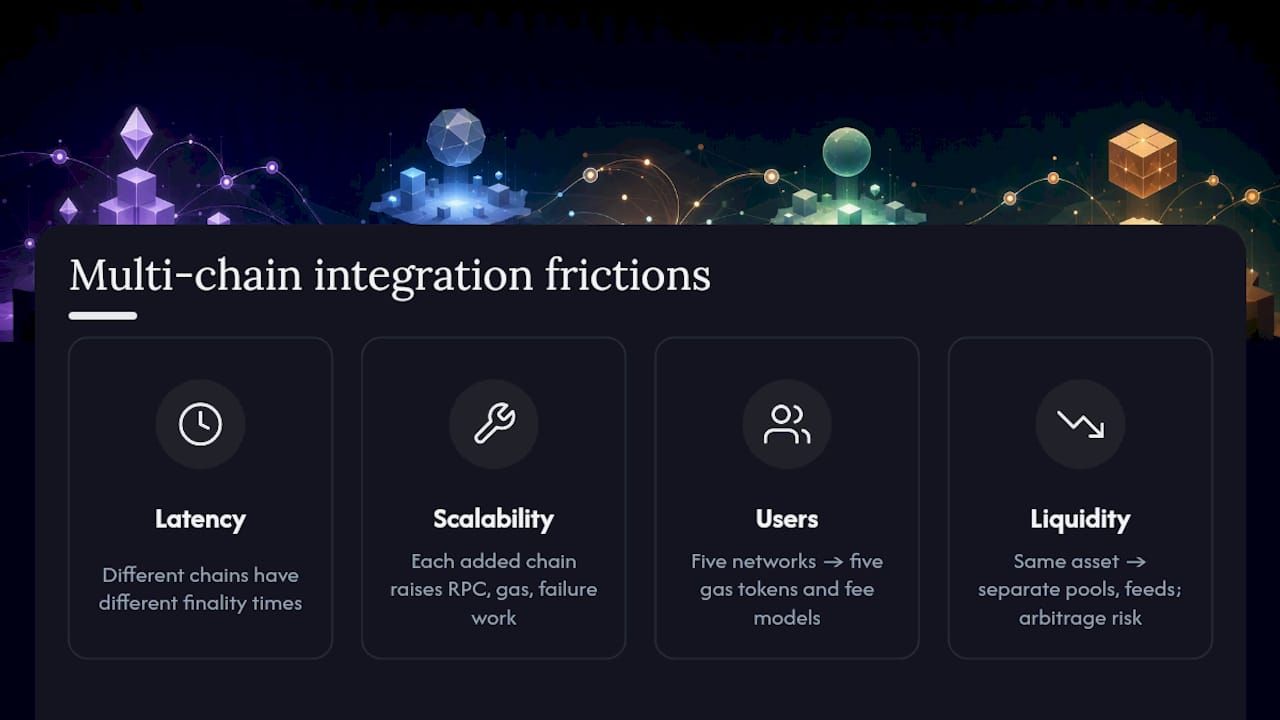
Latency is the most immediate practical friction. Different chains finalize transactions on different timelines, so a user experience designed around one chain’s speed often feels broken on another. An application that shows “confirmed” after two seconds on a fast rollup and forces users to wait a minute on a slower base layer needs separate UX patterns per chain, not one generic loading spinner.
Scalability compounds this unevenly. Adding a fourth or fifth chain to an existing multi-chain application isn’t linear work: each new network brings its own RPC quirks, gas token, and failure patterns, and the operational burden of monitoring and maintaining that surface grows with every addition. Teams that budget for chain three as if it costs the same as chain one tend to underestimate their own roadmap.
User complexity is the quieter problem. Holding assets across five networks means five different gas tokens, five sets of network fees, and five places where a transaction can silently fail because a user picked the wrong network in their wallet. Session models like CAIP-25 reduce some of this friction by letting one approval cover multiple chains, but they don’t eliminate the underlying cognitive load of managing balances that don’t automatically move where the user expects them to be.
Liquidity fragmentation sits at the intersection of all three problems. The same asset trading on three chains means three separate liquidity pools, three separate price feeds, and real arbitrage risk if those pools drift out of sync, which is exactly the pressure that pushes some teams toward cross-chain messaging even when they’d prefer to avoid the added attack surface.
What Are the Major Multi-Chain Platforms and Tools?
Different multi-chain ecosystems solve interoperability at different architectural layers, and the choice shapes what a development team ends up building versus what the platform provides.
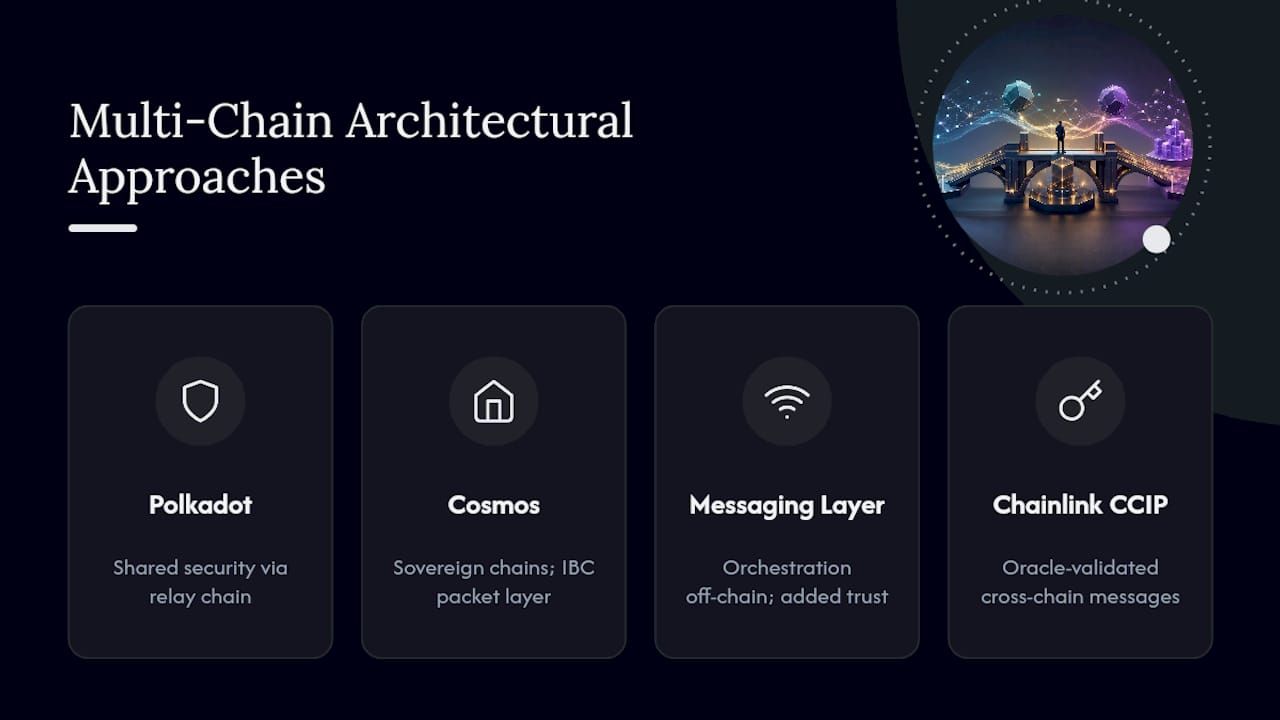
Polkadot takes a shared-security approach: parachains connect to a central relay chain, which handles cross-chain messaging natively rather than relying on external bridges. This gives parachains a common security baseline but ties them to Polkadot’s specific governance and slot-allocation model.
Cosmos takes a sovereignty-first approach. Each chain in the Cosmos ecosystem, built with the Cosmos SDK, keeps its own validator set and governance, and chains communicate through the Inter-Blockchain Communication protocol, a standardized packet-passing layer that doesn’t require chains to share security assumptions. That independence is a trade-off: more flexibility per chain, but each chain is individually responsible for its own security.
LayerZero and similar messaging-layer protocols take a different route again, functioning as a communication layer that sits on top of existing chains rather than requiring a new base layer or relay chain. Orchestration stacks in this category, including patterns documented by Biconomy, let a single user signature trigger a multi-step flow across several chains, with the orchestration logic handled off-chain. That convenience comes with added trust in the orchestrator, which tends to suit managed or custodial setups better than fully trustless ones.
Chainlink’s CCIP occupies a related space, providing programmable cross-chain messaging with an oracle network validating message delivery, positioned for institutional and enterprise flows that need unified liquidity access without building bridge infrastructure from scratch.
What’s Next for Multi-Chain Integration?
Standardization is accelerating faster than most roadmaps account for. CAIP adoption across wallets and dApp tooling is turning what used to be custom, error-prone chain-handling code into a shared vocabulary, and that trend shows no sign of slowing as more wallets follow MetaMask’s lead on multichain session support.
Account abstraction is reshaping how users interact with multiple chains at all. Rather than managing separate accounts and gas tokens per network, abstracted account models are starting to let a single identity operate across chains with sponsored or unified gas handling, which directly addresses the user complexity problem covered earlier.
Orchestration is moving from bespoke integrations toward standardized protocol layers. The distinction between “a team builds custom bridge logic” and “a team plugs into an audited GMP” is narrowing, and that shift favors smaller teams that previously couldn’t justify the security review overhead of custom cross-chain code.
Modular blockchain architecture, where execution, consensus, and data availability separate into distinct layers, adds a new wrinkle to the multi-chain question entirely: a single logical application might span multiple specialized layers that aren’t traditionally categorized as separate chains at all, which will likely force a rethink of where multi-chain integration ends and normal infrastructure scaling begins.
Choosing Between Multi-Chain and Cross-Chain for Enterprise dApps
The trade-off comes down to this: isolated multi-chain deployment minimizes attack surface, while cross-chain orchestration buys unified liquidity and user experience at the cost of added trust assumptions. Default to standards-first, chain-isolated architecture, and add narrow, audited cross-chain paths only where the business case demands it. Stage the rollout, chain by chain, and bring in an integration partner once orchestration complexity exceeds what an internal team can confidently monitor.
— Bitecode
Get Enterprise Multi-Chain Support From Bitecode
Bitecode is the faster alternative to building multi-chain infrastructure from a blank codebase.
That modular foundation applies directly to the checklist and runbook items covered above: custom business software development at Bitecode covers the chain adapters, canonical registries, and testing infrastructure a production multi-chain system needs, while AI business process automation can handle the credential rotation, alerting, and configuration monitoring that keep a live system from drifting out of sync. Teams tackling general systems-integration challenges alongside blockchain work may also find value in a partner like Monstrous Media Group’s API integration services for the broader backend picture.
If your team is scoping a multi-chain rollout, or evaluating whether a bridge is actually necessary for your use case, request a technical assessment from a qualified provider to get a concrete plan for what a modular build would look like for your specific chains and volume.
Sources
- MetaMask Connect Multichain quickstart (MetaMask docs)
- What Is Multi-Chain? (Chainlink Education Hub)
- A brief history of blockchain interoperability (Communications of the ACM)
- FinCEN guidance on convertible virtual currency