An immutable audit log is a record of system activity that no one can alter, whatever their privileges, or where any alteration is at least detectable. The most reliable way to get one is to design it into the system’s foundation: append-only recording, protected storage, signed or hashed entries and a defined retention policy. Bolting it on after launch is harder and costs more. We build custom enterprise software from modular components, and audit-readiness is easiest to deliver when the logging model is settled before the first workflow goes live.
This guide is written for executives, IT managers and technical teams who must decide what “immutable” should mean in their own systems, which U.S. rules touch the question and how to build it without creating new risks.
TL;DR
- An immutable audit log cannot be changed by anyone, or any change to it is detectable. Both approaches count, and strong systems combine them.
- Prevention uses storage arrangements such as write-once media or redundant off-site copies. Detection uses digital signatures, serialization or hashing.
- U.S. rules rarely say “immutable” outright. HIPAA requires activity records and their review, ONC health IT criteria require tamper protection and detection, and PCI DSS v4.0 groups log protection under Requirement 10.3.
- The log itself is a sensitive asset: encrypt it, keep it in more than one place, restrict access and audit the people who read it.
- Decide scope, timestamps, retention and review at design time, because those choices are expensive to retrofit.
What “immutable” actually means
The term is used loosely. A widely cited Markle Foundation report on trusted information sharing defines an immutable audit log as a record of system activity that cannot be altered by anyone, regardless of privilege, or where alterations are tamper-evident. That second clause matters. In practice, absolute physical impossibility of change is rare. What a business needs is that nobody, including an administrator or a compromised service account, can rewrite history without the change being exposed.
Three terms are often mixed up:
- System log: operational output used for debugging and monitoring. It is usually rotated, truncated and editable by whoever runs the server.
- Audit log (or audit trail): a record of who did what, when, to which data. It exists to answer oversight and investigation questions.
- Immutable audit log: an audit log with protections that stop changes or expose them.
The difference is not cosmetic. Computer-security logs support incident identification, forensic analysis, internal investigations, audits and trend analysis, according to NIST’s log-management bulletin. A log that an insider can edit supports none of those uses with confidence.
Prevention versus detection
The most useful distinction for a technical team is between making alteration hard and making alteration visible.
The Markle report describes prevention through custody arrangements, including redundant off-site copies and limited-functionality media. It describes tamper evidence through serialization and digital signatures. ONC, the U.S. health IT regulator, draws the same line in its auditable events and tamper-resistance criterion: certified health IT must protect audit records from change, overwrite or deletion, and must also be able to detect alteration, with hashing named as one detection method.
In design terms:
| Approach | How it works | What it gives you | Where it goes wrong |
|---|---|---|---|
| Write-once storage | Records go to media or storage that accepts writes but not edits | Prevents alteration at the storage layer | Retention and deletion obligations must be planned, since entries cannot simply be removed |
| Off-site redundancy | Copies kept in separate locations or accounts | Survives deletion or compromise of one copy | Copies must be kept in sync and protected equally |
| Digital signatures | Each entry or batch is signed | Alteration breaks the signature | Key management becomes part of the audit design |
| Serialization and hashing | Entries are numbered and chained so a gap or edit is visible | Reveals deletion, reordering and edits | Detection only helps if someone checks the chain on a schedule |
A system that only detects tampering still needs a person or an automated job that actually verifies. Evidence nobody checks is decoration.
What an immutable log should record
Immutability does not help if the log is missing the event that mattered. The Markle report says scope should come from oversight, security and operational needs, and lists user queries, information created, altered or deleted, exchanges between systems, automated updates and database-maintenance processing. Granularity can range from whole records to individual fields.
For a business application, a practical baseline is:
- Authentication events and failed access attempts.
- Changes to user roles and privileges. ONC’s test procedure specifically calls out recording changes to user privileges.
- Creation, modification and deletion of business records, with the before and after values where the field is sensitive.
- Actions by automated processes and integrations, not only by humans.
- Administrative actions, including configuration changes and maintenance activity.
Then add restraint. NIST advises prioritizing the information of greatest importance and adding other sources as time and resources permit, noting that very large volumes can outstrip the capacity to review them. A log nobody can read in time protects no one.
Timestamps and format
NIST lists inconsistent formats and timestamps among the practical challenges of log management. The ONC 2020 test procedure for health IT requires recorded dates and times to come from a system clock synchronized following NTPv4. Even outside health care, a single clock source and one event schema across services make reconstruction possible when an incident crosses several systems.
How to make audit logs immutable: a build sequence
No single standard gives a step-by-step recipe. NIST SP 800-92, the agency’s guide to computer security log management, offers practical enterprise guidance but is not a manual for implementing logging technology, and the agency’s log management project page says the draft revision under development focuses on organization-wide planning. So the engineering is yours to design. A workable sequence:

1. Write the logging policy first
NIST’s bulletin recommends policies that define logging goals and requirements and cover generation, transmission, storage, analysis and disposal, with audits, testing and validation to check conformance. This is where you decide who may read logs, how long they stay and what happens at the end of retention.
Where it goes wrong: teams jump to tooling and discover later that no one owns retention or review. Defining these in the specification of the system is far cheaper than negotiating them mid-project.
2. Make recording append-only at the application layer
The application should only ever add entries. No update or delete path should exist in the code that writes audit records, and the database account used by the application should not hold permissions to change them. Corrections are new entries that reference the old one.
3. Move records out of the writer’s reach
A log stored beside the application it monitors can be rewritten by whoever compromises that application. Ship entries promptly to separate storage with different credentials, and keep more than one copy. The Markle report advises avoiding a single storage location.
4. Add tamper evidence
Sign entries or batches, or chain them with hashes so each record depends on the one before. Deleting or altering any entry then breaks the chain. Store signing keys apart from the log store.
5. Verify on a schedule
Run integrity checks automatically and alert on failure. Treat a failed verification as a security incident, not a housekeeping warning.
6. Plan retention and archiving
NIST warns that size limits and rotation can overwrite or stop the recording of older events. Set retention by regulatory and business need, and archive with integrity protection intact.
What U.S. rules actually require
Most U.S. regulations ask for audit controls and integrity without prescribing a storage technology. Reading them precisely avoids both under-building and over-building.
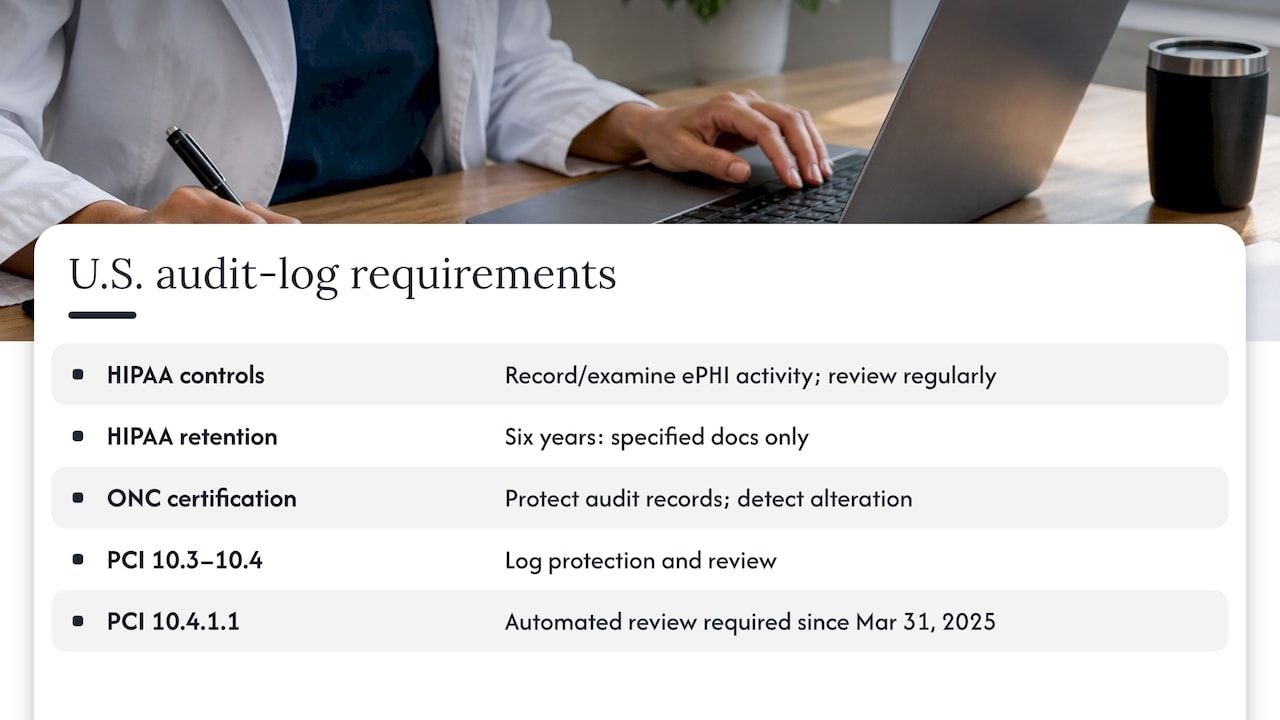
HIPAA Security Rule. The rule at 45 CFR §164.312(b) requires covered entities and business associates to implement hardware, software or procedural mechanisms that record and examine activity in systems containing or using electronic protected health information. It does not explicitly prescribe immutable storage. A separate provision, §164.308(a)(1), requires regular review of information-system activity records, including audit logs and access reports. The six-year retention period in §164.316(b)(2)(i) applies to specified Security Rule documentation, not as a blanket rule for audit-log retention. Confirm your own retention period with your compliance counsel.
ONC health IT certification. For technology certified under the ONC criterion, the requirements are explicit: audit records must be protected from change, overwrite or deletion by the technology, and alteration must be detectable, including alteration by activity outside the technology’s control. Content ties to the ASTM E2147-01 standard (reapproved 2013).
PCI DSS v4.0. The PCI Security Standards Council’s summary of changes says audit-log protection requirements were reorganized under Requirement 10.3 and log review under 10.4. It also notes that the automated audit-log review requirement, 10.4.1.1, was a best practice only until March 31, 2025. For card-data environments, that means automated review is now a requirement to plan for, not an option.
If you operate in finance, add your own regulator’s expectations and your auditors’ preferences. Our enterprise security compliance checklist is a starting point for mapping controls across frameworks.
Protecting the log itself
A complete log is a concentrated record of sensitive activity, which makes it a target. The Markle report warns that audit logs can themselves create security risks and recommends encrypting them, avoiding a single storage location, restricting access and auditing the people who review them. NIST adds that logs may capture passwords or email content, creating confidentiality exposure.
Practical rules that follow:
- Log identifiers and references rather than full sensitive payloads wherever the audit question can be answered that way.
- Mask or exclude credentials and secrets at the point of writing.
- Give log readers role-based access, and log their reads too.
- Encrypt at rest and in transit between services.
Privacy and immutability can pull in different directions: you cannot easily erase an entry from write-once storage. That is a design reason to keep personal data out of the log body in the first place.
For emergency administrative access, which is exactly the kind of action an auditor will ask about, see our guide on setting up break glass accounts safely. For the engineering patterns behind testable logs, our audit trail design article goes deeper.
Finance, ledgers and blockchain anchoring
Financial systems face the sharpest version of the problem, because every balance must be explainable from its history. A double-entry model helps: transactions are never edited, only reversed by new entries, which matches the append-only logic above. We cover it in audit-ready double-entry ledgers. Accounting tools expose the same principle to finance staff through an audit trail of changes you can check and export.
For teams that want independent proof that a record existed in a given state, anchoring is an option: store the bulk of the data in your own systems and publish only a compact fingerprint to a blockchain. This keeps on-chain cost down and avoids placing personal data on a public ledger. Our article on hybrid anchoring and modular audit trails describes the pattern, and the crypto compliance framework checklist covers the surrounding controls for companies running crypto settlements.
Automation raises the stakes further, since workflows act without a human in the loop. Every automated decision needs its own audit entry; see why security in automation matters for complex workflows.
The benefits you can honestly expect
The Markle report says an audit, whether based on mutable or immutable logs, can deter, detect and prove policy violations, and that immutable logs improve detection and evidentiary proof because insiders and attackers are less able to erase evidence unnoticed. That is the value proposition: stronger deterrence and stronger evidence when a dispute, investigation or audit arrives.
It is also worth being exact about what the log cannot do. It only protects what was captured. If an action never reached the log, immutability guarantees nothing about it. That is why scope, covered above, is the first design decision and not the last.
Our view: build the audit foundation once
We see immutable logging as a foundation decision, not a feature to add late. When the audit model is part of the base system, every workflow, integration and module inherits it. When it is added afterward, each component needs its own retrofit, and gaps appear at the seams between them.
That is why we start projects from modular, ready-made components, with up to 60% of the baseline system pre-built. Our approach is designed so teams spend their effort on business-domain logic, such as the rules, approvals and financial flows that are specific to them, instead of rebuilding audit-ready plumbing. Multi-currency, audit-ready and self-hosted functionality are part of what we offer, which matters when you need to keep your logs and keys under your own control.
The aim is to accelerate delivery without accelerating chaos: one consistent event model, one retention policy and one verification routine across the whole system.
Bitecode
Where we can help
If you are planning a finance platform, an internal system, a SaaS product or a blockchain settlement flow and need audit records that stand up to scrutiny, our Financial Module is a natural place to start, and our custom business software service covers systems built around your own workflows. Tell us what your auditors, regulators or customers will ask to see, and we will scope the logging model together with the rest of the system.

For blockchain-based payment flows, see our Token Module for blockchain payments.
FAQ
How do you make audit logs immutable?
Combine prevention and detection. Prevent changes with append-only writes, write-once media or redundant off-site copies, and detect them with digital signatures, serialization or hashing. Then verify the chain regularly, because detection only helps if someone checks.
Should logs be immutable?
Audit logs that serve compliance, investigation or evidence should be. Operational debug logs usually need rotation and do not require the same protection. Decide by the question each log must answer and by the rules that apply to your sector.
Does HIPAA require immutable audit logs?
The Security Rule requires mechanisms that record and examine activity in systems with electronic protected health information, and regular review of those records. It does not explicitly prescribe immutable storage. ONC-certified health IT, however, must protect audit records from change and detect alteration.
What is the difference between an audit log and an immutable audit log?
An audit log records who did what and when. An immutable audit log adds protections so that records cannot be changed or deleted, or so that any change is detectable. The first tells you what happened, and the second lets you prove it.
Sources
- Trusted Information Sharing Environment, Markle Foundation report
- NIST ITL Bulletin: Log Management
- ONC Auditable events and tamper-resistance test method
- ONC Auditable events and tamper-resistance test procedure, 2020
- NIST SP 800-92, Guide to Computer Security Log Management
- NIST Log Management project
- eCFR 45 CFR Part 164, June 25, 2024
- eCFR 45 CFR Part 164 Subpart C, November 24, 2020
- PCI DSS v4.0 Summary of Changes
- Audit trail in Exact Online