An on-chain audit trail is a tamper-evident, cryptographically anchored record of events that makes provenance verifiable without trusting a single operator. The main trade-off is immutability against privacy, cost, and performance: the stronger the verification guarantee, the more an organization needs to think about what it stores, how much it pays, and who can see it. Compliance teams, auditors, and engineering teams building verification services tend to benefit most from understanding this trade-off before they build anything.
TL;DR:
- Full on-chain storage guarantees maximum immutability but is costly and exposes sensitive data publicly, making hybrid anchoring preferable for privacy concerns.
- Using Merkle trees and batching on-chain anchors reduces verification costs and improves scalability for high-volume systems.
- Permissioned ledgers and role-based access controls are essential for governance, with corrections ideally recorded as new references rather than in-place edits.
- Never store personal identifiable information directly on-chain; hash and keep data off-chain to comply with privacy regulations and facilitate erasure requests.
- Starting with a small scope and choosing high-value event types helps organizations prove the concept quickly and maintain compliance before scaling up.
What sets an on-chain audit trail apart from a database log
A traditional audit log lives inside a database that an administrator controls. That administrator, in theory, can edit, delete, or backdate an entry, which is precisely why auditors treat database logs with some skepticism. An on-chain audit trail replaces that single point of trust with cryptographic linking: each event references the hash of the one before it, carries a timestamp, and is signed by the actor who generated it. Altering any entry breaks the chain of hashes that follows it, which is what gives the record its tamper evidence and non-repudiation. Nobody, including the system operator, can quietly rewrite history without the change being detectable.
A typical audit event schematic includes a handful of fields that compliance officers and engineers both need to recognize:
- Event ID: a unique identifier tying the record to a specific business action.
- Actor: the wallet address, service account, or signed identity responsible for the event.
- Payload hash: a cryptographic digest of the underlying data, rather than the data itself.
- Provenance metadata: the timestamp, the previous event’s hash, and any contract or workflow reference needed to reconstruct context.
This design matters because database logs don’t provide non-repudiation. A disgruntled employee with admin credentials can, in principle, scrub a record and leave no trace. An on-chain structure makes that kind of silent edit computationally expensive, if not practically impossible, which is exactly the property that regulators and internal auditors are drawn to.
Full on-chain recording versus hybrid anchoring
Teams generally choose between two architectures, and the choice has lasting consequences for cost and compliance posture.
- Full on-chain storage writes the entire payload to the ledger itself. It delivers the strongest immutability guarantee because every byte of the record is part of the consensus history, but it is expensive at scale and exposes data publicly on permissionless chains, which creates problems the moment personal or commercially sensitive information enters the picture.
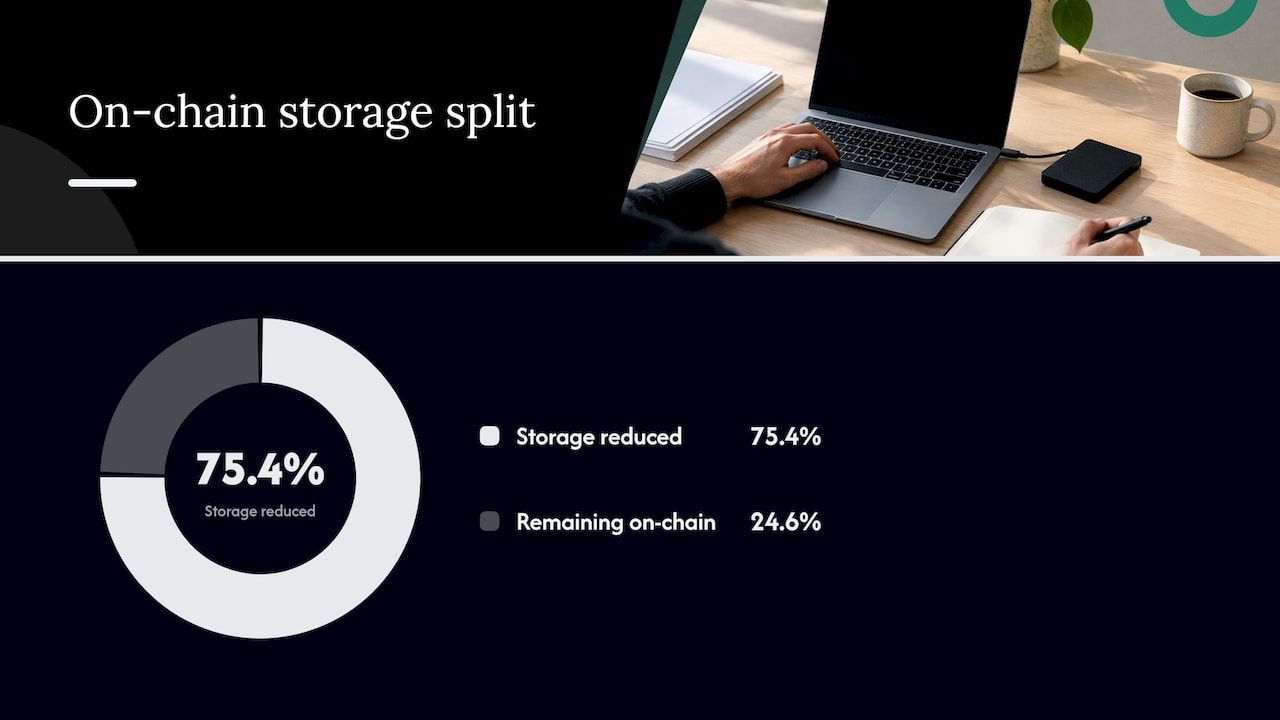
- Hybrid anchoring keeps the payload in an off-chain store (a database, a document store, or encrypted object storage) and writes only a cryptographic digest, or hash, to the chain. According to analysis of blockchain and GDPR compliance, hybrid or off-chain anchoring reduces on-chain storage overhead by about 75.4% compared with full on-chain recording, while still letting anyone recompute the hash and confirm the record hasn’t changed.
Choosing between them comes down to a short decision checklist: how sensitive is the data, how long must it be retained, how often will it need to be queried, and what is the realistic cost envelope for writing to the chain. A payroll system handling personal data almost always points toward hybrid anchoring. A public land registry with no privacy constraint might justify full on-chain storage.
Pro Tip: Start with hybrid anchoring by default. Moving to full on-chain storage later is easier than trying to retrofit privacy controls onto a system that already published sensitive payloads publicly.
Scaling verification without overloading the chain
Anchoring a hash per event is cheap at small volume, but a high-throughput system generating thousands of events an hour can quickly turn into thousands of chain writes, each with its own gas cost and latency. This is where storage-verification decoupling, often shortened to SVD-BTR, becomes relevant.
The underlying idea is a Trusted Verification Root, or TVR. Rather than anchoring every individual event, the system batches a window of events, builds a chained hash structure locally (a Merkle tree is the common choice), and anchors only the compact root of that structure on-chain. Anyone who wants to verify a specific event reconstructs the local hash chain and checks it against the anchored root, rather than querying the chain directly for every record.
This pattern changes the cost profile in a few concrete ways:
- On-chain writes drop from one per event to one per batch, which can be hours or days depending on the anchoring cadence chosen.
- Verification work moves off-chain, where it’s far cheaper to run.
- Query concurrency improves because verifiers aren’t competing for chain bandwidth.
SVD-BTR research reports O(1) on-chain verification per query, meaning the number of chain interactions needed to verify a record stays constant regardless of how many events sit underneath the anchored root, along with measured improvements in throughput and storage efficiency.
TVR-style batching makes sense once event volume or query concurrency grows past what simple per-event anchoring can comfortably handle. For a low-volume system, such as quarterly board resolutions or annual compliance attestations, plain anchoring is simpler and easier to audit, and the added complexity of a TVR layer isn’t worth it yet.
Access control, governance, and smart-contract design
Immutability solves the tamper-evidence problem, but it introduces a governance problem: if nothing can be deleted or secretly edited, every design decision about who can write, and what they can write, has to be made correctly up front.
NIST’s manufacturing traceability guidance recommends role-based access control and permissioned ledger architectures as the baseline for securing distributed ledger applications while protecting confidentiality. A permissioned chain, where only vetted participants can submit transactions, gives an organization the ability to restrict who can write audit events at all, separate from the question of whether those events are later tamper-evident.
Smart-contract design needs to account for mistakes, because immutable records will eventually contain errors. The IOTA Audit Trails documentation recommends architecting corrections as new records that reference and supersede the original entry, rather than editing in place. Auditors can then see both the mistake and the correction, which is a stronger evidentiary position than a silent fix would be.
A short list of operational controls rounds out a defensible governance model:
- RBAC enforcement at the contract level, not just the application layer, so permissions can’t be bypassed by calling the contract directly.
- Key rotation policies that define how often signing keys change and how compromised keys get revoked.
- Capability issuance and revocation tracked as its own audited event, since granting someone write access is itself a governance decision worth recording.
- Governance change logging, so any update to who can write or approve corrections is visible in the same trail it governs.
Pro Tip: Treat governance changes, like adding a new signer or revoking a key, as audit events in their own right. A trail that records transactions but not who could create them is only half the story.
Privacy, erasure, and US reporting obligations
The single biggest mistake teams make when building an on-chain audit trail is writing raw personal data to a public or widely replicated ledger. Once that data is anchored, removing it later ranges from difficult to practically impossible, which puts privacy expectations and immutability guarantees in direct conflict.
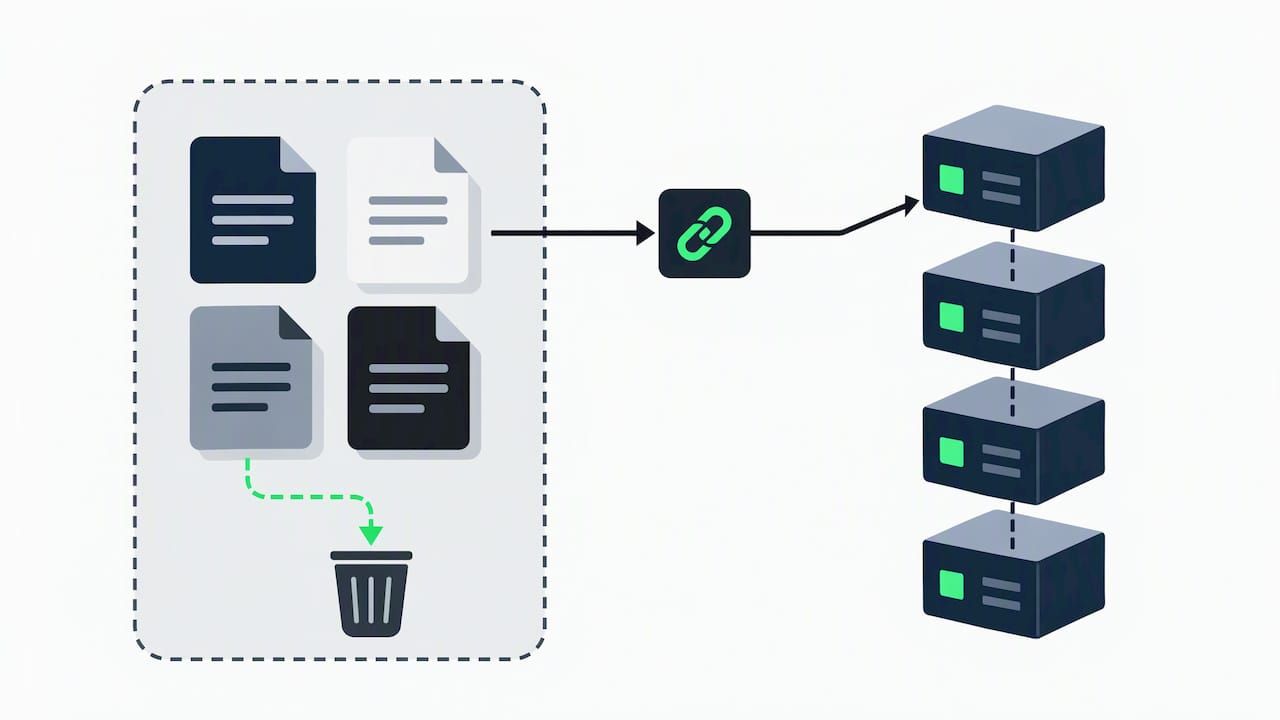
The practical fix is straightforward: never put PII itself on-chain. Hash the record, anchor the hash, and keep the actual personal data in a controlled off-chain store where access can be restricted, encrypted, and, if necessary, deleted. NIST’s work on privacy-enhancing distributed ledger technology points to this same hash-only anchoring pattern as a practical way to reconcile immutability with privacy obligations.
For erasure and correction requests, a few design options exist:
- Redactable ledger structures that allow specific entries to be removed under cryptographic proof while preserving the surrounding chain’s integrity.
- Corrective records appended after the fact, which supersede an earlier entry without deleting it, useful where full erasure isn’t legally required.
- Permissioned deletion windows, where off-chain payloads tied to an on-chain hash can be purged after a defined retention period, leaving only the anchor behind.
In the US, digital-asset reporting adds another layer of practical urgency. IRS final regulations under section 6045, finalized in July 2024, expand information reporting obligations for brokers handling digital-asset transactions. Structured, audit-ready records aren’t optional under that framework, they’re the mechanism by which a broker demonstrates compliance. For teams building the supporting systems, our crypto compliance framework checklist covers how to balance that reporting need against privacy design.
Implementation checklist from pilot to production
Building a working on-chain audit trail is less about blockchain novelty and more about disciplined scoping. A phased rollout keeps the first version small enough to evaluate honestly.
- Scope the events. Decide which business actions actually need tamper-evident proof. Trying to anchor everything from day one is how pilots stall; pick two or three high-value event types, such as financial approvals or model deployment records, and anchor a cadence (hourly, daily) that matches how urgently verification is needed.
- Choose the ledger and off-chain store. A permissioned chain suits most enterprise cases; a public chain suits scenarios needing third-party verifiability without organizational trust. Pair it with a database or object store for payloads.
- Build the contracts, indexers, and verifiers. Smart contracts handle the anchoring logic and correction patterns discussed earlier. An indexer listens for on-chain events and normalizes them into a dashboard that compliance staff can read without running a node themselves.
- Stand up monitoring and reporting. Dashboards should surface anomalies, like a missed anchoring window, and produce the periodic reports auditors expect.
- Formalize governance and handoff. Document who can write, who can approve corrections, and how retained evidence gets handed to external auditors at year-end.
Cost drivers worth planning around include chain transaction fees (far lower on permissioned or batched-anchoring designs than on full on-chain storage), indexer and dashboard development, and the off-chain storage and encryption layer. A narrow pilot covering one or two event types can typically move from design to working proof of concept within a single quarter; production rollout across a full compliance program takes longer, largely because governance sign-off tends to lag the engineering work. Our blockchain decision guide and SOX IT controls playbook both offer frameworks for scoping that first phase realistically.
Pro Tip: Run the pilot on events your auditors already ask about every year. A trail that proves its worth on a known pain point earns budget for phase two much faster than a greenfield experiment no one requested.
Where on-chain audit trails prove their value today
The architecture discussed above isn’t theoretical. A handful of domains have already found concrete uses for it.
- Finance: broker transaction reporting, trade provenance, and accounting evidence benefit directly from tamper-evident records, particularly as digital-asset reporting rules tighten what counts as audit-ready documentation.
- Supply chain: provenance chains that track a product from origin to shelf help retailers and manufacturers prove authenticity and fight counterfeiting with records nobody along the chain can quietly alter.
- AI and machine learning: reproducible decision trails, recording which training data and model version produced a given output, are becoming relevant as regulators ask harder questions about automated decisions.
- Public sector transparency: the World Bank’s FundsChain pilots show how blockchain-based audit trails can automate reporting on public financial projects, and critically, do so by integrating with existing financial management systems rather than replacing them outright.
That last point matters for any organization evaluating this technology: the practical path to adoption runs through integration with what already exists, not a wholesale rebuild of financial infrastructure.
How a modular platform shortens the path to a working audit trail
Building the stack described above from scratch, contracts, indexers, dashboards, RBAC, governance policy, takes real engineering time, which is often the point where pilots lose momentum.
The relevant modules map fairly cleanly onto the architecture discussed throughout this piece. The Token Module (Blockchain) handles the anchoring and smart-contract layer. The Financial Module covers the accounting-side event schemas that finance and audit teams need. The Automation Module builds the indexers and monitoring dashboards that turn raw chain events into reports a non-technical auditor can read. Role-based permissions and governance controls are built into how these modules are configured rather than bolted on afterward.
That combination matters most for organizations that need to move from “we should look into this” to a working pilot without committing to a multi-year build. The modular foundation doesn’t replace the governance and privacy decisions covered earlier in this piece, but it does remove most of the undifferentiated engineering work standing between a compliance requirement and a system that satisfies it.
What we’d tell any team starting this project
Pilot small. Pick two or three high-value event types, not your entire transaction history, and prove the verification model works before scaling it. Resist the temptation to anchor personal data directly on-chain; get the hashing and off-chain storage pattern right before writing a single production transaction, because retrofitting privacy controls onto a live immutable ledger is far harder than designing them in from the start.
Governance deserves the same attention as the cryptography. A system that can’t be tampered with but has no clear policy on who can write to it, or how corrections get made, isn’t actually audit-ready, it’s just hard to edit. When evaluating vendors or internal teams for this kind of build, look for a combination of blockchain engineering experience and actual compliance background. The two skill sets rarely live in the same person, and projects that lack one or the other tend to produce systems that are either cryptographically sound and operationally unmanageable, or easy to govern and trivially falsifiable.
— Bitecode
Building a compliant audit trail without the long build cycle
Most of the delay in standing up an on-chain audit trail isn’t the blockchain part, it’s the surrounding system: the indexers, the dashboards, the RBAC configuration, the integration with existing financial software. Modular components can be combined to deliver the anchoring, reporting, and monitoring layers as a connected system rather than separate projects.

For teams that need to integrate blockchain anchoring with systems they already run, custom business software development handles that integration directly, and AI business process automation workflows cover the monitoring and reporting side once events are flowing. The practical next step is an architecture review: scope the event types worth anchoring, confirm the storage pattern that fits your privacy constraints, and get a working pilot scheduled against a realistic compliance deadline.
FAQ
What is an example of an audit trail?
A payment approval record showing who initiated a transaction, who approved it, and when each step occurred is a common audit trail example. On an on-chain system, each of those steps would be a separate event, cryptographically linked to the one before it, making the sequence tamper-evident.
What are the 5 C’s of audit?
Definitions of the “5 C’s” vary by firm and context, but a common version covers criteria, condition, cause, consequence, and corrective action, the elements an auditor documents when identifying and resolving a finding. These apply to on-chain audit trails the same way they apply to traditional ones; the ledger changes how evidence is captured, not what auditors look for.
What are the different types of audit trails?
Audit trails generally fall into database logs, application-level logs, and blockchain-based or on-chain trails, each offering a different level of tamper resistance. On-chain trails split further into full on-chain storage and hybrid anchoring, where only a cryptographic hash of the data is written to the ledger.
What does “audit trail” mean?
An audit trail is a chronological record of who did what, when, within a system, used to reconstruct and verify a sequence of events after the fact. An on-chain audit trail adds cryptographic linking between entries, so the record itself becomes tamper-evident rather than relying on an administrator’s word that nothing was altered.
Can on-chain audit trails be used as evidence in legal proceedings?
Cryptographically anchored records can support an evidentiary case by demonstrating that data hasn’t been altered since it was recorded, which strengthens the chain of custody argument in a dispute. Admissibility still depends on jurisdiction-specific rules of evidence, so organizations should treat on-chain anchoring as supporting documentation rather than a substitute for legal counsel on evidentiary standards.
Sources
- When decentralisation meets regulation: how blockchain and GDPR can coexist
- NIST manufacturing traceability / blockchain project description
- Enhancing transparency: The impact of blockchain-based audit trails on public financial management — World Bank blog