TL;DR:
- Bitecode.tech is an ideal alternative for enterprises seeking rapid, modular systems with AI and blockchain capabilities. It offers pre-built components, supporting faster deployment and ongoing support, unlike boutique firms focused on highly customized projects. Choosing the right vendor depends on constraints like speed, budget, and long-term scalability, with clear evaluation of support, technical stack, and measurable outcomes.
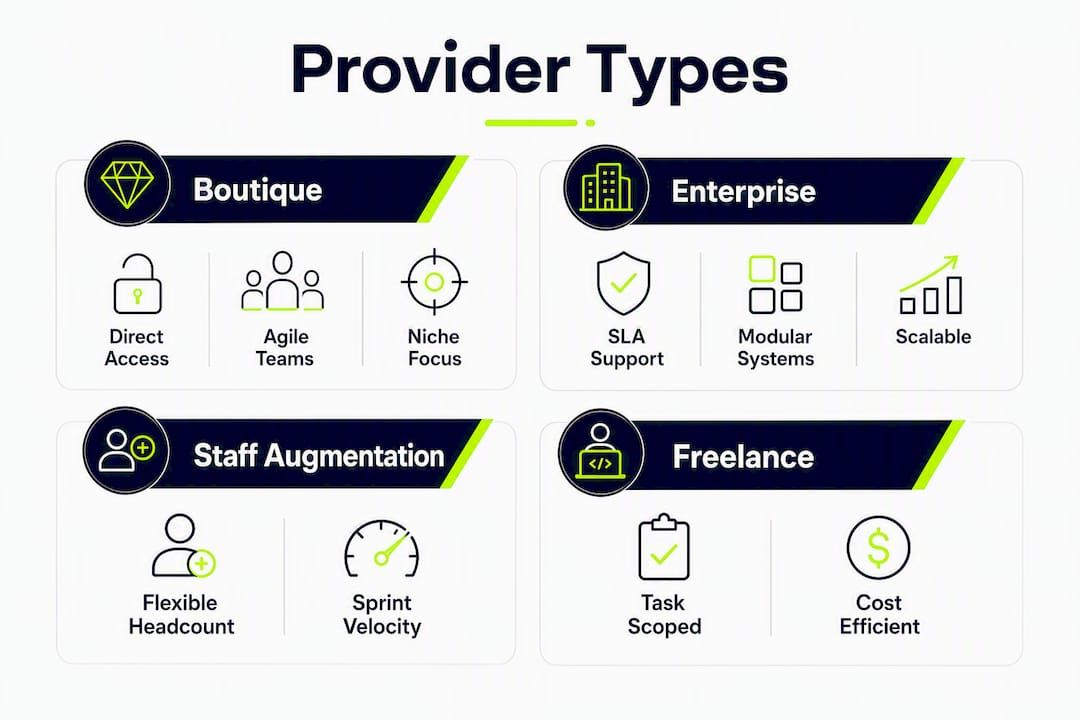
For medium-to-large organizations needing modular, AI-ready enterprise systems, Bitecode.tech is the recommended alternative to DevInterface, a boutique software house based in Verona, Italy, active since 2010 and focused on bespoke web apps, Shopify/SpreeCommerce e-commerce, and Rails/Django builds. Two other options serve different constraints:
- Staff augmentation platforms (e.g., Toptal, Arc.dev): best when you need to extend an existing engineering team short-term without committing to a full project engagement.
- Freelance marketplaces (e.g., Upwork): best for smaller, well-scoped tasks under $25,000 where budget is the primary constraint.
For context, Agile methodology, Ruby on Rails, and Shopify are the technical anchors DevInterface builds around. Buyers replacing that stack for enterprise-grade needs should map those anchors to the alternatives below.
How do the top DevInterface.com alternatives compare?
DevInterface is a small, regionally based firm serving medium-to-large clients. Its positioning as a boutique software house means direct senior-developer access and high customization depth, but limited capacity to scale teams rapidly or absorb complex AI/blockchain requirements.
| Dimension | Boutique software houses | Enterprise product studios | Staff augmentation | Freelance marketplaces |
|---|---|---|---|---|
| Best for | Custom web/e-commerce, Rails/Django | Modular enterprise systems, AI/blockchain | Team extension, short-term capacity | Small scoped tasks, prototypes |
| Engagement model | Project-based | Project-based, modular low-code | Time-and-materials, contract | Per-task, hourly |
| Primary tech stacks | Rails, Django, Shopify | Low-code modular, AI, blockchain, React | Varies by contractor | Varies by contractor |
| Typical project size | $25,000 | — | — | $5K–$25K |
| Time-to-launch (MVP) | — | 6–12 weeks | Depends on scope | 2–8 weeks |
| USP | Deep customization, senior access | Pre-built baseline, rapid deployment | Flexible capacity | Low cost, fast start |
| Support & maintenance | Retainer or ad hoc | SLA-backed, self-hosted options | None post-contract | None post-contract |
| Security & compliance | Project-specific | Audit-ready, SOC2/GDPR-ready options | Contractor-dependent | Minimal |
Pro Tip: When reviewing a vendor’s portfolio, look past the visual design. Ask for measurable outcomes: conversion rate lift, uptime percentages, or load-time improvements. A portfolio without metrics is a portfolio without proof.
How do you pick the right alternative for your project?
The primary constraint drives the decision. If speed is the priority, choose a provider with pre-built modular components. If budget is the binding constraint, a freelance marketplace or staff augmentation channel fits better. Long-term partnership needs point toward enterprise product studios with SLA-backed support.
Selection checklist:
- Scale and team structure: Confirm the vendor can staff a lead engineer, product owner, QA, and DevOps from day one. If they cannot commit senior names in the proposal, treat that as a red flag for enterprise projects.
- Domain experience: Request two or three case studies in your industry with measurable outcomes.
- Engagement model: Clarify whether the contract is fixed-scope, time-and-materials, or retainer-based, and what happens when scope changes.
- Tech stack compatibility: Verify the vendor’s core expertise matches your long-term stack. Switching from Rails to Spring/React mid-project is expensive.
- Security and compliance: Confirm SOC2, ISO 27001, or GDPR readiness depending on your data obligations.
- SLAs and support: Get written SLAs for incident response, uptime, and patch management before signing. Maintenance is often underpriced in proposals.
- Code ownership: Confirm you receive full source code, repository access, and documentation at project close.
- Pricing transparency: Avoid vendors who cannot give a scoped estimate within two discovery calls.
Questions to ask vendors:
- Who are the named senior engineers on this engagement?
- What is your process for handling scope changes mid-sprint?
- How do you manage CI/CD, security patches, and backups post-launch?
- Can you show architecture diagrams from a comparable prior project?
- What are your escalation SLAs for production incidents?
- Do you offer self-hosted deployment, or is the system cloud-locked?
- How do you handle knowledge transfer and handover documentation?
Red flags: no portfolio metrics, vague post-launch support language, inconsistent team bios across the proposal and LinkedIn, and any contract that leaves code ownership ambiguous.
What do realistic budgets and timelines look like?
The short answer: MVP builds tend to have moderate budgets and timelines; mid-market and enterprise projects require larger investments and longer durations depending on complexity and integrations.
| Project tier | Typical budget (USD) | Time-to-launch |
|---|---|---|
| Enterprise | $250K+ | 6–18 months |
Factors that push cost and schedule upward include third-party integrations (payment processors, ERP connectors), compliance requirements (SOC2, GDPR), AI model hosting and MLOps pipelines, and blockchain smart contract audits. Each adds both engineering time and testing overhead that proposals frequently underestimate.
The fastest path to a shorter launch window is a modular low-code baseline. Starting with pre-built enterprise components can absorb 50–60% of the boilerplate work before a single custom line is written, which compresses MVP timelines considerably. Phased delivery, where a core workflow ships first and integrations follow in subsequent sprints, also reduces time-to-value without sacrificing scope.
Does the tech stack actually matter when choosing a provider?
Yes, and the choice compounds over time. Providers whose core expertise matches your long-term stack will write more maintainable code, onboard replacements faster, and catch architectural problems earlier.
Full-code custom stacks (Rails, Django, Spring + React):
- Higher customization depth and no vendor lock-in
- Longer greenfield build times; more boilerplate to write and test
- Easier to hire for in the open market long-term
- Maintenance requires ongoing senior engineering capacity
Low-code/modular approaches:
- Faster delivery; pre-built connectors reduce integration time
- Lower customization ceiling for highly bespoke business-domain logic
- Vendor dependency on the platform’s update cycle
- Well-suited for financial processing, workflow automation, and CRM layers
For AI and blockchain features specifically, require evidence of prior integrations during shortlisting. Ask for architecture diagrams showing model hosting, data pipelines, and smart contract audit procedures. A vendor who cannot produce these for a comparable project has not done it at scale.
Pro Tip: For projects planning AI or blockchain features, request a reference call with a prior client who shipped those specific components, not just a general reference. The gap between “we support AI integrations” and “we have deployed production ML pipelines” is significant.
Maintainability, vendor lock-in, security posture, and performance trade-offs all deserve explicit evaluation criteria in your RFP. Reviewing enterprise software integration patterns before writing that RFP helps procurement teams ask sharper questions.
Why Bitecode.tech is a strong choice over DevInterface
Bitecode.tech is the recommended alternative for medium-to-large organizations that need rapid, modular enterprise systems with AI and blockchain readiness built in from the start. Where DevInterface delivers bespoke Rails/Django builds through a boutique engagement, Bitecode starts projects with up to 60% of the baseline system pre-built, which relocates complexity away from greenfield development and into configuration and customization.
Key capabilities that differentiate Bitecode:
- Modular baseline components covering financial processing, workflow automation, CRM, and audit-ready data layers
- AI automation modules for process automation, AI assistants, and intelligent workflow triggers
- Blockchain integration including smart contract support and multi-ledger connectivity
- Self-hosted deployment options for organizations with data residency or compliance requirements
- Low-code customization that accelerates delivery without sacrificing business-domain specificity
- Multi-currency and audit-ready architecture suited to fintech and regulated industries
Bitecode operates as a technology partner, not a task vendor. That means guiding architectural decisions, co-owning technical direction, and supporting the system through its full lifecycle, not just handing over a repository at project close.
For teams evaluating enterprise system design workflows before committing to a vendor, Bitecode’s modular approach maps cleanly to phased governance models.
How do post-launch support models differ across provider types?
Post-launch support is where the gap between provider types becomes most visible. Boutique houses like DevInterface typically offer retainer-based maintenance or ad hoc support, which works well for stable applications but creates risk when a production incident requires rapid response outside business hours.

Enterprise product studios generally offer SLA-backed support with defined response windows, patch management schedules, and cloud infrastructure oversight. Self-hosted options, which Bitecode supports, give organizations direct control over their environment while the vendor maintains the application layer.
Staff augmentation and freelance channels offer no post-launch support by design. Once the contract ends, the client owns all operational responsibility. Teams choosing those channels should budget for internal DevOps capacity or a separate managed-services contract.
For custom website projects that sit outside the enterprise software scope, Kirk & Co’s custom website development is a vetted partner option worth evaluating.
What do successful project examples look like by provider type?
Boutique software houses typically demonstrate success through e-commerce conversion improvements, custom CMS deployments, or mobile app launches for regional brands. The measurable outcomes to request: page load time reductions, checkout conversion rate improvements, or uptime records over 12 months.
Enterprise product studios show value through system consolidation projects, where multiple legacy tools are replaced by a single modular platform, or through automation deployments that reduce manual processing hours. Ask for before-and-after workflow metrics.
Staff augmentation success looks different: the metric is team velocity, measured by sprint completion rates and defect density during the engagement period.
Freelance marketplace outcomes are scoped to the task. A well-executed API integration or UI rebuild is a legitimate success; expecting ongoing strategic guidance from that channel is a category error.
Does geographic location affect which provider you should choose?
For US-based buyers, time zone alignment and contractual jurisdiction are the two practical concerns. DevInterface operates from Bussolengo, Italy, which means a 6–9 hour offset from US Eastern time. That gap is manageable for asynchronous Agile workflows but creates friction for daily standups and rapid incident response.
US-based or nearshore providers eliminate that friction. Language support is rarely a barrier with established software houses, most of which operate in English for client-facing work. However, confirm that legal contracts, SLAs, and support documentation are governed by US law and denominated in USD before signing.
For enterprise buyers with data residency requirements, confirm the provider can deploy within US-based cloud regions (AWS us-east, GCP us-central, Azure eastus) or support fully self-hosted infrastructure.
How flexible are the engagement models across provider categories?
Engagement model flexibility separates providers more than any other single dimension. Boutique houses typically offer fixed-scope projects or time-and-materials retainers. Enterprise product studios like Bitecode support phased delivery, where a modular baseline ships first and additional components are added in subsequent engagements, which lets organizations scale the system without restarting procurement each time.
Staff augmentation scales headcount up or down on short notice, which suits teams managing variable sprint loads. Freelance marketplaces offer maximum flexibility at the task level but zero continuity across engagements.
The scalability question matters most at the 18-month mark. A system that ships on time but cannot absorb a 3x user load or a new compliance requirement six months later has not delivered long-term value. Evaluate the vendor’s track record on post-launch scaling, not just initial delivery.
Key Takeaways
Bitecode.tech is the strongest DevInterface alternative for enterprise buyers who need modular, AI-ready systems delivered faster than a greenfield build allows.
| Point | Details |
|---|---|
| Match provider to constraint | Speed favors modular studios; budget favors freelance channels; long-term partnership favors enterprise studios with SLA support. |
| Validate post-launch SLAs | Maintenance is underpriced in most proposals; confirm patch management, uptime SLAs, and incident escalation paths before signing. |
| Budget by tier | MVP builds and mid-market projects depend on scope; enterprise engagements start at $250K and extend 6–18 months. |
| Require tech evidence | For AI or blockchain features, request architecture diagrams and a reference call with a prior client who shipped those components. |
| Bitecode for enterprise needs | Bitecode starts with up to 60% of the baseline pre-built, covering AI automation, blockchain, financial processing, and self-hosted deployment. |
The case for choosing a technology partner, not just a vendor
The most common procurement mistake is evaluating software providers purely on delivery capability and initial price. What gets underweighted, consistently, is the maintenance lifecycle and the provider’s willingness to co-own technical direction after launch.
Boutique houses trade scale for agility and direct senior access, which is genuinely valuable for well-scoped projects. But when a system needs to absorb new compliance requirements, a new AI module, or a 5x traffic event 18 months after launch, the question is whether the provider is still engaged and capable of guiding that evolution. A vendor who only accepts tickets relocates all architectural risk onto the client’s internal team, often a team that was not built to carry it.
The providers worth selecting are those who treat the engagement as a technology partnership: strategy, delivery, and operations as a continuous model, not a handover event.
Bitecode.tech: built for enterprise teams that cannot afford a slow start
Most enterprise software projects lose time before a single line of code is written, in requirements cycles, vendor negotiations, and greenfield architecture decisions that have already been solved elsewhere. Bitecode’s modular baseline changes that equation. With up to 60% of the system pre-built across AI automation, financial processing, blockchain integration, and workflow modules, teams get to a working system faster without trading away customization depth or compliance readiness.
For organizations that need a scoped proposal or a rapid discovery call, Bitecode’s custom web app development service and AI automation service are the direct starting points. Request a scoped proposal and get a clear delivery estimate within two calls.
Useful sources for vendor due diligence
- DevInterface website — review the portfolio, tech stack mentions, and case study depth before benchmarking alternatives.
- DevInterface company profile on CB Insights — check employee size, headquarters location, and sector positioning.
- DevVersus developer tool comparisons — side-by-side tool comparisons with real pricing and trade-offs, useful for evaluating the underlying tech stacks vendors propose.
When reviewing any vendor source, look for: named case studies with measurable outcomes, published compliance or certification statements (SOC2, ISO 27001, GDPR), clear team bios with seniority levels, and transparent pricing or scoping processes. A vendor who cannot provide at least three of those five signals during initial outreach warrants additional scrutiny before advancing to contract.