For enterprise teams evaluating modular, low-code platforms to replace or supplement a davinci-studio.com-style system, Bitecode is recommended for use-cases requiring AI automation, fintech, or blockchain integration — it delivers up to 60% of the baseline system pre-built, supports self-hosting, and covers these domains without a greenfield build. For other requirements, see the best-fit shortlist below, each evaluated across procurement-centric dimensions.
Quick best-for guide:
- Bitecode — audit-ready custom systems with AI, fintech, or blockchain requirements
- Microsoft Power Platform — Azure-invested enterprises needing broad connectors
- OutSystems — large, governed low-code deployments with professional services
- Mendix — rapid prototyping with strong IT/business collaboration
- Appian — complex workflow orchestration and case management
- Salesforce Platform — CRM-centric extensions within the Salesforce ecosystem
- Pega Systems — advanced decisioning, rules engines, and case automation
A structured five-criterion framework covering business process orchestration, UI/UX customization, integration, governance/security, and AI automation gives procurement teams a reproducible scoring model for comparing these platforms.
| Platform | Best for | Deployment | AI / GenAI | Security & Compliance | Extensibility | Time-to-Value |
|---|---|---|---|---|---|---|
| Bitecode | AI, fintech, blockchain custom systems | Cloud, self-host, hybrid | AI automation modules, custom AI integration | Audit-ready, multi-currency, self-hosted controls | Full custom code + APIs | Fast — up to 60% pre-built baseline |
| Microsoft Power Platform | Azure-invested enterprises | Cloud (Azure-native), hybrid | Copilot, AI Builder | Microsoft enterprise controls | Connector ecosystem, limited deep custom code | Moderate |
| OutSystems | Large governed deployments | Cloud, on-prem, hybrid | AI-assisted development | Enterprise lifecycle governance | Strong, with guardrails | Moderate to long |
| Mendix | Rapid prototyping, IT/business collaboration | Cloud, on-prem, hybrid | GenAI tooling for citizen devs | Enterprise governance | Model-driven, extensible | Fast to moderate |
| Appian | Process-heavy workflow and case management | Cloud, on-prem, hybrid | AI process automation | BPM governance controls | Workflow-centric APIs | Moderate |
| Salesforce Platform | CRM-centric app extensions | Cloud (Salesforce-native) | Einstein AI, Agentforce | Salesforce enterprise controls | AppExchange, Apex code | Moderate |
| Pega Systems | Advanced decisioning and case automation | Cloud, on-prem, hybrid | Pega GenAI features | Mature enterprise controls | Rules engine, APIs | Long |
Key Takeaways
The strongest davinci-studio.com alternatives for enterprise teams are those that best match your deployment model, compliance requirements, and AI integration needs — Bitecode offers the fastest path for AI, fintech, or blockchain custom systems, while Appian and Salesforce Platform are best for process orchestration and CRM extensions, respectively.
| Point | Details |
|---|---|
| Use a five-criterion framework | Score platforms on BPO, UI/UX, integration, governance/security, and AI automation before shortlisting. |
| Run a 30–90 day PoC | Test your three most critical integrations, security controls, and a data-export drill before committing. |
| Require exit documentation | Contracts must include data-export APIs, documented runbooks, and migration support terms. |
| Match platform to use case | Appian for process orchestration, Salesforce for CRM extensions, Bitecode for AI/fintech/blockchain custom systems. |
| Bitecode for custom systems | Starts with up to 60% pre-built baseline modules, supports self-hosting, and delivers full source ownership. |
What strengths and trade-offs define each platform?
Bitecode starts engagements with a modular foundation — pre-built components for workflows, financial processing, and blockchain integration — so teams avoid the boilerplate phase entirely. Self-hosting options keep sensitive data inside the organization’s own infrastructure, which matters for regulated industries.
Microsoft Power Platform relocates complexity into the vendor relationship: Azure Logic Apps, Power Automate, and AI Builder are well-documented, but deep customization hits the platform’s guardrails quickly. Best for teams already running Microsoft 365 and Azure who need visual workflow tools without heavy engineering.
OutSystems and Mendix both target enterprise-scale delivery. OutSystems leans on professional-services-led implementations and strong lifecycle tooling; Mendix emphasizes model-driven development that lets business analysts contribute alongside developers. Neither is a fast-start option for small teams.
Appian is purpose-built for process orchestration. Its BPM engine handles complex case routing and regulatory workflows well, though UI flexibility is narrower than general-purpose platforms.
Salesforce Platform is the right choice only when the core system of record is already Salesforce. Outside that ecosystem, the data model and licensing costs create friction.
Pega Systems carries the steepest learning curve on this list. Its rules engine and decisioning capabilities are mature, but implementation timelines are long and the platform suits large enterprises with dedicated Pega practices.
How does support quality compare across these vendors?
Microsoft, Salesforce, and Pega offer tiered enterprise support with named account teams at higher contract levels. OutSystems and Mendix both maintain professional services arms and certified partner networks for implementation support. Appian provides direct support with SLA-backed response times for enterprise tiers.
Bitecode operates as a direct engagement model: a dedicated team works alongside the client from scoping through delivery, which removes the support-ticket abstraction layer common in platform-as-a-service models. For organizations that need a single accountable partner rather than a platform vendor plus a system integrator, that structure reduces coordination overhead.
AI-assisted code generation can introduce authorization and logic gaps when generic models lack visibility into an enterprise’s data hierarchies — a risk that pre-tested, modular frameworks mitigate by design.
How large are the user communities and partner ecosystems?
Microsoft Power Platform and Salesforce Platform have the largest third-party ecosystems on this list, with thousands of certified partners, AppExchange listings, and active community forums. OutSystems and Mendix each maintain global partner networks and annual developer conferences. Pega’s ecosystem is deep but narrower, concentrated in financial services and insurance.
MULTIMOORA-based comparative studies of low-code platforms show that ecosystem size correlates with implementation risk reduction — more certified partners means more options when a primary integrator underperforms. Procurement teams should request a list of U.S.-based certified partners before signing.
Low-code adoption improves profitability most reliably when paired with a center of excellence and cross-team governance — community size alone does not determine outcomes.
Which industries have deployed these platforms successfully?
Financial services organizations use Appian for loan origination and compliance case management, and Pega for credit decisioning and collections automation. Healthcare teams deploy Mendix for patient-facing portals and operational dashboards. Retail and manufacturing enterprises use Microsoft Power Platform for supply chain visibility and process automation tied to existing Azure infrastructure.
Bitecode’s modular approach fits fintech startups and mid-market financial firms that need audit-ready ledger systems, multi-currency processing, and blockchain-backed transaction records without the multi-year implementation timelines of Pega or OutSystems. The low-code automation patterns that accelerate these deployments are documented in Bitecode’s published implementation guides.
What trial and proof-of-concept options are available?
OutSystems, Mendix, and Microsoft Power Platform all offer free developer tiers or trial environments. Salesforce Platform provides sandbox environments within existing org licenses. Appian offers a free community edition with limited enterprise features. Pega provides trial access through its Academy program.
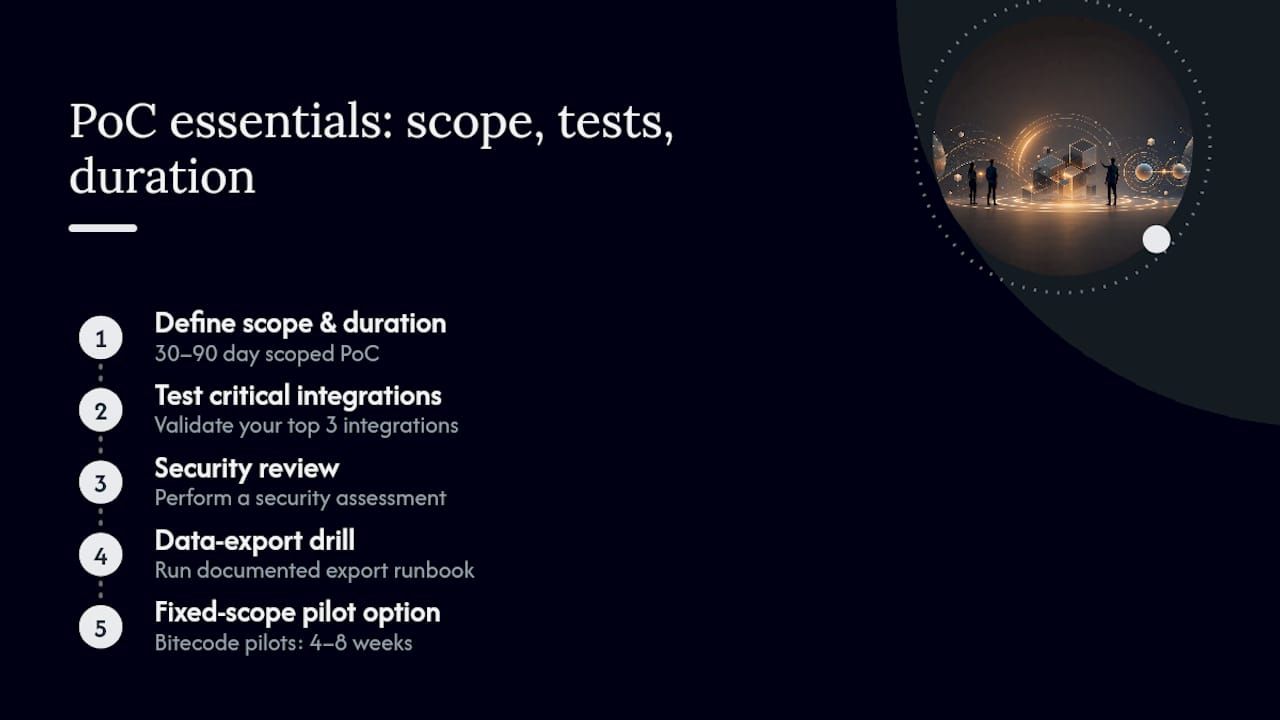
Evaluating integrations, extensibility, and exit strategy before committing is the single most important procurement step — many platforms make migrating apps difficult once production data is involved. A 30–90 day scoped PoC that tests your three most critical integrations, a security review, and a data-export drill is the minimum viable evaluation.
Bitecode structures pilot engagements as fixed-scope, time-boxed projects — typically 4–8 weeks — so teams validate the modular foundation against real business requirements before committing to full production scope.
Pro Tip: During any PoC, request a documented data-export runbook and test it. If the vendor cannot produce one, that is a vendor lock-in signal, not a minor gap.
The case for modular foundations over black-box platforms
The conventional wisdom in enterprise software procurement is that a recognized platform vendor may reduce risk. That framing is partially right and mostly misleading. A black-box platform does relocate risk — away from the build phase and into the vendor relationship, the upgrade cycle, and the contract renewal. Organizations that discover this after go-live face a harder problem than the one they started with.
The more useful frame, supported by HBR’s build-or-buy analysis, is: buy commodity capabilities, build what differentiates you, and compose the middle layer from pre-tested modular components. That third path — compose — is where Bitecode operates. It is not a platform license; it is a delivered system built from pre-validated modules, which means the organization owns the output and is not bound to a vendor’s roadmap.
Composing systems from low-code tools plus AI is now commercially viable for differentiated B2B workflows, and the governance responsibilities that come with AI-assisted development — documented data flows, secure model grounding, preproduction test cases — are built into Bitecode’s delivery process rather than left to the client to retrofit.
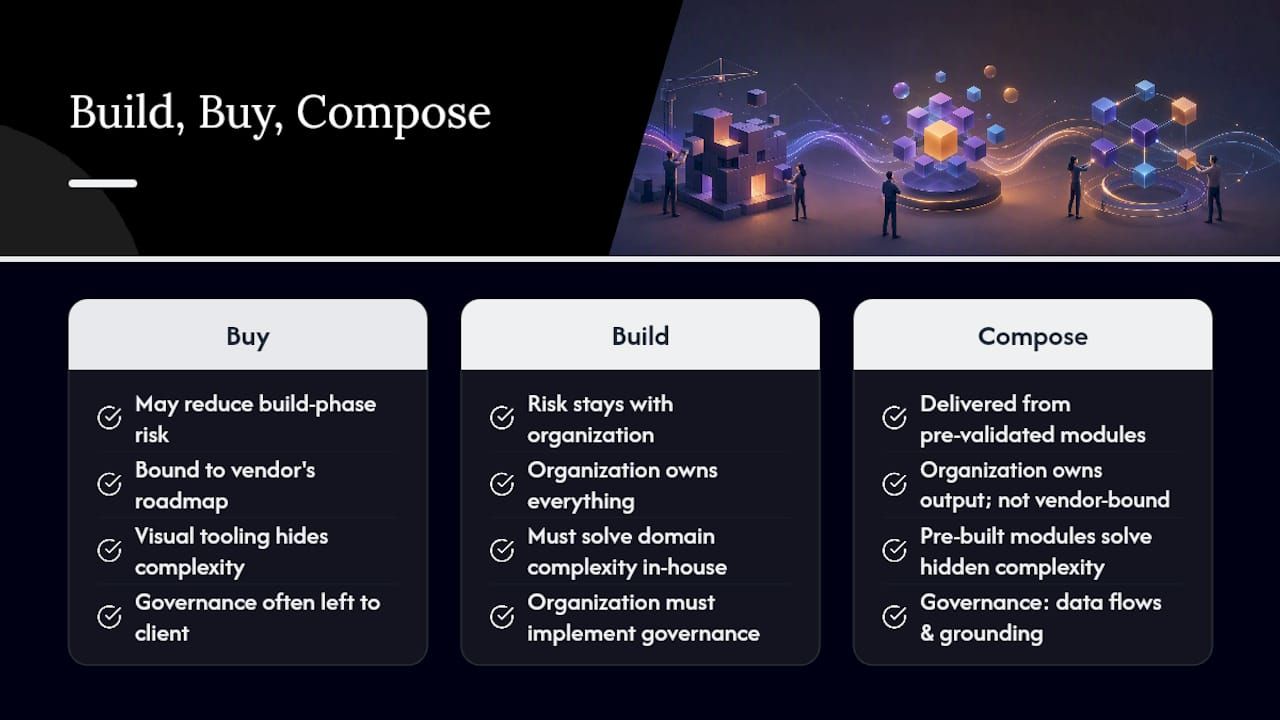
The teams that get this wrong typically underestimate business-domain complexity and overestimate how much a platform’s visual tooling will absorb it. A workflow that looks simple in a drag-and-drop editor often hides authorization logic, exception handling, and audit requirements that only surface in production. Pre-built modules that have already solved those problems in a real deployment are worth more than a clean UI.
Bitecode as a direct alternative to platform licensing
The platforms compared above are licenses. Bitecode is a delivered system. For organizations that need a custom enterprise application — AI automation, financial processing, blockchain integration, or a bespoke SaaS product — without a multi-year platform implementation, Bitecode’s modular approach starts with a large share of the baseline already built, enabling a production-ready pilot within weeks, not a six-month configuration project. Teams get full source ownership, self-hosting options, and a single accountable delivery partner. To scope a pilot or request RFP materials, visit the custom enterprise software service page.
Primary sources and next reads
- A Structured Evaluation Framework for Low-Code Platform Selection (arXiv) — adapt the five-criterion weighted model for your RFP scoring sheet
- MULTIMOORA comparative study of LCDPs (MDPI) — use the MCDM methodology to build objective vendor scoring tables
- How to choose a low-code or process automation platform (InfoWorld) — practical checklist for integrations, extensibility, and exit strategy
- How AI reshapes the build vs. buy decision (TechTarget) — governance risks of AI-assisted code generation
- 3 Ways to Rethink Your Build-or-Buy Strategy (HBR) — the buy/build/compose framework for procurement decisions
- Build vs. Buy Decision Framework (Peppereffect) — market context and compose-path viability for B2B workflows
- AI integration guide (Bitecode) — practical steps for AI-driven automation in modular systems
- Production-ready AI development (VibeProd) — external perspective on moving from AI-assisted prototypes to secure, production-grade systems
Sources
- 3 Ways to Rethink Your Build-or-Buy Strategy
- A Structured Evaluation Framework for Low-Code Platform Selection: A Multi-Criteria Decision Model for Enterprise Digital Transformation
- A comparative study of LCDPs using MULTIMOORA (MDPI)
- How to choose the right low-code, no-code, or process automation platform | InfoWorld
- Build vs Buy Software: The 2026 Decision Framework