Custom software development cost usually falls into three bands: a small MVP, a mid-market application, and an enterprise system. The figures vary with scope, technical complexity, and delivery model, so the most reliable estimate is a range with stated assumptions, not a single number. Below, we show how to map your project to a band and request a scoped estimate.
TL;DR:
- Plan roughly 4–9 months for a mid-market SaaS module with roles, dashboards, notifications, and integrations, plus a designer and dedicated QA.
- Integrations, data migration, licensing, hosting, and maintenance can push a project toward its band’s high end, so request separate lifecycle cost lines.
- Request low, expected, and high estimates with written assumptions and contingency, then split delivery into phases and estimate again at every milestone.
- Defects caught late can cost 10 to 100 times more to fix than defects found during design, so fund architecture and testing early.
- Fixed pricing suits a clearly defined scope, while time and materials fits exploratory work; compare subscription, hosting, support, and customization fees across multiple years.
How much does custom software cost by project size?
Treat the ranges below as illustrative planning bands, not quotes. They assume professional delivery with design, QA, and security included, and they shift with the seniority of the team you hire.
- Small apps and MVPs: a focused workflow tool with a handful of core features, typically at a relatively modest budget compared with larger systems.
- Mid-market applications: a SaaS module or internal system with roles, reporting, and a few integrations, commonly at a moderate budget compared with enterprise systems.
- Enterprise and highly complex systems: finance, blockchain, or multi-system platforms where budgets can be substantially higher.
- Hidden items that move every band: maintenance, integrations, data migration, and licensing often decide whether a project lands at the low or high end.
Labor assumptions matter as much as features. A senior-heavy team costs more per hour and often delivers faster with fewer defects, so compare total delivered cost, not hourly rates alone.
What drives the final price of custom software?
Several factors do most of the work. If you can score your project against each one, you can predict whether it sits at the low or high end of its band.
- Scope and feature count: every feature you break into finer detail adds design, build, and test effort.
- Technical complexity: custom algorithms, AI features, blockchain logic, and strict scale or performance targets act as multipliers on effort.
- Integrations and legacy systems: connections to ERPs, payment providers, and older databases add scope and risk. Our guide to enterprise software integration covers this in depth.
- Design and UX: bespoke interface work costs more than adapting a template.
- Data migration and quality: mapping, cleansing, and converting existing records is rarely trivial.
- Team composition and rates: product management, frontend, backend, QA, DevOps, and security each carry different pay levels.
- Maintenance, hosting, and licensing: lifecycle costs continue well after launch.
On labor, the median annual wage for software developers was $135,980 as of May 2025, with the lowest 10 percent earning under $82,460 and the highest 10 percent earning over $214,670. That spread explains why two quotes for the same scope can differ widely. The wage profile for QA analysts and testers shows the same effect: your role mix shapes your labor bill.
What do real project budgets look like?
Three vignettes make the bands concrete. All three assume a professional team, QA, and basic security hardening, and the dollar figures are illustrative planning ranges, not market data.
- MVP or small workflow app: core features such as user accounts, a main workflow, and basic reporting. Plan for a project lasting several months with a small team of a product lead, developers, and part-time QA. Budget: a relatively modest amount compared with larger projects.
- Mid-market SaaS module or internal app: role-based access, dashboards, notifications, and integrations. Plan on roughly 4–9 months with a team that adds a designer and dedicated QA. Budget: a moderate amount compared with enterprise projects.
- Enterprise finance or blockchain integration: audit trails, multi-currency logic, security review, and connections to existing systems. Plan for an extended project with a larger team including DevOps and security specialists. Budget: a substantial amount.
If your project has unclear requirements, expect to sit toward the top of its band until discovery narrows the scope.
How do you turn scope into a budget you can trust?
Good estimates come from a repeatable process, not a vendor’s first number. Use these steps to validate any proposal you receive.
- Ask for a range with a confidence level instead of a single-point quote.
- Split delivery into phases: build the MVP first, then iterate on the features with the most business value.
- Write down every assumption and add a contingency line for unknowns.
- Map lifecycle costs, including maintenance, hosting, support, and licensing.
- Set milestone acceptance criteria and re-estimate at each phase gate.
This approach matches what practitioners advise. Moving to high-level estimates that are refined iteratively tends to give better cost control than trying to lock every requirement and cost up front. Earlier federal reviews also found that contracting without clear requirements often led to overruns, and that phased contracts with independent estimate review reduced the risk. For lifecycle thinking, GAO’s cost estimation review stresses that reliable estimates are comprehensive, well documented, accurate, and credible.
Pro Tip: Ask every vendor to show the estimate as a low, expected, and high case, and to name the two assumptions most likely to push you toward the high case.
For a procurement-ready starting point, our software selection checklist works well when you prepare a request for proposal.
How can you reduce or control custom software costs?
Most savings come from decisions made before development starts. These tactics lower both cost and risk.
- Reuse modular components or low-code building blocks so you do not pay to rebuild standard functions such as accounts, billing, or workflows.
- Prioritize ruthlessly and defer features that do not affect launch value.
- Invest early in architecture and design. Industry material reports that defects found late can cost 10 to 100 times more to fix than those caught in design.
- Automate testing and use CI/CD so QA and release effort shrinks over time.
- Match the engagement model to uncertainty: fixed price for well-defined scope, time and materials for exploratory work.
Pro Tip: Run a short paid discovery phase before committing to a fixed price. It converts vague requirements into a scope a vendor can actually price.
Commercial discipline helps too. BCG’s analysis recommends a three-pronged approach to enterprise software costs: commercial measures, strict demand management, and continuous technical optimization. For a view on vendor type, see our comparison of a bespoke company versus a big agency.
How do licensing and subscription fees add up with modular components?
Modular components shift part of your spend from build effort to ongoing fees, so you need to see both sides of the ledger. Fee structures differ by vendor, and we do not publish fixed prices for our modules, so treat the categories below as a checklist of what to ask about.
- One-time license or setup fees: a charge for the component itself or for configuring it to your workflow.
- Recurring subscription fees: monthly or annual charges for hosted modules, often scaled by users, transactions, or usage tiers.
- Third-party licenses: payment processors, mapping services, AI model providers, and similar services billed separately from the module.
- Hosting and infrastructure: cloud costs that grow with traffic and data volume. A self-hosted module moves these costs onto your own infrastructure.
- Support and maintenance: updates, security patches, and service-level commitments, either bundled or priced as a percentage.
- Customization on top of the baseline: developer time to adapt a component to your rules, which is usually billed at project rates.
Ask each vendor for a multi-year view of these lines, not just year one. A subscription that looks cheap at launch can eventually overtake a one-time fee, and a module with heavy customization can erase the savings of reuse. Pricing models in SaaS also affect long-term cost, as this overview of SaaS growth and lower costs explains from the vendor-visibility side. The goal is a total cost of ownership comparison where every fee is named, dated, and attached to an owner.
Why reuse changes the cost math
Most overruns come from rebuilding things that already exist. Our position is that a pre-built baseline can shift a substantial part of a project from invention to configuration. We claim that a substantial part of a baseline system can be pre-built when a project starts from our modules, which is a vendor benefit you can check against any proposal.
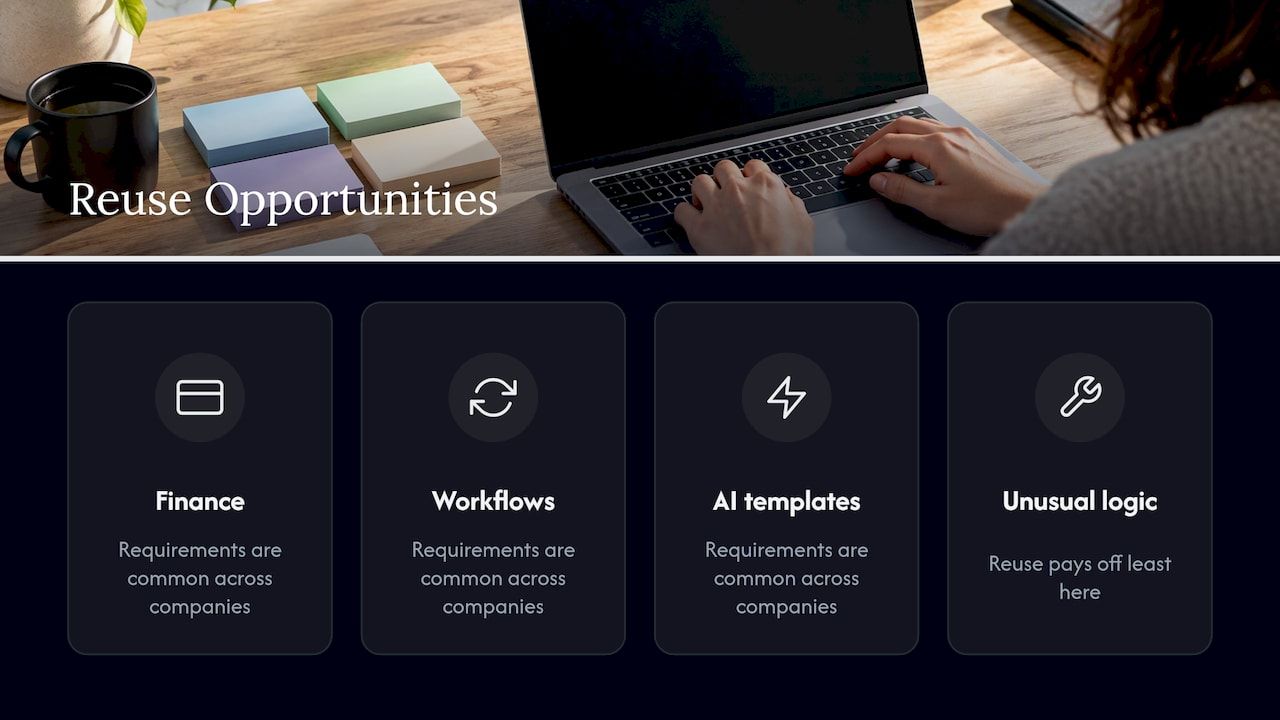
Reuse pays off most in finance modules, workflow automation, and AI assistant templates, where requirements are common across companies. It pays off least when your core business logic is unusual. Whatever vendor you choose, ask for a written reuse plan: which components are reused, which are custom, and how that changes the timeline.
— Bitecode
What can we build for you, and how do you get a scoped estimate?
We deliver faster, lower-risk implementations by starting from ready-made modules instead of a blank page. Our work covers a small MVP or larger software projects, custom business software, AI business process automation, and financial modules.
To get a scoped estimate, send us three things: your feature list, the systems you need to integrate with, and your desired timeline. We reply with a range and the assumptions behind it, so you can compare it against any other proposal. Start at Bitecode and tell us what you plan to build.
FAQ
How much does it cost to develop customized software?
Cost depends mainly on scope, complexity, and team composition. Small MVPs often cost far less than enterprise platforms, and the most reliable estimate is a range tied to documented assumptions. Labor is a major factor, since software developer pay varies widely by experience.
How much does it cost to install custom software?
Installation itself is usually a small line item compared with development. The larger costs are data migration, integration with existing systems, user training, and hosting setup. Ask for these as separate lines in your proposal so they do not surface late.
How much should software development cost?
It should cost what the agreed scope and quality bar require, expressed as a range with a contingency. A very low quote often signals missing scope, such as QA, security, or maintenance, which returns later as rework. Compare proposals on total lifecycle cost, not the build price alone.
Is fixed price or time and materials cheaper for custom software?
Neither is cheaper by default. Fixed price works for well-defined scope and shifts estimation risk to the vendor, who usually prices it in. Time and materials suits exploratory work where requirements will change, and it keeps you paying only for effort actually spent.
Sources
- Bls
- Taking Control of Enterprise Software Costs | BCG
- Gao
- Gary Petersen Shim Enterprise, Inc. CrossTalk, July 2004