AI cash forecasting replaces a spreadsheet that someone updates by hand with a model that reads your receivables, payables, bank and ERP data, forecasts each cash flow on its own pattern, and compares itself with actuals as they arrive. The model is the easy part. The value comes from the system around it: reliable data pipelines, explainable outputs and a routine for checking forecasts against reality. That is why most companies get further by building a forecasting layer on a modular financial foundation than by starting from a blank page or fitting their processes to a black-box tool. At Bitecode, we build custom enterprise systems from ready-made modules, including a Financial Module and an Automation Module, so the data work and the integration work start from a working base.
TL;DR
- AI cash forecasting predicts cash flows driver by driver, produces probabilistic scenarios and updates continuously. It does not just extend last year’s trend.
- Data quality decides the outcome. Reconciled bank balances, AR and AP detail, payroll and debt schedules come first, and the model second.
- Published results are encouraging: one treasury case study reports about a 25% accuracy improvement, but only after months of parallel running.
- Explainability and oversight matter as much as accuracy, especially in regulated environments.
- The practical path is a phased build on top of your existing ERP, banking and ledger systems, with a modular foundation shortening the route.
What AI adds to cash forecasting
A traditional cash forecast is a spreadsheet. Analysts pull balances, invoices and payment schedules, apply assumptions, and produce one number per period. It is slow to refresh, and it hides the assumptions behind that single number.
Gartner describes AI-enabled cash flow forecasting as driver-based, using traditional AI techniques to produce probabilistic, explainable forecasts that support liquidity planning and scenario analysis. Three practical differences follow from that description:
- Line-by-line logic. Payroll and rent have known dates and amounts, so they are handled by rules. Customer payments vary with behavior, so they are handled by predictive models trained on payment history.
- Ranges instead of a single figure. J.P. Morgan notes that AI can generate thousands of scenarios for stress testing and strengthen Monte Carlo simulations, which estimate how likely different outcomes are. A treasurer sees a probable band, not a promise.
- Continuous learning. Each week’s actuals feed back into the model, so estimates are replaced by observed behavior.
The same J.P. Morgan piece describes models that pull in ERP and CRM data and market feeds. For most mid-sized and large organizations, the first win comes from the internal data, especially the gap between invoice due dates and the dates customers actually pay.
The data a cash forecast needs
Every guide on this topic reaches the same conclusion: the forecast is only as good as the inputs. APQC lists the inputs a business needs as reconciled cash positions plus trusted receivables, payables, bank, payment and operating data, meaning:
- customer orders, invoices and expected payments;
- supplier invoices, approved purchases and payment schedules;
- bank and electronic funds transfer information;
- planned investments and expenditures, plus budget and operating-plan data;
- known changes in activity or timing, and documented assumptions about uncertain receipts and payments.
APQC’s preparation advice is operational: agree on common definitions, name data owners and source systems, set validation rules, and use automated checks to catch missing, duplicate, inconsistent or outdated records. Then test scenarios and compare the forecast with actual cash regularly.
U.S. Bank’s chief AI, data and innovation officer makes the same point from the banking side. Data sits in many places, from AR and AP ledgers to ERP systems, and the challenge is getting it into cash management technology reliably and repeatably, along with accurate current balances from every business unit and subsidiary.
Why integration is the real project
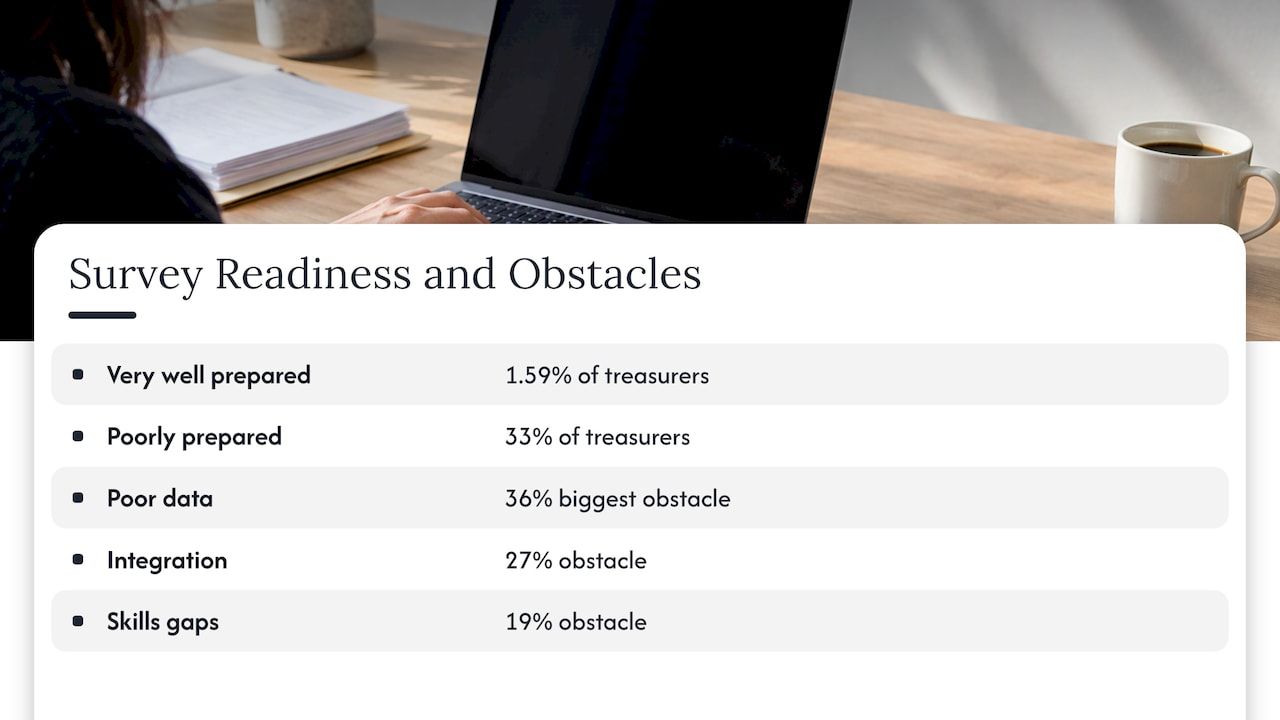
A EuroFinance survey of treasurers found that only 1.59% described their treasury data environment as very well prepared for AI-driven cash forecasting, 33% said it was poorly prepared, and 36% named poor underlying data as the biggest obstacle to trusting AI forecasts, ahead of system integration at 27% and skills gaps at 19%.
The same report quotes a practitioner on what goes wrong: poor data undermines AI forecasting as easily as it did traditional models, only faster. If one flow is misclassified, say accounts payable tagged as payroll, the model keeps forecasting that category wrong. Her advice, borrowed from a colleague, is to spend your time buying good fruit rather than the best blender.
For technical teams, this means the first build is a data layer: connectors to the ERP, bank feeds and ledgers, a shared chart of categories, and validation that runs before any model sees a record. It is the same plumbing that automation of cash application and financial reconciliation already depends on, so one investment serves several finance workflows.
How a forecasting model works in practice
In a well-designed setup, three layers do the work.
Ingestion and validation. Scheduled jobs pull balances, open invoices, payment runs and payroll calendars. Validation rules flag duplicates, stale records and unmapped categories, and route them to a named data owner.
Forecasting engine. Rule-based drivers handle flows with known dates. Statistical or machine learning models handle variable flows such as customer receipts. Initial models are commonly trained on a couple of years of history, so a company with a recent system migration should plan how to bring older records across.
Presentation and variance review. Forecasts are shown as ranges by entity, currency and horizon. Actuals are compared with the forecast on a rolling basis, and deviations are explained in plain language. Finance leaders act on a forecast they can interrogate, not on a score.
Rules or machine learning: a simple split
| Cash flow type | Typical method | Why |
|---|---|---|
| Payroll, rent, debt service | Rule-based driver | Dates and amounts are known |
| Customer receipts | Predictive model on payment history | Timing varies by customer behavior |
| Supplier payments | Driver plus approval-status logic | Depends on approvals and terms |
| One-off items (capex, tax, financing) | Planned inputs with documented assumptions | No history to learn from |
This split keeps the system explainable. Machine learning is used only where the pattern justifies it, and everything else stays auditable.
How accurate is it, and how to measure it
Vendors quote impressive numbers, so it helps to know what the independent evidence looks like.
- J.P. Morgan reports that case studies from multinational corporations show AI models reducing error rates by up to 50% against traditional methods, while stressing that results must be explainable in regulated environments.
- A NeuGroup member case study describes a global treasury that replaced a legacy process involving about 180 monthly forecasters with ML models. It reported roughly a 25% accuracy improvement, with 12 to 18 month forecasts averaging under 10% variance to actuals across 14 hedged currencies, and as low as 5% for some.
The second case matters for what it says about method. The team ran legacy and ML forecasts in parallel for about seven months, then spent three months with ML live and the legacy process as backup. Custom models were built for each currency, a multi-year effort. Treat the figures as a sign of what disciplined rollout can achieve, not as a default result.
A measurement routine that holds up
- Choose the horizon you care about (next week, 13 weeks, 12 months) and measure each separately.
- Compare forecast and actual by cash flow category, not only in total. Errors that cancel out in the total still point to a broken category.
- Track variance every week and log the cause of each large miss: data error, behavior change or one-off event.
- Run the new forecast in parallel with the old process until the variance record earns trust.
- Review model design on a schedule. Gartner warns that AI forecasts can look reliable while design choices embedded in the model introduce hidden risk, and advises CFOs to move oversight upstream, understanding how forecasts behave when conditions change instead of relying on variance review alone.
One practical habit follows: define in advance which new events the model cannot know about, such as a large acquisition, a regulatory change or a sudden market shift. AI models learn from historical patterns, so these events need human-entered scenarios.
Building it: a phased path
Teams that succeed rarely launch a company-wide forecast on day one. A sequence that works for mid-sized and large organizations:
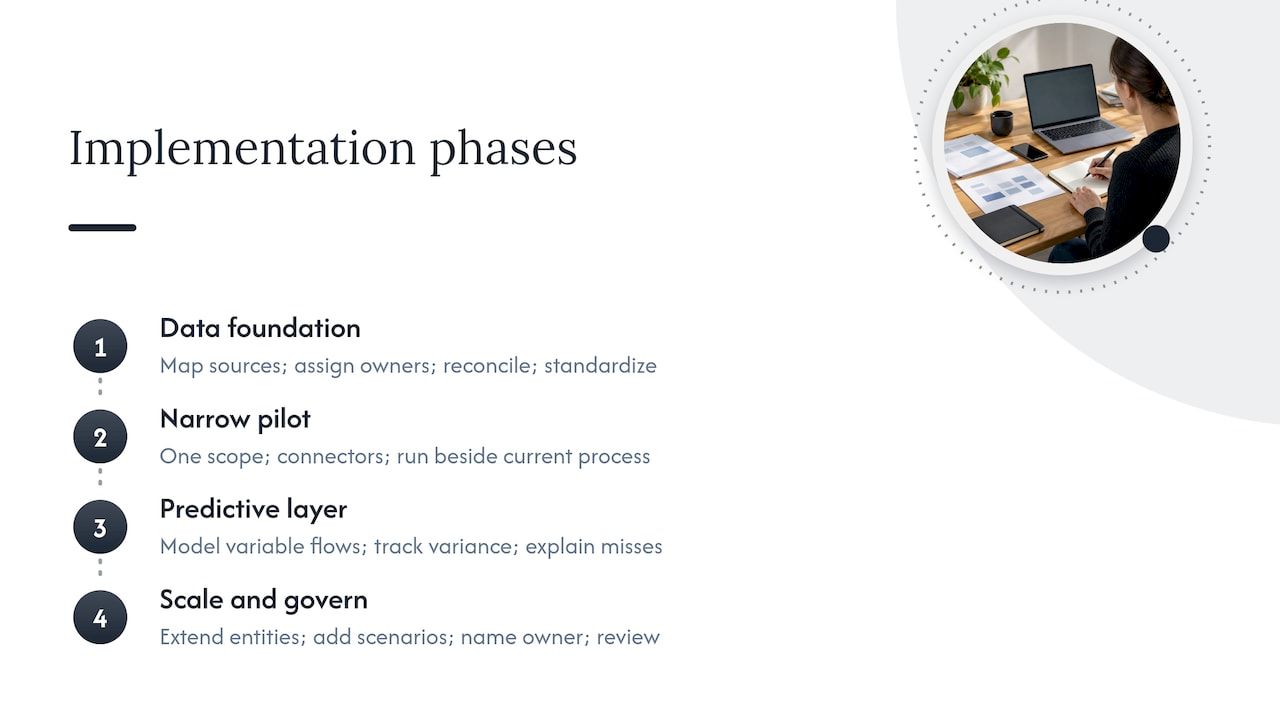
Phase 1: Data foundation. Map sources, assign owners, reconcile bank balances, and standardize categories. This phase decides the accuracy of everything after it. Plan real time for it, not a week.
Phase 2: A narrow pilot. Pick one entity, one currency or one business line. Build the connectors and the first driver-based forecast, then run it next to the existing process.
Phase 3: Predictive layer. Add models for variable flows such as customer receipts, with variance tracking and plain-language explanations of misses.
Phase 4: Scale and govern. Extend to more entities, add scenario tools, define ownership of the model, and set the review cycle. Gartner frames cash flow forecasting as a use case CFOs should assess, pilot and operationalize, which maps closely to these phases.
Teams planning the technical side can find broader guidance on using data for growth insights, including keeping data pipelines and reporting maintainable once they are live.
People are part of the build. Forecasting analysts spend less time collecting data and more time challenging assumptions, which is a change in working habits as much as a change in tools. Plan training and ownership alongside the software.
For a wider view of where finance teams are applying these methods, see our overview of AI applications in finance for enterprises, and our step-by-step guide to AI automation in fintech.
Where a modular foundation shortens the path
Two questions decide most cash forecasting projects: where the data will live and who controls the logic. A packaged tool gives you a fixed data model and a vendor-controlled roadmap. A from-scratch build gives you control but spends months on boilerplate: user management, audit trails, multi-currency handling, integration scaffolding.
A modular foundation addresses both. Bitecode starts projects with up to 60% of the baseline system pre-built from ready-made components, and our systems are multi-currency, audit-ready and can be self-hosted. For a forecasting project, that means the ledger, financial processing and workflow automation pieces exist before the forecasting-specific work begins. Your team spends its time on the parts that are unique to your business: your categories, your customer payment behavior, your approval rules.
The same logic applies to related treasury work. If you are weighing how much to assemble yourself, our article on build or buy for treasury automation walks through the decision, and the financial close automation guide shows why starting with one module is lower risk than a large program.
Perspective
Finance leaders often ask us which forecasting model to choose. We think the better question is where the data lives and who owns it.
A model can be replaced in a sprint. A fragmented data layer, with no audit trail and no agreed definitions, cannot. That is why we build forecasting capabilities on a modular foundation: the financial module, the automation module and the AI assistant give a team the controls, multi-currency handling and workflow logic first, and the predictive layer sits on top.
Our approach is designed to accelerate work without accelerating chaos. Starting with a large share of the system pre-built lets a team run a narrow pilot early, compare it with the existing process, and expand once the variance record supports it. Self-hosted options keep sensitive financial data inside the company’s own environment, and client-controlled customization keeps the logic in your hands rather than relocating complexity into a vendor relationship.
The result we aim for is a forecast your finance team can explain line by line.
Bitecode
Build a forecasting system with Bitecode
If you are planning cash forecasting as part of a wider finance system, we can scope it as a small MVP, such as a single-entity pilot, or as a larger program across entities and currencies. Our AI business process automation workflows cover the pipelines that feed a forecast, and our custom business software service builds the dashboards and controls around it. You can also browse the AI, financial and automation modules we start from, or talk to us through the Bitecode site.
Projects are scoped per engagement, so the first step is a conversation about your systems, entities and forecasting horizon.
FAQ
Can AI be used for forecasting cash flow?
Yes. AI forecasting models use payment history, invoices, bank data and planned expenses to predict cash flows and show a range of outcomes. They work best when the underlying data is reconciled and categorized consistently. Most teams start with one entity or business line and expand after comparing the forecast with actuals.
What data do I need for predictive cash forecasting?
At minimum: reconciled bank balances, receivables and payables detail, payroll calendar and amounts, and debt or lease schedules. Orders, budgets and known timing changes improve the forecast further. APQC also recommends documented assumptions and automated validation to catch duplicate, missing or outdated records.
Is AI cash forecasting more accurate than traditional methods?
Published case studies point that way. One treasury reported about a 25% accuracy improvement after a parallel run of several months, and J.P. Morgan cites error reductions of up to 50% in multinational case studies. Results depend on data quality and rollout discipline, so measure variance by category and horizon.
Can ChatGPT make a cash flow statement?
A general chatbot can help draft a statement or explain a format from figures you give it, but it does not replace a connected forecasting system. A cash flow statement in a three-statement model is a reconciliation of balance sheet changes, whereas a cash forecast predicts future receipts and payments from live data. Production forecasting needs validated feeds and an audit trail.
What are the main risks of AI cash forecasting?
Poor data, unexplained models and unprecedented events. Models learn from history, so sudden market shifts need human scenarios, and Gartner advises oversight of model design as well as variance review. Explainable outputs and a regular review cycle keep the forecast trustworthy.
Sources
- Gartner: AI Implementation Guide, Cash Flow Forecasting
- Gartner: How CFOs Can Manage the Hidden Risks of AI Forecasting
- APQC: How Can I Create an Accurate Cash Flow Forecast for My Business
- U.S. Bank: AI cash flow forecasting for capital advantage
- EuroFinance: AI in treasury
- J.P. Morgan: AI-Driven Cash Flow Forecasting, The Future of Treasury
- NeuGroup: Working Cash Flow Forecast Magic With Data Wizards and ML Models