API-first design means writing and publishing the API contract, typically as an OpenAPI document, before a single line of implementation code exists. Teams that adopt it get three concrete outcomes: frontend and backend work runs in parallel instead of sequentially, integration bugs drop because both sides build against the same machine-readable contract, and onboarding new consumers gets faster because the documentation already exists. The contract becomes the source of truth, not an afterthought written after the code ships.
TL;DR:
- API-first design relies on publishing a machine-readable contract, like OpenAPI, before coding begins, enabling parallel development and reducing integration bugs.
- It emphasizes designing the API contract first, collaborating across teams, and enforcing consistency through style guides and automated checks in CI.
- Tools like Spectral, Prism, and Pact support automated validation, mocking, and contract testing to maintain spec integrity and prevent drift.
- Governance involves a clear taxonomy, versioning policies, and enforceable style guides, with a recommended deprecation window of six to twelve months for breaking changes.
- Skip API-first for rapid prototyping or unstable domains, but for production APIs, a structured, contract-driven process improves long-term scalability and maintainability.
What Is API-First Design, and How Does It Differ From Code-First?
API-first design flips the traditional build order. Instead of writing server code and generating documentation afterward, teams design the API’s request and response structure, publish it as a formal specification, and only then start implementation. Code-first does the opposite: a developer builds the endpoint, and the “spec,” if it exists at all, is reverse-engineered from whatever the code happens to produce.
The distinction matters because API-first design actually operates on three layers that need separating. The data model describes the underlying entities. The object model describes how those entities are represented and related in the API’s responses. The API specification describes the actual contract, endpoints, parameters, status codes, and payloads a consumer will interact with. Conflating these three layers is how teams end up with APIs that leak database schema quirks straight into public responses.
Machine-readable specs are what make this whole approach work in practice. OpenAPI is the format nearly every tool in this space understands, which means one spec file can drive:
- Auto-generated documentation
- Mock servers for frontend teams
- Client SDKs in multiple languages
- Automated contract tests in CI
Without a machine-readable contract, none of that automation exists. You’re back to a wiki page and hope.
What Are the Core Principles Behind API-First Design?
API-first design rests on a handful of disciplines that separate teams who do it well from teams who bolt the label onto business as usual.
- Treat the API as a product. eBay’s developer ecosystem team redesigned its APIs around consumer needs rather than internal convenience, using a defined taxonomy and interface design method to keep the whole portfolio consistent. That product mindset, complete with documentation, changelogs, and a feedback loop, is what separates an API people actually adopt from one they tolerate.
- Design the contract first, then implement to it. The spec is the deliverable, not a byproduct.
- Collaborate across roles. Frontend, backend, QA, product, and external partners all review the contract before code is written, not after.
- Enforce consistency. Naming conventions, error formats, pagination patterns, and authentication schemes should look the same across every endpoint in the portfolio.
- Build in versioning discipline. Every API needs a stated policy for how it changes and how consumers get warned before something breaks.
Pro Tip: Write your error response format once, in the style guide, before you build a single endpoint. Retrofitting a consistent error shape across a dozen live APIs is one of the most painful cleanup jobs in software.
How Do You Implement API-First Design Step by Step?
Putting API-first into practice follows a repeatable sequence rather than a one-time decision.
- Design the contract collaboratively. Draft it in OpenAPI directly, or author it in TypeSpec and compile it down. TypeSpec’s declarative, code-like syntax makes large specs easier to maintain than hand-written YAML.
- Run stakeholder review and get consumer sign-off. Frontend leads, partner teams, and QA should all sign off on the shape of the contract before implementation starts.
- Generate mock servers and client stubs. Tools like Prism spin up a working mock straight from the spec, which unblocks frontend work while backend implementation is still in progress.
- Implement the server against the contract, then verify it matches using automated contract tests.
- Lint the spec and gate merges in CI. Automated style checks catch drift before it reaches production.
This sequence is what Swagger’s own explanation of the API-first approach describes as the mechanism behind parallel development: because both sides build against the same contract simultaneously, integration problems surface during design review instead of during a late-stage merge. Teams running joint design sessions on stacks like Spring Boot and React, for instance, benefit from structuring that collaboration around a shared contract from day one rather than negotiating payload shapes mid-sprint.
Common failure points at this stage:
- Skipping stakeholder review and discovering misalignment after implementation starts
- Treating the mock server as optional instead of the thing that actually unblocks parallel work
- Leaving spec linting out of CI, which lets drift creep back in within a few sprints
Which Tools and Standards Actually Power API-First Design?
OpenAPI is the baseline format almost every serious tool in this space speaks natively, and it’s where most teams publish their docs, whether through a dedicated developer portal or a public catalog like Api. Beyond that baseline, a handful of tools cover specific parts of the workflow:
- TypeSpec gives teams a declarative, code-like syntax for authoring contracts that compile to OpenAPI, which cuts down on the tedium of hand-writing large YAML files.
- Spectral enforces a style guide through linting rules, catching naming inconsistencies or missing error schemas before a merge goes through.
- Prism generates mock servers directly from an OpenAPI spec, letting frontend teams build against realistic responses before backend work is finished.
- Pact handles consumer-driven contract testing, verifying that a provider’s actual behavior still matches what consumers expect.
- OASDiff and similar diffing tools flag breaking changes between spec versions before they ship.
None of these replace judgment. They replace the manual, error-prone version of the same checks.
How Should Teams Govern and Version a Portfolio of APIs?
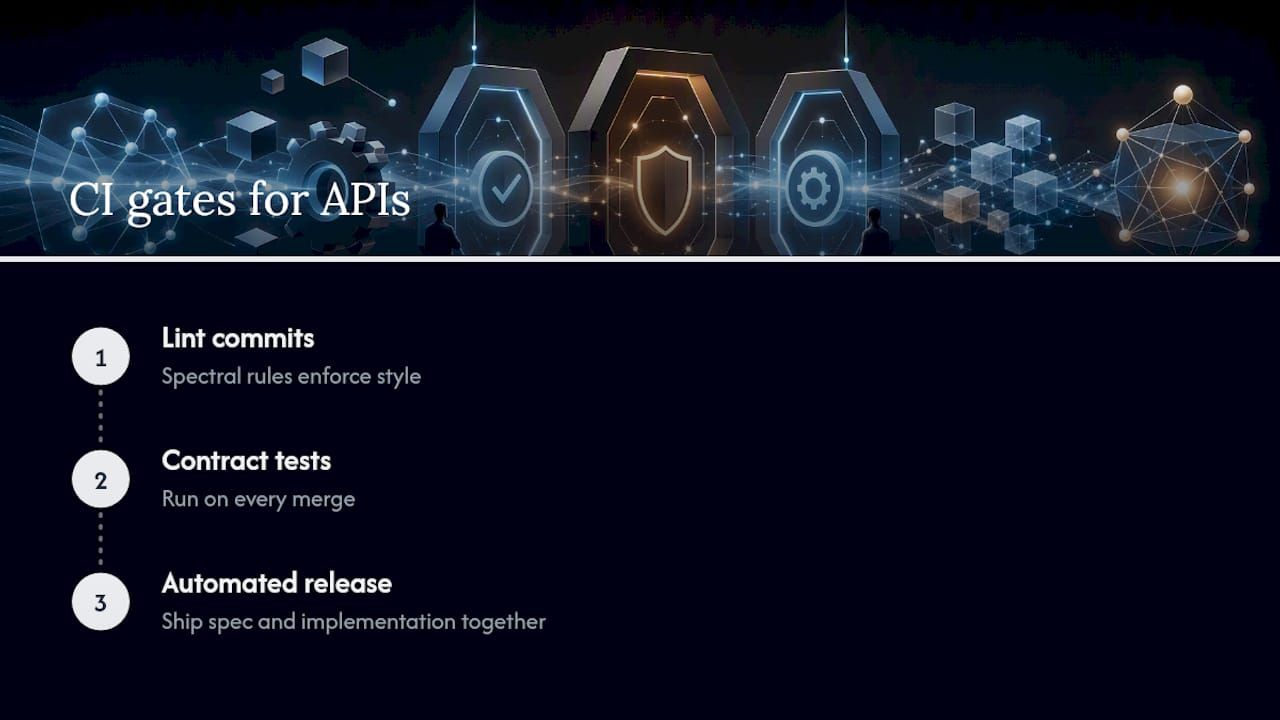
Governance starts with a written taxonomy and a style guide stored in version control, not in someone’s memory. That guide should cover naming, error formats, pagination, and auth, and it should be enforced automatically through Spectral rules in CI rather than through code review alone. A style guide nobody enforces is decoration.
Versioning strategy needs a deliberate choice early. Semantic versioning (major.minor.patch) suits APIs with a clear public contract and infrequent breaking changes. Date-based versioning suits APIs that evolve continuously and need a clear timeline of what changed when. Either way, publish the rule for how consumers get notified before a breaking change ships, and stick to it.
Pro Tip: Set a hard deprecation window, commonly six to twelve months, and put it in writing before you need it. Teams that improvise deprecation timelines under pressure almost always cut corners that break a partner integration downstream.
CI gates close the loop: lint on every commit, run contract tests on every merge, and automate the release so a spec change and its implementation ship together, never separately.
When Should You Skip API-First Design?
API-first design adds process overhead that isn’t worth paying in every situation.
- Rapid prototyping and early-stage MVPs, where the goal is validating an idea fast and the API’s shape will likely change entirely within weeks.
- Small, single-team internal APIs with one consumer and no external surface to protect.
- Genuinely unstable domains, where the data model itself is still being figured out and a formal spec would need rewriting every few days.
In those cases, a pragmatic middle ground works better: build a rough prototype first, then write the spec once the shape stabilizes. Reserve full contract-first rigor for APIs with real external consumers, partner integrations, or a public surface where breaking changes carry real cost.
How Do You Start an API-First Pilot in Your Organization?
A realistic pilot runs three to six months and follows a specific sequence rather than a big-bang rollout.
- Pick one representative API and name an actual owner accountable for its contract, not a committee.
- Write a short style guide, then enforce it immediately with Spectral rules in CI, not as a future cleanup task.
- Stand up mock servers and codegen so frontend and backend teams start working in parallel from day one.
- Add contract verification to CI and publish the spec to a central, searchable catalog rather than a shared drive.
- Review what broke or slowed the pilot, then adjust governance before rolling the approach out to a second and third API.
Architecture decisions made here echo well beyond the pilot. Teams weighing where the core API layer ends and the experience layer begins are effectively setting the enterprise system design pattern the rest of the portfolio will inherit.
How Does API-First Fit Into Modular Enterprise Development?
Design freezes only pay off if implementation can move fast right after. Bitecode builds custom enterprise systems from modular, ready-made components, which means a frozen contract can be implemented against a working baseline instead of a blank codebase. That’s the practical value of modular monoliths in custom development: less time spent scaffolding, more time spent honoring the contract you already designed.
— Bitecode
Get Help Piloting API-First Architecture
Running a spec-first pilot well takes more than picking a tool. It takes an implementation partner who can turn a frozen contract into working software fast, without rebuilding standard plumbing from zero every time. Bitecode starts custom enterprise projects with a modular baseline already in place, so once your API contract is locked, the build phase focuses on your business logic instead of boilerplate authentication, logging, and data access layers.
That modular foundation also supports the CI and contract testing practices this guide covers: automated linting, contract verification, and integration patterns fit naturally into systems built from reusable components rather than one-off code. If your team needs help translating an OpenAPI contract into a working, production-ready system, Bitecode’s custom software development service is built for exactly that handoff. For APIs that orchestrate business processes across systems, Bitecode’s automation service extends that same modular approach into workflow orchestration. Reach out to scope a pilot around your first API.
Where to Learn More About API-First Standards
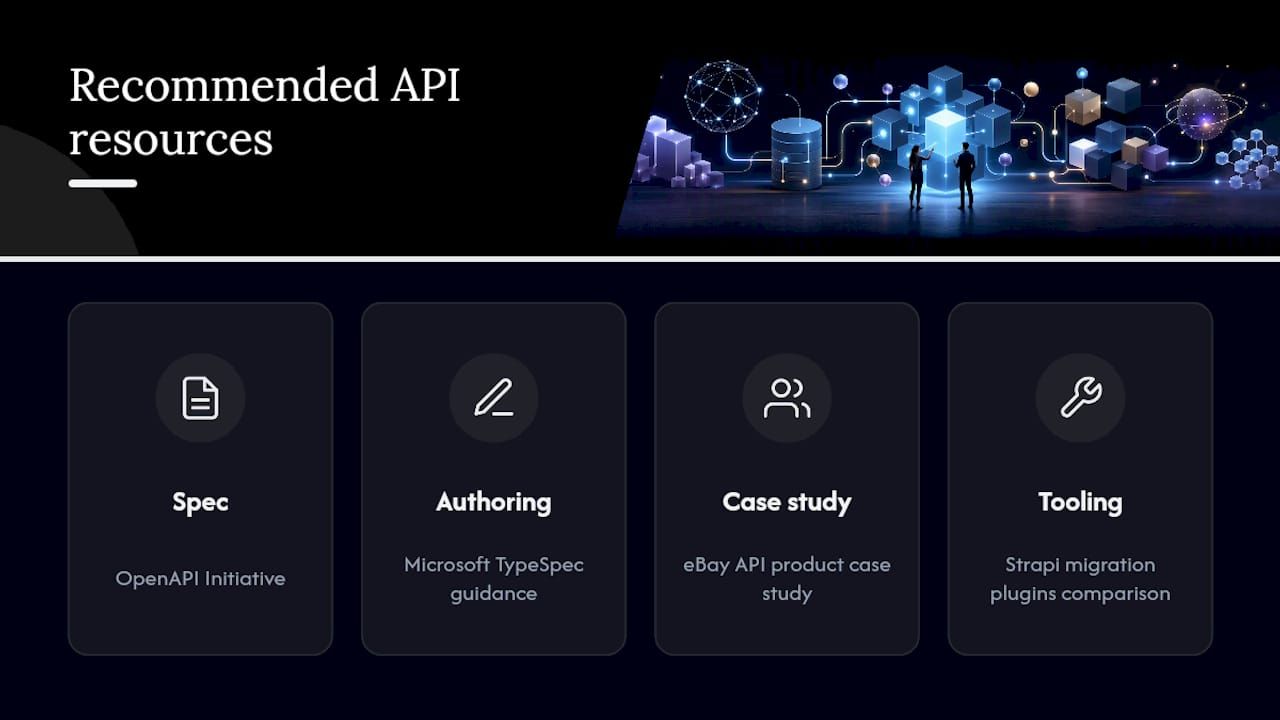
Start with the OpenAPI Initiative for the specification itself, Microsoft’s TypeSpec guidance for a code-like authoring workflow, and eBay’s API product case study for a real-world governance example. Teams choosing tooling around schema migrations may also find the comparison of Strapi migration plugins useful when versioning content models alongside API contracts.
Sources
- Design API first with TypeSpec — Microsoft ISE blog
- eBay developer ecosystem team — API product approach
- Openapis
FAQ
What Is API-First Design?
API-first design means writing and publishing the API’s contract, usually as an OpenAPI spec, before any implementation code exists, so every consumer builds against the same agreed structure from day one.
What Does API Stand For?
API stands for Application Programming Interface, a defined set of rules that lets one piece of software request data or functionality from another.
How Do You Avoid Spec Drift Once an API Ships?
Enforce the style guide with automated linting tools like Spectral in CI, add contract tests with a tool like Pact on every merge, and diff spec versions before release so breaking changes get caught before they reach a consumer.
When Should a Team Skip API-First and Just Build?
Skip formal contract-first design for early prototypes, single-team internal tools with no external consumers, or domains still too unstable for a spec to hold its shape for more than a few days.
Is API a Good Approach for Enterprise Software?
Yes. An API-centric architecture, with a stable core API layer and a separate experience layer, supports faster integration and cleaner scaling, which is why enterprise teams building modular systems lean on it for long-term maintainability.