Role-based access control (RBAC) grants system access based on assigned job roles rather than individual identities, governed by three primary rules: role assignment, role authorization, and permission authorization. Formalized by NIST and standardized as ANSI/INCITS 359, RBAC gives enterprises a way to scale authorization, enforce the least privilege, and satisfy compliance auditors without rebuilding permissions user by user.
TL;DR:
- Proper role design prevents role explosion by anchoring roles to job functions, avoiding creating unnecessary new roles for minor variations.
- Using role inheritance thoughtfully and documenting it reduces complexity and simplifies audits and separation-of-duty enforcement.
- Automating role provisioning, attestation, and permission recertification minimizes permission creep and ensures ongoing access accuracy.
- RBAC’s structured approach streamlines compliance evidence, aligning access controls with frameworks like HIPAA, PCI DSS, and NIST.
- Integrating RBAC into enterprise systems from the start avoids costly retrofits and supports automation, auditability, and scalable access management.
What Is Role-Based Access Control, According to NIST?
RBAC’s formal grounding traces back to a 1992 paper by David Ferraiolo and Rick Kuhn, later codified by NIST as ANSI/INCITS 359. The model replaced ad hoc, per-user permission grants with a structured layer: users get roles, roles get permissions, and permissions get enforced against resources. NIST also estimated measurable economic upside from this shift, citing faster provisioning and reduced administrative downtime as organizations adopted it at scale.
Three rules define how the model operates in practice:
- Role assignment: a user can exercise a permission only after being assigned a role that carries it.
- Role authorization: a user’s active role must be authorized for that user, closing the gap where someone claims a role they were never granted.
- Permission authorization: a role can exercise a permission only if that permission has been explicitly authorized for the role.
RBAC sits alongside older models like mandatory access control (MAC) and discretionary access control (DAC). It is policy-neutral enough to emulate both when configured with the right constraints, which is part of why it displaced flatter permission schemes in most enterprise environments.
What Are the RBAC Model Variants and Their Properties?
NIST IR 6192 breaks RBAC into three increasingly sophisticated levels, each adding structure without abandoning the core rules.
- Core (flat) RBAC covers the baseline: users, roles, permissions, and sessions, with no hierarchy. It suffices for smaller organizations or single-application deployments where job functions rarely overlap.
- Hierarchical RBAC introduces role inheritance, letting a “senior analyst” role inherit everything a “junior analyst” role can do, plus additional permissions. This cuts duplication but requires documented inheritance paths.
- Constrained RBAC layers in separation of duty (SoD). Static separation of duty (SSD) prevents a user from ever holding two conflicting roles, like “invoice creator” and “invoice approver.” Dynamic separation of duty (DSD) allows holding both roles but blocks activating them in the same session.
The NIST IR 6192 model treats static properties as fixed at role-definition time and dynamic properties as enforced at runtime, a distinction that matters when auditors ask how conflicts are prevented versus merely detected.
Why Does RBAC Matter for Enterprise Compliance and ROI?
Per-user access control lists (ACLs) scale linearly with headcount. Every new hire, transfer, or termination means someone manually edits permission entries across dozens of systems, and each manual edit is a chance for error. RBAC decouples that work: change a role’s permissions once, and every user assigned to it inherits the update automatically.
That structural difference also maps cleanly onto compliance frameworks. HIPAA’s minimum-necessary standard, PCI DSS’s access-control requirements, and NIST SP 800-53’s access-control family all expect organizations to demonstrate who can access what and why. Role-based structures give auditors a direct answer instead of a spreadsheet reconstruction project.
Statistic Callout: NIST’s research into RBAC adoption found that structured role-based provisioning meaningfully lowers administrative costs and downtime compared to identity-by-identity permission management, a big part of why it became the default model for large organizations.
How Do You Design Roles Without Causing Role Explosion?
Role explosion happens when teams create a new role for every minor variation in duties instead of asking whether an existing role, tweaked slightly, would do. It is the single most common failure mode in RBAC rollouts, and it is largely preventable with disciplined design.
- Anchor roles to job functions, not job titles. “Accounts Payable Clerk” is a role; “Sarah’s Access” is not. Naming should survive personnel turnover.
- Use hierarchy sparingly and document it. Every inheritance link is a dependency someone has to trace during an audit or an SoD review.
- Reach for attributes before you reach for a new role. If an exception depends on context (time of day, location, project assignment) rather than job function, that is an ABAC problem, not a reason to fork a role.
- Mine actual permissions before assigning roles. Pull existing entitlements and map them against real job tasks rather than guessing what a role “should” need.
Pro Tip: Run a pilot on one low-risk application before touching your ERP or financial systems. It surfaces naming problems, inheritance mistakes, and attestation gaps while the stakes are still low.
What Does an RBAC Implementation Checklist Look Like?
Rolling out RBAC across an enterprise works best as a phased program rather than a single cutover. A workable sequence:
- Inventory. Catalog every system, resource, and existing ACL entry. You cannot design roles around access you have not mapped.
- Design workshop. Bring in stakeholders from each business unit to build role templates and set acceptance criteria for what “correct” access looks like.
- Automate provisioning. Integrate an identity and access governance (IAG) platform with your identity provider, using SCIM or native connectors so role assignments sync automatically with HR systems.
- Pilot and phase. Roll out to one department, validate, then expand. Keep a documented rollback path in case a role definition breaks a workflow.
- Schedule attestation. Set recurring review cycles from day one, not as an afterthought once auditors ask for evidence.
Supporting practices that make each step stick:
- Assign an owner for every role, not just every system.
- Version role definitions so changes are traceable.
- Tie provisioning workflows to HR events (hire, transfer, termination) automatically.
A structured enterprise system design workflow helps keep the workshop phase from sprawling into an open-ended committee exercise.
How Do You Keep RBAC Clean Once It’s Running?
RBAC does not stay accurate on its own. Roles accumulate stale permissions as people change teams and nobody revokes what they no longer need, a pattern security teams call permission creep.
- Automated attestation cycles should ask managers to re-certify their team’s role assignments on a fixed schedule, not wait for an audit deadline to force the question.
- Permission creep detection works best when you track a small set of metrics: dormant privileged accounts, time since last access, and the percentage of users whose role no longer matches their department.
- Audit logging needs to capture who assigned which role, when, and under what approval, since that evidence is what shortens compliance reviews.
- Break-glass access for emergencies should be time-boxed, logged automatically, and reviewed within days, never left as a standing exception.
Statistic Callout: Governance programs that track attestation completion rate alongside time-to-provision catch stale access far earlier than those relying on annual audits alone, since dormant privileged accounts are usually where the most damaging creep hides.
An automation governance checklist built around these metrics turns attestation from a quarterly scramble into a background process.
RBAC vs. ABAC vs. ACLs: Which Model Fits?
ACLs attach permissions directly to a resource for specific users, which is precise but does not scale. RBAC groups permissions by role, trading some granularity for dramatically easier administration across hundreds or thousands of accounts. Attribute-based access control (ABAC) goes further, granting access based on real-time attributes like device, location, or project status.
- Keep ACLs for narrow, low-level resources where only a handful of people ever need access, such as a single shared file or a specific database table.
- Prefer RBAC as the baseline for anything organization-wide: applications, systems, and workflows tied to job function.
- Layer in ABAC when exceptions become frequent. If you are creating a new role every time someone needs temporary or context-dependent access, that is a sign to build an attribute policy instead.
The most durable pattern in practice is not choosing one model exclusively. It is running RBAC as the structural core and using ABAC rules for the contextual exceptions that would otherwise cause role explosion, while leaving ACLs in place for the handful of resources too narrow to justify a role.
How Is RBAC Used Across Different Industries?
RBAC’s flexibility shows up differently depending on what a sector needs to protect and prove.
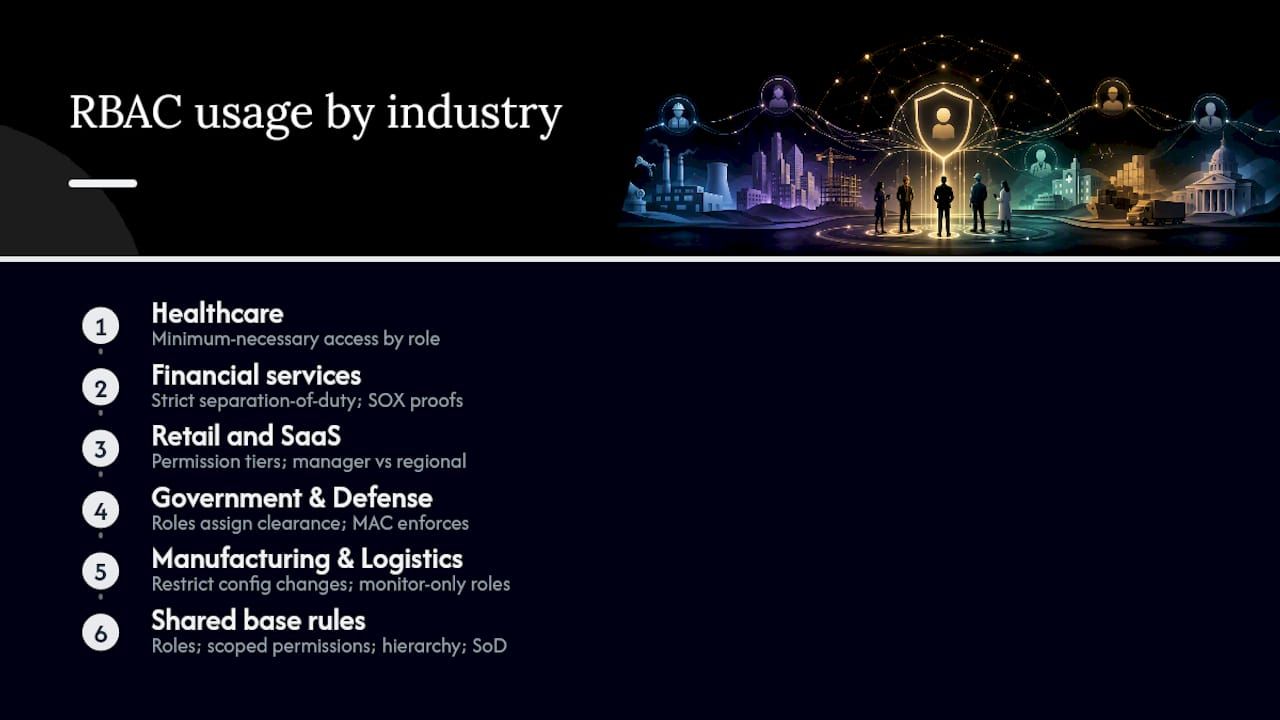
Healthcare systems use RBAC to enforce HIPAA’s minimum-necessary principle: a nurse role sees patient records for assigned wards, a billing role sees financial data but not clinical notes, and physician roles inherit broader clinical access through hierarchy.
Financial services lean on constrained RBAC heavily, since separation-of-duty violations there translate directly into fraud risk. A trader role and a settlement-approval role are kept in static conflict, and controls built for SOX IT compliance depend on being able to prove that separation held all year.
Retail and SaaS platforms use RBAC to manage internal staff access alongside customer-facing permission tiers, where a “store manager” role and a “regional admin” role inherit differently scoped views of the same sales data.
Government and defense systems often combine RBAC with mandatory access control, using roles to assign clearance-level permissions while MAC enforces the classification rules underneath.
Manufacturing and logistics apply RBAC to operational technology environments, restricting which roles can modify machine configurations versus simply monitor them, a distinction that matters as OT and IT networks converge.
Each of these deployments reuses the same three rules. What changes is how aggressively the organization applies hierarchy and separation-of-duty constraints on top of that base.
How Does RBAC Shape Security Policy and Compliance Programs?
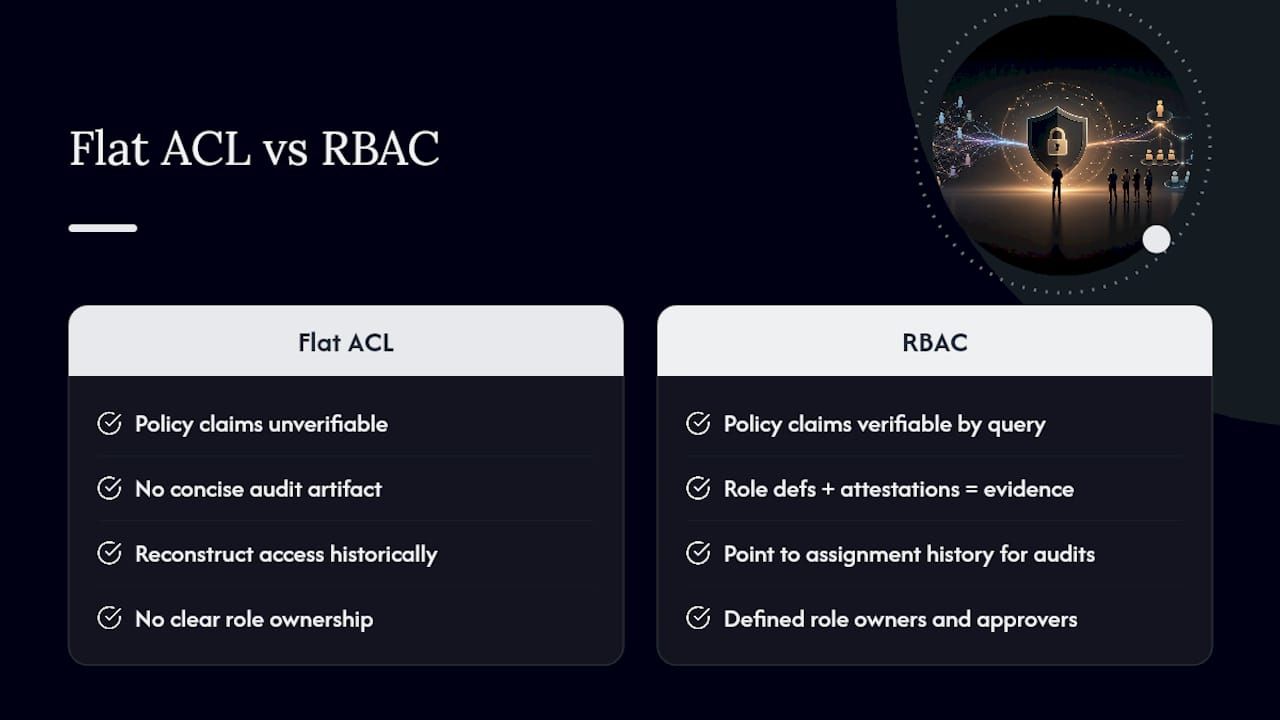
Adopting RBAC does not just change how permissions get assigned. It changes what a security policy can credibly claim. A policy that states “access follows least privilege” is unverifiable under a flat ACL system with thousands of individual grants. Under RBAC, that same claim becomes a query: pull the role definitions, show the permissions attached, done.
This shift matters most during audits. Instead of reconstructing who had access to what six months ago, compliance teams point to role definitions, assignment history, and attestation records. Frameworks like PCI DSS and NIST SP 800-53 explicitly expect this kind of evidence trail, and RBAC is the mechanism most organizations use to produce it without building bespoke logging for every system.
RBAC also forces a policy conversation that flat access control never requires: who owns a role, and who approves changes to it? That governance question, once answered, tends to tighten access review cycles across the whole organization, not just the systems RBAC directly controls. Separation-of-duty rules baked into constrained RBAC give policy writers a concrete enforcement mechanism instead of a paragraph that says “conflicting duties should be separated” with no way to verify it.
The net effect is that security policy stops being aspirational language and starts being something auditors can test against real configuration data, which is precisely why RBAC shows up in nearly every major compliance framework’s access-control section.
What Tools Support RBAC Management and Automation?
Most cloud platforms now ship RBAC natively rather than treating it as a bolt-on. Azure RBAC is a clear example: it defines principals, role definitions, and role assignments directly against Azure resources, letting administrators scope access down to a specific subscription or resource group without writing custom permission logic.
Identity governance and administration (IAG) platforms extend that further by automating the parts that break down at scale: attestation campaigns, SCIM-based provisioning, and connectors that sync role assignments with HR systems in real time. These platforms are where most of the “automated attestation” advice in this article actually gets executed, since manual spreadsheet reviews do not survive contact with a few thousand employees.
For teams building or customizing systems rather than buying off-the-shelf, open-source libraries like py-rbac implement NIST-style RBAC levels in code, giving developers a reference for how core, hierarchical, and constrained RBAC translate into actual data structures.
The common thread across all of these tools is that none of them replace the design work. Software can enforce a role hierarchy and automate a recertification campaign, but it cannot decide whether “Regional Sales Manager” should inherit from “Sales Rep” or stand alone. That decision still belongs to the people who understand the business.
Bitecode’s Perspective on Embedding RBAC Into Modular Systems
Most RBAC failures encountered in practice trace back to treating role design as a one-time project instead of a maintained artifact. Baseline role templates, paired with automated attestation, cut time-to-compliance considerably when built into a system from the start rather than retrofitted after an audit finding.
— Bitecode
Build RBAC Into Your Next Enterprise System
Retrofitting role-based access control into a legacy system usually costs more time than designing it in from the start. RBAC can be built directly into custom enterprise software using pre-built role and permission modules, so the access model does not have to wait until later phases of a development roadmap.

Starting projects with a substantial share of the baseline system already built allows RBAC, attestation workflows, and audit logging to be part of the initial deployment rather than a later change order. This is important for teams where compliance auditors expect role evidence from day one, not after backlog completion. Pairing RBAC structures with automated provisioning and attestation also keeps role reviews from becoming a quarterly fire drill.
If your organization needs a system where access control, financial processing, or workflow automation are designed together instead of bolted on separately, start with a scoped conversation about custom enterprise software development and get a concrete plan for what a modular, RBAC-ready build looks like for your systems.