PCI DSS scope covers every system that stores, processes, or transmits cardholder data, plus anything connected to or capable of affecting the security of that environment. The immediate action for any compliance team is to build a current, evidence-backed data-flow map and asset inventory before doing anything else. Segmentation and annual scope confirmation follow only once that foundation exists.
TL;DR:
- Building a current, evidence-backed data-flow map and asset inventory is essential before attempting scope reduction or segmentation.
- Cloud tagging, runtime discovery, and automated tools are critical for maintaining an accurate environment amid dynamic, ephemeral cloud resources.
- Modern microsegmentation and zero trust architectures can effectively isolate cardholder data, but encryption alone does not eliminate scope without proper key management.
- Vendor certifications like attestation of compliance are snapshots; ongoing contracts should specify continuous control monitoring and prompt notification of changes.
- Regular scope confirmation, especially after cloud migration or significant deployment updates, is vital to avoid assessment failures and maintain audit readiness.
Defining PCI DSS Scope: CDE, Connected-To, and Security-Impacting Systems
Scope determination starts with three categories, and misclassifying any one of them is the fastest route to a failed assessment. The Guidance for PCI DSS Scoping and Network Segmentation breaks the environment into system types that assessors expect to see mapped explicitly.
- Cardholder Data Environment (CDE): any system that stores, processes, or transmits primary account numbers (PAN) or sensitive authentication data (SAD), including databases, payment applications, and log files that inadvertently capture card data.
- Connected-to systems: components with network connectivity or logical access to the CDE, even without directly touching card data, such as jump servers, patch management tools, or a shared file share.
- Security-impacting systems: infrastructure that could affect CDE security if compromised, including authentication servers, key management systems, SIEM platforms, and remote access gateways.
- Physical and virtual assets: endpoints, virtual machines, cloud storage buckets, container orchestration control planes, and point-of-sale terminals all count if they meet the criteria above.
A system does not need to touch a card number to be in scope. It only needs the ability to reach something that does.
Mapping Data Flows and Building an Auditable Asset Inventory
Discovery is where most PCI DSS scoping efforts either succeed or quietly fail six months later. A one-time spreadsheet exercise cannot keep pace with cloud environments where instances spin up and disappear within minutes.
- Trace cardholder data end to end. Document every point where PAN or SAD is created, transmitted, stored, or logged, including backup jobs and third-party API calls that pass card data.
- Automate the inventory. Use cloud tagging, CMDB integrations, and runtime discovery for containers and serverless functions rather than manual asset lists that go stale within weeks.
- Correlate assets with identity and network topology. Cross-reference which service accounts, IAM roles, and network paths can reach the CDE to surface connected-to systems that manual reviews miss.
- Preserve the artifacts. Requirement 12.5.2 calls for documented evidence that scope was reviewed and confirmed, so keep dated diagrams, inventory exports, and sign-offs on file.
Pro Tip: Tag every cloud resource that could touch cardholder data with a standardized “cde” label, enforce that tag in your CI/CD pipeline, and run a weekly automated comparison of tagged assets against observed network flows. Untagged resources reaching the CDE are the scoping gaps assessors find first.
Segmentation and Scope Reduction: From VLANs to Zero Trust
Traditional network segmentation using VLANs and subnets still works, but it was never designed for workloads that live for minutes instead of years. Microsegmentation, identity-based access controls, and service mesh architectures now do the same job at the workload level, isolating traffic by service identity rather than by network address. PCI SSC’s information supplement on scoping and segmentation for modern network architectures explicitly addresses zero trust and multi-cloud deployments, and it treats scoping as a continuous process rather than an annual event.
Tokenization and point-to-point encryption (P2PE) reduce the footprint of in-scope systems, but neither eliminates PCI DSS applicability outright. Tokenization guidelines make clear that any component able to generate or retrieve a PAN remains part of the CDE — only systems storing tokens with no path back to the original PAN can be considered out of scope.
- Segmentation must give assessors reasonable assurance that out-of-scope systems cannot reach the CDE, verified through penetration testing and both network and host-based controls.
- Host firewalls, intrusion detection, and multi-factor authentication on administrative access all count as segmentation evidence, not just a single annual pentest.
- Encryption alone rarely de-scopes a system. If decryption keys or key management functions live inside the same environment, that environment stays in scope regardless of encryption strength.
Cloud and Third-Party Scoping: Shared Responsibility in Practice
Cloud deployments split PCI DSS obligations between the provider and the customer, and the split shifts depending on whether the service is IaaS, PaaS, or SaaS. An IaaS provider typically secures the physical infrastructure and hypervisor, leaving network configuration, patching, and application security to the customer. SaaS shifts more responsibility to the vendor, but the customer still owns access management and data governance.
Multi-tenant environments raise a specific problem: if a provider cannot demonstrate verifiable isolation between tenants, the shared infrastructure itself may pull the customer’s environment into scope. PCI SSC’s Cloud Computing Guidelines recommend requesting specific artifacts before signing any contract.
- The provider’s current Attestation of Compliance (AOC) and its effective date.
- A validated services list showing exactly which services the AOC covers.
- Segmentation test results demonstrating tenant isolation.
- Contract language specifying which controls the provider monitors continuously versus at point-in-time audits.
An AOC is a snapshot, not an ongoing guarantee. Contracts should require the provider to notify customers of material architecture changes that could affect that snapshot’s accuracy.
Choosing Between SAQ and QSA Validation Each Year
Self-Assessment Questionnaires work for merchants meeting specific transaction volume and risk criteria, while service providers are typically restricted to SAQ D or a full Qualified Security Assessor (QSA) review. The right path depends on card brand requirements and processing volume, not organizational preference.
Requirement 12.5.2 requires an annual scope confirmation regardless of which validation path applies. That confirmation needs supporting evidence, not just a checkbox.
- Updated data-flow diagrams reflecting any architecture changes made during the year.
- Segmentation test results proving isolation still holds.
- Approved Scanning Vendor (ASV) scan reports for external-facing systems.
- Current AOCs from every third-party provider touching the CDE.
The most common audit failure is not a missing control. It is a scope definition that no longer matches the environment because nobody updated it after a cloud migration or a new microservice deployment.
A Practical Scoping Checklist for Engineering Teams
Scoping breaks down when it lives in a compliance binder instead of the engineering workflow. Automated inventory and continuous discovery matter more than any single control because manual tracking cannot keep up with ephemeral cloud resources.
- Run automated discovery tools weekly against cloud accounts, container registries, and network flow logs.
- Gate infrastructure-as-code deployments so any resource touching the CDE requires a tagging and review step before merge.
- Sync your CMDB with runtime discovery data instead of relying on manually maintained spreadsheets.
- Fold scope review into change control, so a new service or vendor integration triggers a scoping assessment automatically.
- Build scoping checks into incident response playbooks, since a breach investigation moves faster with an accurate map already in hand.
Pro Tip: Treat every pull request that touches network policy, IAM roles, or storage configuration as a potential scope change. Reviewing infrastructure diffs against your CDE tag list catches scope creep before it reaches production. Bitecode’s guide to software development security covers how to bake these checks into a development pipeline without slowing releases.
Impact of Wireless and Mobile Devices on PCI DSS Scope
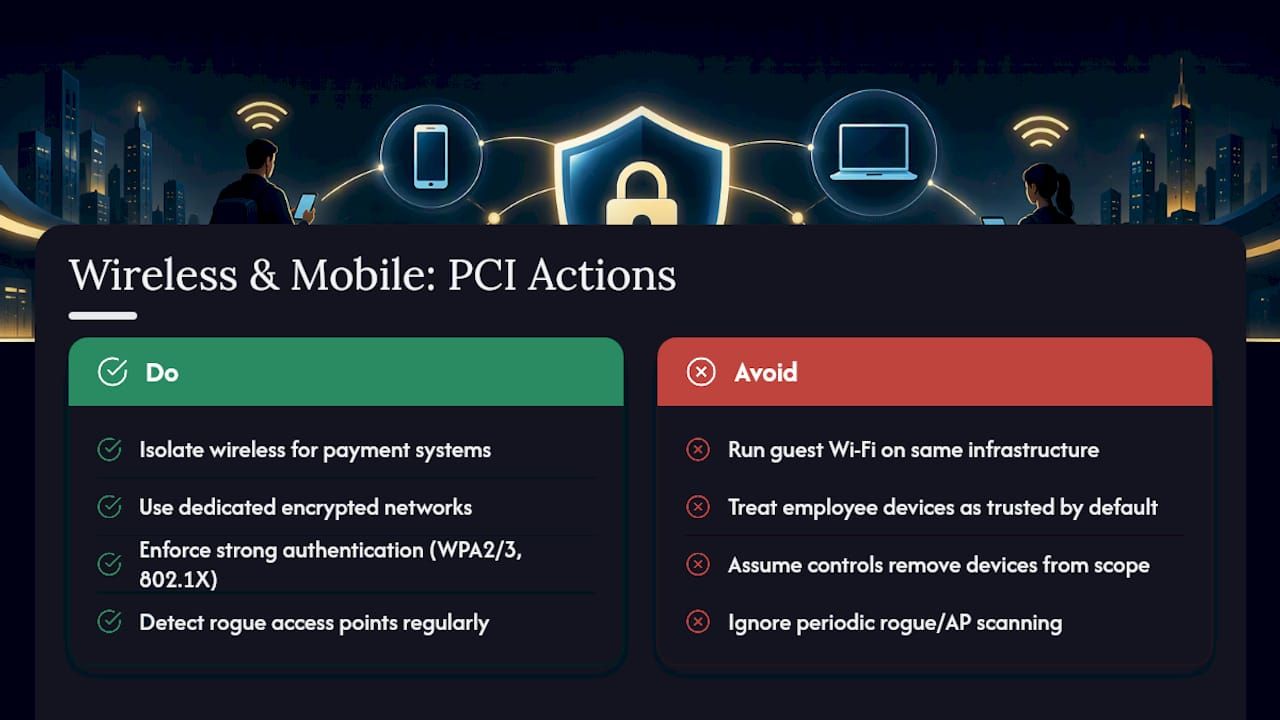
Wireless networks and mobile devices expand scope in ways that are easy to underestimate. Any wireless access point connected to the CDE, even indirectly, falls under PCI DSS requirements for encryption, authentication, and monitoring. A retail location running a guest Wi-Fi network on the same physical infrastructure as its point-of-sale terminals creates a connected-to relationship that assessors will flag immediately if segmentation isn’t verified.
Mobile point-of-sale (mPOS) devices introduce a different challenge. These devices process card data directly, which places them squarely inside the CDE, but they also connect over cellular or Wi-Fi networks that may not be under direct organizational control. Employee-owned devices used for administrative access to payment systems, sometimes under bring-your-own-device policies, count as connected-to systems the moment they can reach CDE resources, regardless of who owns the hardware.
The safest approach isolates wireless traffic touching payment systems onto dedicated, encrypted networks with strong authentication, separate from general corporate or guest Wi-Fi. Rogue access point detection matters too. An unauthorized wireless device placed near a point-of-sale terminal is a documented attack vector, and PCI DSS requires periodic scanning specifically to catch it. Mobile device management (MDM) enforcement, VPN requirements for remote access, and network access control lists that block unmanaged devices from reaching payment infrastructure all reduce the wireless attack surface. None of these controls remove wireless devices from scope entirely. They only make the boundary defensible when an assessor asks how isolation is enforced.
Role of Third-Party Vendors and How Their Systems Affect PCI DSS Scope
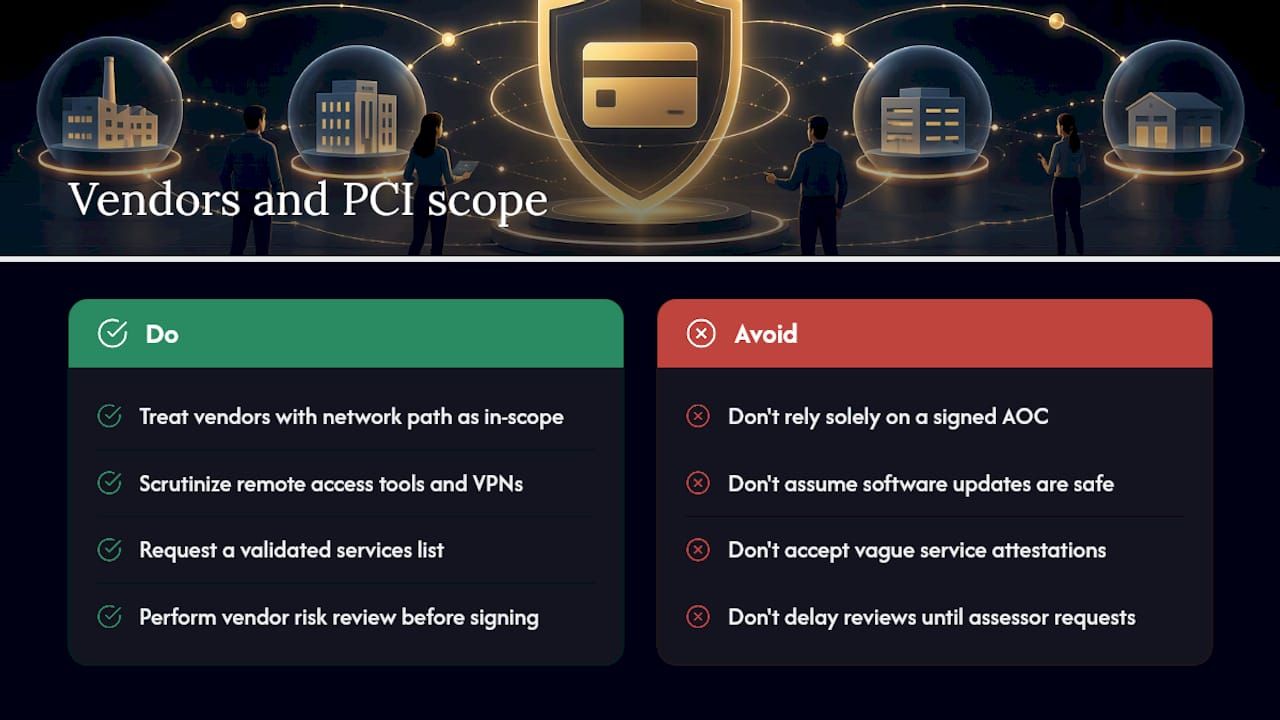
Every vendor with a network path to the CDE inherits a share of the compliance burden, whether that vendor is a payment gateway, a customer support platform with screen-sharing access, or a managed IT provider with remote administrative rights. The organization processing card data remains accountable for the full environment even when a vendor caused the exposure.
Remote access tools deserve particular scrutiny. A help desk vendor with standing VPN access to production systems is a connected-to system, and its security posture becomes part of the assessment whether or not the vendor ever touches a card number directly. The same logic applies to software vendors pushing updates into CDE-adjacent infrastructure, since a compromised update pipeline is a documented breach pattern in the payments industry.
Contract diligence has to go further than a signed AOC. Compliance teams should confirm what specific services that AOC actually validates, since a vendor’s attestation might cover only a subset of the product the organization actually uses. Requesting a validated services list, reviewing the vendor’s own sub-processor relationships, and building in a right-to-audit clause all reduce the risk of an unpleasant surprise mid-assessment. Vendors offering tokenization or payment processing services, such as those covered in discussions of payment system architecture changes, should be evaluated on whether their integration points genuinely isolate PAN from the merchant’s own systems or simply relocate the same exposure.
Vendor risk reviews work best when they happen before contract signature, not after an assessor asks for evidence the organization never collected.
Handling Scope When Using Virtualization and Containerization Technologies
Virtualization and containers changed how PCI DSS scope gets defined, because the old model of a server with a fixed IP address and a known physical location no longer applies. A hypervisor hosting both in-scope and out-of-scope virtual machines becomes a security-impacting system itself, since a hypervisor compromise could affect every guest running on it. That means the hypervisor management plane, and not just the individual VMs, requires the same hardening and monitoring as the CDE.
Containers raise a sharper version of the same problem. A single Kubernetes cluster running both payment processing pods and unrelated application workloads puts the entire cluster’s control plane in scope unless namespace isolation, network policies, and admission controls can demonstrate genuine separation. Shared container registries, shared secrets managers, and shared CI/CD pipelines used to build both in-scope and out-of-scope images all become connected-to systems if they lack strict access segmentation.
Ephemeral containers that exist for seconds create a documentation problem that traditional scoping methods were never built to solve. A container that processes a payment and terminates within thirty seconds still needs to be captured in the asset inventory at the moment it existed, which is why runtime discovery tools matter more here than in traditional infrastructure. Service mesh architectures can enforce mutual TLS and identity-based access between services, providing the kind of verifiable isolation that PCI SSC’s guidance on microsegmentation now explicitly recognizes as a valid scope-reduction technique. Bitecode’s overview of financial data security best practices covers architecture patterns that keep containerized payment workloads cleanly separated from general application infrastructure.
Updates in PCI DSS Scope Requirements for Emerging Technologies
IoT devices, connected point-of-sale peripherals, and edge computing nodes are pushing PCI DSS scoping into territory the original standard never anticipated. A smart payment terminal that also connects to inventory management systems or cloud analytics platforms creates data flows that are easy to miss during a scoping review focused on traditional network boundaries.
PCI SSC’s approach to this shift has been to provide general guidance rather than write device-specific rules for every new technology category. The scoping principles in PCI DSS v4.0.1 apply the same CDE and connected-to logic regardless of whether the device in question is a traditional server or an IoT sensor. That consistency is deliberate. It means a compliance team does not need a new framework every time a new device category appears. It also means the burden falls on the organization to correctly classify novel devices rather than waiting for explicit guidance naming that exact device type.
Edge computing complicates this further, since processing that once happened in a centralized, well-monitored data center now happens on distributed nodes that may have inconsistent patching and physical security. Any edge node handling authorization data, even temporarily, inherits full CDE obligations. Organizations deploying IoT devices anywhere near payment infrastructure should default to network isolation for those devices until a documented data flow assessment proves they have no path to cardholder data. Given how frequently IoT devices ship with weak default configurations, treating them as connected-to systems until proven otherwise is the more defensible position during an assessment.
Scoping as Continuous Security Engineering
Scope drifts the moment engineering teams treat it as a compliance checkbox instead of an architecture decision. The organizations that stay audit-ready build scoping into vendor contracts and CI/CD pipelines from day one, favoring automated discovery over annual scrambles. Innovation and auditability are not opposing goals when the inventory never goes stale.
— Bitecode
Building Audit-Ready Payment Systems Without the Rebuild
Reducing PCI DSS scope often comes down to architecture decisions made long before an assessor ever asks a question, and that’s where a modular build approach changes the economics. Bitecode starts payment and automation projects with up to 60% of the baseline system already built, which means scope-aware design patterns, tokenization-friendly data flows, and audit logging get built in from the first sprint instead of retrofitted after a failed assessment.
The Financial Module is built for exactly this kind of work: audit-ready payment processing components with the accounting, subscription, and audit trail infrastructure that compliance teams need documented from day one. Pair it with the Automation Module to keep infrastructure changes gated and logged, and with cloud application services when the environment needs a compliant, self-hosted deployment rather than a black-box SaaS dependency. If your team is scoping a new payment workflow or rebuilding one that’s outgrown its original architecture, talk to Bitecode about a project before the next assessment cycle forces the decision.
Sources
- New Information Supplement: PCI DSS Scoping and Segmentation Guidance for Modern Network Architectures
- Guidance for PCI DSS Scoping and Network Segmentation v1.1
FAQ
What Are the 12 Requirements of PCI DSS?
The 12 requirements cover building a secure network, protecting cardholder data, maintaining a vulnerability management program, implementing strong access controls, monitoring and testing networks regularly, and maintaining an information security policy. Each requirement applies specifically to systems within your defined PCI DSS scope, which is why accurate scoping determines how much of your environment those 12 requirements actually touch.
What Are the Six Major Goals of PCI DSS?
PCI DSS organizes its 12 requirements under six goals: building and maintaining a secure network, protecting cardholder data, maintaining a vulnerability management program, implementing strong access control measures, regularly monitoring and testing networks, and maintaining an information security policy. These goals apply to every system inside the cardholder data environment plus any connected-to or security-impacting system.
Is PCI DSS Still Relevant With Tokenization and Cloud Payments?
Yes, and arguably more relevant than ever, since tokenization and cloud architectures reduce but never eliminate scope. PCI SSC continues issuing updated guidance specifically for zero trust, microservices, and multi-cloud environments, which signals the standard is actively adapting rather than becoming obsolete.
What Does PCI DSS Stand For?
PCI DSS stands for Payment Card Industry Data Security Standard, a set of security requirements maintained by the PCI Security Standards Council for any organization that stores, processes, or transmits cardholder data. The standard applies globally across merchants, service providers, and payment processors regardless of transaction volume.
How Often Does PCI DSS Scope Need to Be Reconfirmed?
Scope confirmation is required at least annually under Requirement 12.5.2, though any significant architecture change, such as a cloud migration or new vendor integration, should trigger an immediate scope review. Waiting for the annual cycle to catch a mid-year change is one of the most common causes of failed assessments.
Can Bitecode Help Reduce PCI DSS Scope in a New Build?
Bitecode’s Financial Module and cloud application services are designed with audit-ready, scope-aware architecture patterns built in from the start, which reduces the retrofitting work typically needed to isolate payment data flows. Project pricing depends on scope and is available directly through Bitecode’s services page.