Use REST for public and edge APIs, gRPC for internal low-latency hot paths, and event-driven messaging when a service needs to react to something without blocking the producer. The real trade-off is not which protocol wins. It is how much latency, coupling, and operational complexity your team can absorb per interaction. REST is simple and universally compatible; gRPC trades that simplicity for speed and strict contracts via Protocol Buffers; Kafka-style event streams trade immediate consistency for resilience and decoupling.
TL;DR:
- REST remains the default for public APIs due to its simplicity and universal compatibility, despite larger payloads and lack of native schema enforcement.
- gRPC offers lower latency, binary serialization with Protocol Buffers, and strict contracts but requires a proxy for browser clients and is primarily suited for internal networks.
- Asynchronous messaging with event streams like Kafka decouples traffic effectively, but introduces eventual consistency and complexity in handling duplicate messages and failure management.
- Resilience tools such as retries, circuit breakers, and load balancing are essential for production service calls, while a service mesh adds overhead but eases large-scale management.
- Start with simple, well-defined interfaces and incrementally adopt advanced protocols or patterns only when operational scale or latency demands justify it.
What Is Microservices Communication, and How Does Sync Differ From Async?
Microservices communication is the set of protocols and patterns services use to exchange data and trigger work across a distributed system. Every interaction between two services falls into one of two buckets, and misclassifying it is the most common source of fragile architecture: synchronous request/response or asynchronous message passing. Microsoft’s Azure architecture guidance frames these as the two foundational patterns underlying nearly every interservice design decision.
Synchronous communication means the caller blocks until it gets an answer. A checkout service calling an inventory service to check stock before confirming an order is synchronous by necessity. Asynchronous communication means the sender fires a message and moves on, trusting the receiver to process it eventually. An order confirmation triggering three downstream events (email, analytics, loyalty points) is asynchronous by design.
Within those two buckets, three interaction primitives cover almost every real case:
- Query: a synchronous read, like a basket lookup that needs the current cart state before rendering a page.
- Command: a synchronous or asynchronous instruction that changes state, like “ship this order,” which may be issued over REST or dropped onto a queue.
- Event: a fact broadcast after something happened, like “order confirmed,” consumed by zero, one, or a dozen downstream services without the publisher knowing or caring who’s listening.
The trade-offs compound quickly. Synchronous calls give you immediate responsiveness and simpler debugging, since the failure surfaces right where it happened. But every synchronous hop adds temporal coupling: if the inventory service is down, checkout is down too. Asynchronous flows decouple failure domains but introduce a lag between cause and effect, and that lag is exactly where subtle bugs (stale reads, out-of-order processing) tend to hide.
Which Protocol Should You Use: REST, gRPC, or a Message Broker?
Each protocol optimizes for a different constraint, and picking one without naming that constraint is how teams end up rewriting their transport layer eighteen months in.
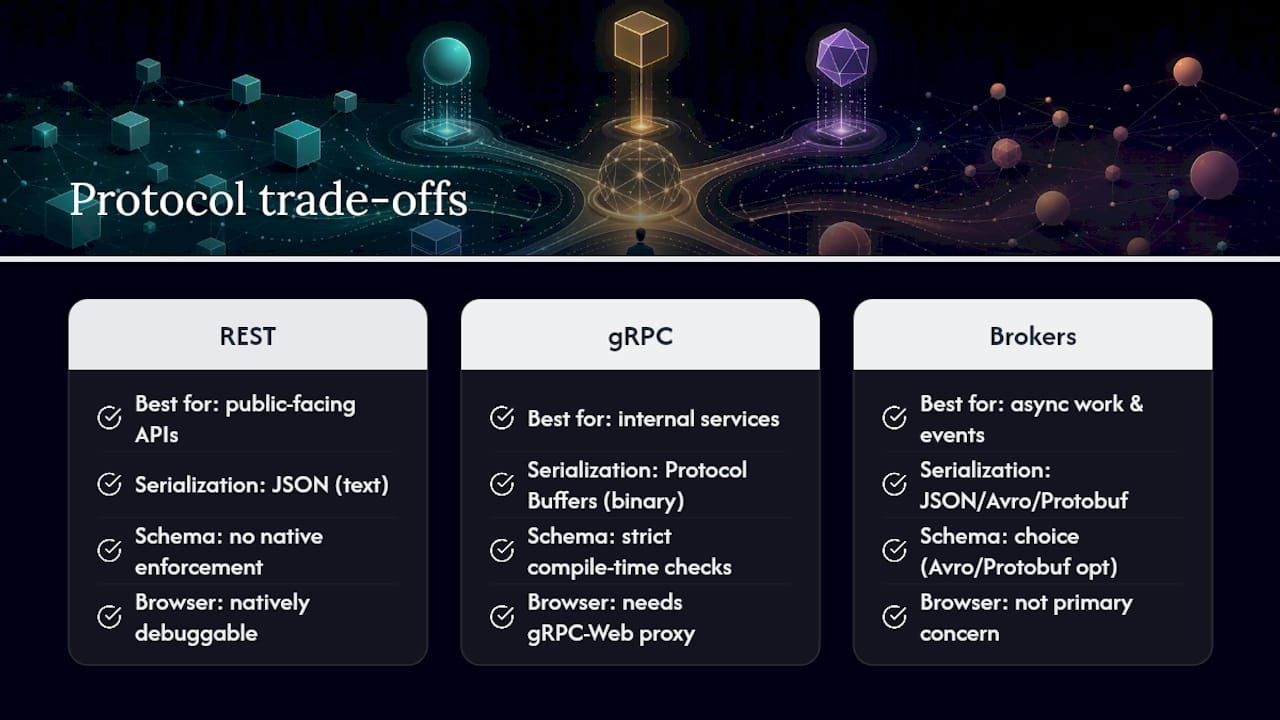
REST over HTTP with JSON remains the default for anything public-facing. It’s human-readable, cacheable, debuggable with a browser tab, and every language and tool understands it without extra tooling. Its weakness is verbosity: JSON payloads are larger than binary alternatives, and REST has no native contract enforcement, so schema drift between client and server is a runtime surprise rather than a compile-time error.
gRPC runs over HTTP/2 and serializes payloads with Protocol Buffers, a binary format that’s smaller and faster to parse than JSON. It supports four call modes: unary, server streaming, client streaming, and bidirectional streaming, which REST has no clean equivalent for. Because Protobuf enforces a strict schema contract, breaking changes get caught at build time instead of in production logs. The catch: browsers can’t speak gRPC natively, so public-facing gRPC needs a gRPC-Web proxy layer, and that’s part of why AWS’s own comparison treats gRPC as an internal-network tool rather than an edge protocol.
Message brokers and event streams (Kafka, RabbitMQ) operate on a different axis entirely: topics versus queues. A queue delivers each message to exactly one consumer, useful for distributing work across a pool of workers. A topic broadcasts to every subscriber, which is what Apache Kafka is built around at scale, using partitions to sustain high-throughput event streaming across thousands of consumers. Serialization here is your choice: JSON for simplicity, Avro or Protobuf when you need schema evolution guarantees.
Statistic to know: teams that migrate hot internal paths from REST to gRPC often report lower tail latency, according to Toptal’s practitioner analysis, but that gain only shows up when both ends of the call are under your own team’s control. Public APIs consumed by third parties gain little from the switch since the client tooling and debugging ecosystem still favor REST.
How Do You Design Synchronous Communication Without Creating a Fragile Call Chain?
Synchronous patterns fail predictably: one slow downstream service becomes everyone’s problem. Three patterns keep that risk contained.
- API gateway: a single entry point that handles authentication, rate limiting, and protocol translation, so individual services don’t each reimplement auth logic or expose raw internal contracts to the outside world.
- Aggregator (Backend-for-Frontend): a layer that fans out to multiple services and stitches the results into one response, cutting down on chatty round trips a mobile client would otherwise make directly.
- Request-reply over a queue: the caller publishes a request message and waits on a correlation ID for a reply, keeping the semantics of synchronous communication without a raw blocking HTTP connection tying up threads.
The most common anti-pattern is a service that calls three other services synchronously just to assemble one page. Every one of those calls is a chance for the whole request to fail. The remedy is usually a materialized view: instead of calling the pricing service, inventory service, and reviews service on every product page load, maintain a denormalized read model updated by events, and query that instead.
Pro Tip: Cache aggressively at the aggregator layer, but set a short time-to-live on anything tied to inventory or pricing. Stale product descriptions are harmless; stale stock counts cost you refunds.
What Asynchronous Patterns Keep Event-Driven Microservices Reliable?
Asynchronous microservices live or die on two decisions: queue or topic, and how you guarantee a message actually gets published.
Choose a queue when exactly one consumer should process each message, like a pool of workers handling image resizing jobs. Choose a topic (pub/sub) when multiple independent services need to react to the same fact, like an “order placed” event triggering billing, shipping, and analytics simultaneously without any of them knowing about the others.
The hardest reliability problem in async microservices data exchange is the dual-write: updating your database and publishing an event are two separate operations, and a crash between them silently drops the event. The outbox pattern solves this by writing the event to an outbox table in the same transaction as the business data, then a separate relay process publishes it to the broker. Microsoft’s guidance on microservice communication treats this as close to mandatory for any service that both writes state and emits events.
Because brokers guarantee at-least-once delivery, not exactly-once, consumers will occasionally see the same message twice. Idempotent consumer design (checking a message ID against a processed-messages table before acting) prevents duplicate side effects like double-charging a customer. Pair that with correlation IDs threaded through every hop so you can trace one business transaction across a dozen asynchronous handoffs.
- Use event sourcing only when you need a full audit trail or the ability to replay history, since it adds real complexity to every read path.
- Expect eventual consistency: a read right after a White may return stale data for milliseconds to seconds, depending on your broker’s throughput.
- Log every consumer’s last-processed offset so a stuck consumer is visible before it becomes a backlog crisis.
Pro Tip: Store correlation IDs and message IDs in your logging pipeline from day one. Retrofitting traceability after a production incident is far more expensive than building it in up front.
How Do You Make Service-to-Service Calls Resilient in Production?
Resilience in distributed systems isn’t optional polish. It’s the direct consequence of an uncomfortable truth: networks fail, and the Fallacies of Distributed Computing exist precisely because engineers keep assuming otherwise.
Statistic to know: Microsoft’s architecture guidance names retries, circuit breakers, load balancing, and service meshes as the four standard tools for building resiliency into interservice calls, and treats skipping them as a design gap, not an optimization.
- Retries should be bounded, use exponential backoff with jitter, and only apply to idempotent operations. Retrying a non-idempotent “charge card” call without deduplication logic is how double billing happens.
- Circuit breakers stop calling a failing downstream service after a threshold of failures, giving it room to recover instead of getting hammered by retry storms from every upstream caller.
- Bulkheading isolates resource pools per dependency, so a slow database connection pool for one service doesn’t starve threads needed by an unrelated call.
- Load balancing differs meaningfully by protocol: gRPC’s persistent HTTP/2 connections mean a naive load balancer sends every call down one connection, so gRPC typically needs client-side load balancing or an Envoy-style proxy in Kubernetes, a detail Toptal’s comparison notes. REST’s stateless connections spread more naturally across a standard load balancer.
- Distributed tracing with correlation IDs, combined with dashboards for latency percentiles (especially p99, not just averages), error rates, and queue depth, turns an opaque call chain into something you can actually debug at 2 a.m.
Does Your System Need a Service Mesh?
A service mesh solves a specific problem: once you have dozens of services, hand-rolling mTLS, retries, and telemetry into every codebase becomes unsustainable. A mesh moves that logic into a sidecar proxy, giving you mutual TLS, automatic retries, circuit breaking, fine-grained telemetry, and traffic-aware load balancing without touching application code.
The cost is real. Sidecars add latency and memory overhead per pod, and now you’re operating an entirely new piece of infrastructure with its own failure modes and upgrade cycle. Adopting a mesh before you need one just relocates complexity from your services into your platform team’s on-call rotation.
A short adoption checklist:
- You’re running enough services on Kubernetes that per-service resilience libraries have become inconsistent or unmaintained.
- Your platform team has the operational maturity to run and upgrade a mesh control plane.
- You need uniform mTLS and traffic policy across teams that can’t be trusted to implement it consistently themselves.
- You’ve already tried library-based resilience (retry logic, client-side load balancing) and hit its ceiling.
If none of those apply, a well-maintained resilience library embedded in your service code gets you most of the benefit at a fraction of the operational cost, and it’s the more pragmatic starting point for teams under a certain scale.
Which Communication Pattern Fits Each Interaction? A Five-Dimension Rubric
Score every interaction on five dimensions before picking a pattern:
- Latency sensitivity: does the caller need an answer in milliseconds, or can it wait?
- Temporal coupling: must both services be online simultaneously for this to work?
- Schema coupling: how often does this contract change, and how painful is a breaking change?
- Debugging complexity: can you trace a failure in one hop, or does it require correlating across a broker?
- Operational cost: what infrastructure and on-call burden does this pattern add?
FreeCodeCamp’s analysis of production systems finds most mature architectures blend all three approaches rather than standardizing on one, mapping each interaction to whichever pattern scores best on these five axes.
Applied to common flows: a public product catalog API scores high on schema stability and low on latency sensitivity, so REST fits. An internal fraud-check call in a payment flow scores high on latency sensitivity and low on schema volatility between two teams you control, so gRPC fits. A “user signed up” trigger that fans out to welcome emails, CRM sync, and analytics scores high on temporal decoupling need, so it belongs on an event bus.
Migrating an existing REST-only system toward this mix works best incrementally: use the strangler fig approach, standing up gRPC or event-driven paths alongside existing REST endpoints, then routing traffic gradually at the API gateway as confidence grows, rather than a big-bang rewrite.
What Do Practitioners Get Wrong About Rolling Out Microservices Communication?
Teams often reach for full interservice messaging before they’ve earned the complexity. Bitecode’s engineering approach starts new builds as a modular monolith, which keeps early interservice chatter to a minimum while the domain boundaries are still shifting, and starts projects with up to 60% of the baseline system pre-built from modular components. That head start matters most when a client needs custom business software that has to integrate financial processing or automation from day one, not bolt it on later.
Before extracting any service or wiring up a broker, three things should be true: your data contracts are versioned and reviewed, you have a test plan that covers async failure and replay scenarios, and observability (tracing, correlation IDs, dashboards) is in place before the first message ships, not after the first incident.
How Does Data Consistency Shape Which Pattern You Choose?
Every communication choice is also a consistency choice, whether or not the team names it that way. Synchronous calls default toward strong consistency: the caller gets a real-time answer that reflects the current state, because it waited for it. That’s why query interactions like inventory checks or price lookups usually stay synchronous. Get it wrong and you sell something you don’t have.
Asynchronous, event-driven flows default toward eventual consistency: a consumer might read stale data for a window of time between the event being published and every downstream service catching up. That’s an acceptable trade in a lot of business flows (a loyalty point balance updating a few seconds late is a non-event) and unacceptable in others (a fraud check that runs against yesterday’s transaction history is a real risk).
The mistake teams make is picking a consistency model implicitly, by picking a protocol first, instead of deciding what the business actually requires and then choosing the protocol that delivers it. A financial ledger update usually demands strong consistency and a synchronous, transactional write. A recommendation engine updating based on browsing behavior can tolerate eventual consistency measured in minutes. Mapping consistency requirements onto interactions before choosing REST, gRPC, or an event stream prevents a whole category of production incidents where “the numbers don’t match” turns into a multi-day investigation.
Sagas (chains of local transactions coordinated through events, with compensating actions for rollback) are the standard way to maintain data integrity across services that individually only support eventual consistency, without resorting to a distributed transaction protocol that would reintroduce the coupling everyone was trying to avoid.
How Do You Secure Communication Between Microservices?
Every interservice call is a potential attack surface, and the number of calls in a distributed system means the exposure multiplies fast compared to a single monolith with one perimeter.
Authentication confirms which service (or user, on behalf of a service) is making the call. Mutual TLS (mTLS) is the standard for service-to-service authentication, since it verifies both sides of the connection rather than just the client, and it’s one of the core features a service mesh automates across an entire fleet without touching application code.
Authorization determines what an authenticated caller is allowed to do. Token-based schemes (OAuth 2.0, JWTs scoped to specific claims) let a gateway or individual service check permissions without a round trip to a central auth server on every request, which matters for latency in gRPC hot paths especially.
Encryption in transit should be non-negotiable for both REST and gRPC traffic, even inside a private network, since internal networks get breached too. gRPC’s HTTP/2 foundation supports TLS natively, and REST over HTTPS is the baseline expectation for any API in 2026.
For asynchronous flows, security gets less attention than it deserves. Message brokers need their own access controls: not every service should be able to publish to or subscribe from every topic. Encrypting message payloads at rest in the broker, not just in transit, matters for anything touching financial or personal data, and it’s a requirement Bitecode builds into its financial module work by default rather than treating it as an add-on.
The Simplicity-First Perspective
Start with the smallest surface area and the clearest contracts. Add gRPC or a mesh only once real latency and scale numbers demand it, and verify every change with observability, not assumptions.
— Bitecode
How Bitecode Helps You Build the Right Communication Layer
Bitecode is the alternative to hiring a traditional development shop to figure out your service boundaries from scratch: projects start with up to 60% of the baseline system already built from modular components, so the API layer, event handling, and integration scaffolding aren’t something you’re paying to reinvent.
If your team is weighing REST against gRPC against an event bus for a real project, that decision usually shows up early in an architecture audit or a small MVP engagement, not after months of build-out. Bitecode’s custom software development work covers exactly this kind of interservice design, and the automation workflows service handles the event-driven side when your system needs services reacting to each other without manual glue code. For teams already running on Kubernetes and evaluating whether a mesh or managed cloud infrastructure fits, the cloud systems service covers that ground too. Start with a small MVP engagement to validate the communication pattern before committing to a full rollout.
Sources
- Service-to-Service communication (Microsoft) - Interservice communication
- Service-to-service communication: When to use REST, gRPC and event-driven messaging (FreeCodeCamp)
- REST vs gRPC (Baeldung)
- gRPC vs REST - Difference Between Application Designs - AWS
FAQ
How Do Microservices Communicate With Each Other?
Microservices communicate synchronously over REST or gRPC when one service needs an immediate answer, or asynchronously through a message broker like Kafka or RabbitMQ when a service just needs to announce that something happened.
What Are the Core Principles Behind Microservices Architecture?
Common principles include single responsibility per service, independent deployability, decentralized data management, failure isolation, contract-based communication, observability, and automation of testing and deployment. Different sources phrase the exact list differently, but these themes recur across most architecture guidance.
Is Apache Kafka a Microservice?
No. Kafka is a distributed event streaming platform that microservices use as a message broker, not a microservice itself. It provides the topics and partitions that let services publish and consume events at high throughput.
Is Microservices Architecture Still Relevant in 2026?
Yes. Most production systems still rely on microservices, though the trend has shifted toward pairing them with modular monolith starting points to avoid premature interservice complexity before service boundaries are proven. The pattern hasn’t declined so much as matured toward more deliberate adoption.
Should a New Project Start With REST, gRPC, or Events?
Start with REST for external-facing endpoints and keep the internal architecture as a modular monolith until real latency or team-scaling pressure justifies splitting out gRPC hot paths or an event bus, an approach Bitecode applies by default on new builds.