TL;DR:
- Cloud computing entails layered service models and deployment strategies that impact business scalability, cost management, and data security. Effective cloud adoption requires understanding foundational traits, selecting appropriate service and deployment models, and implementing disciplined governance to prevent cost overruns and operational inefficiencies. Successful organizations view cloud as a strategic, long-term architectural commitment that fosters innovation rather than just a cost-saving migration.
Most executives think cloud computing means storing files somewhere online. That framing understates the reality by a wide margin. Explaining cloud-based solutions accurately requires covering a layered architecture of service models, deployment strategies, and operational disciplines that directly affect how your business scales, manages costs, and protects data. This article cuts through the surface-level descriptions and gives decision-makers and IT managers the structured understanding needed to evaluate, select, and govern cloud environments with confidence.
Key takeaways
| Point | Details |
|---|---|
| Cloud has five defining traits | On-demand access, elasticity, and measured service distinguish cloud from traditional hosting. |
| Service model affects your workload | IaaS, PaaS, and SaaS each shift a different portion of management responsibility to the provider. |
| Deployment choice involves real trade-offs | Public, private, and hybrid cloud differ significantly in cost, control, and compliance exposure. |
| Governance prevents financial waste | Without active management and FinOps discipline, cloud environments accumulate unnecessary costs quickly. |
| Migration is not modernization | Moving workloads to cloud without re-architecting them often preserves the same inefficiencies at higher cost. |
Explaining cloud-based solutions from the ground up
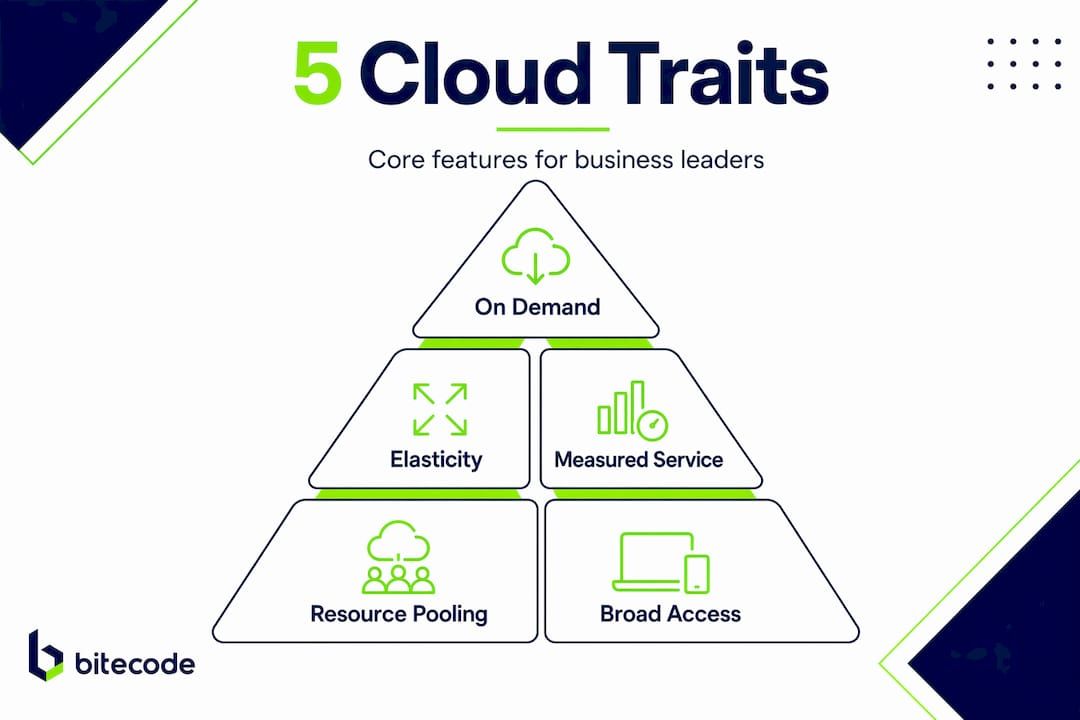
Cloud computing is not a single product. It is a delivery model for computing resources — servers, storage, databases, networking, software — provided over the internet on a consumption basis. The most authoritative starting point comes from NIST SP 800-145, which defines cloud computing through five essential characteristics: on-demand self-service, broad network access, resource pooling, rapid elasticity, and measured service.
Each characteristic carries operational weight for businesses. On-demand self-service means your teams can provision compute capacity without opening a procurement ticket. Broad network access means those resources are reachable from any authorized device. Resource pooling means a provider services multiple customers from shared infrastructure, which creates cost efficiency at scale. Rapid elasticity means capacity adjusts to demand. Measured service means you pay for what you consume.
That last pair matters most for understanding cloud economics. Cloud provisioning shifts from the traditional model of ordering hardware weeks in advance to scaling up or down in minutes, matching actual workload patterns rather than peak estimates. Companies that previously over-provisioned servers to handle quarterly spikes now pay only during those spikes.
Pro Tip: When presenting cloud to a skeptical CFO, frame rapid elasticity and measured service as the answer to over-provisioning costs. Most finance teams understand paying for actual consumption better than they understand infrastructure abstraction layers.
Understanding cloud solutions at this foundational level clarifies why the conversation goes well beyond storage. Service models and deployment configurations sit on top of these five characteristics, and each layer introduces a distinct set of decisions for IT and business leaders.
Cloud service models: IaaS, PaaS, and SaaS
The three primary service models define where the dividing line between provider responsibility and customer responsibility falls. Getting this wrong is how organizations end up managing more infrastructure than they intended, or less control than their compliance posture requires.
| Model | What the provider manages | What you manage | Typical use case |
|---|---|---|---|
| IaaS | Physical hardware, virtualization, networking | OS, middleware, applications, data | Custom workloads, dev/test environments |
| PaaS | Everything in IaaS plus OS and runtime | Applications and data | Application development without infrastructure overhead |
| SaaS | The full technology stack | User configuration and data | CRM, email, collaboration tools |
Infrastructure as a Service (IaaS) gives your team raw compute, storage, and networking. You control everything above the hypervisor. That flexibility also means your team owns OS patching, security configuration, and performance tuning. AWS, Azure, and Google Cloud all offer IaaS as their foundational layer.

Platform as a Service (PaaS) removes the operating system layer from your team’s scope. Developers deploy applications into a managed runtime without caring about the underlying infrastructure. This works well for organizations building custom applications but not running the infrastructure that hosts them.
Software as a Service (SaaS) represents the highest abstraction. SaaS applications are accessed via web browser with the provider managing updates, security patches, and infrastructure entirely. Adoption is fast precisely because the operational footprint for the customer is minimal. For organizations reviewing SaaS automation ROI, the gains compound when SaaS tools connect to automated workflows rather than operating in silos.
Security responsibilities shift with each model. The shared responsibility model means AWS, for example, secures physical infrastructure and the hypervisor. Customers remain responsible for identity and access management, data encryption, and configuration regardless of which service model they use. In IaaS, customers also own OS patching. In SaaS, they do not. Misunderstanding this boundary is one of the most common sources of misconfiguration-related breaches.
Pro Tip: Before selecting a service model, map your team’s actual capacity to manage infrastructure. Organizations that underestimate the management burden of IaaS often drift toward PaaS or SaaS over time, which can mean reworking configurations mid-project.
Cloud deployment models and their trade-offs
Service models describe what you access. Deployment models describe where those resources live and who controls the underlying infrastructure.
- Public cloud runs on infrastructure shared with other tenants, owned and operated by a provider like AWS, Azure, or Google Cloud. The cost efficiency is real, but so are the data residency and isolation concerns for regulated industries.
- Private cloud dedicates infrastructure to a single organization, either on-premises or hosted by a third party. Control and compliance are stronger. Cost is higher, and the operational burden of maintaining that environment belongs to your team.
- Community cloud shares infrastructure among organizations with common requirements, such as healthcare entities with similar HIPAA obligations. It is less common but worth understanding for sectors where shared compliance frameworks reduce individual cost.
- Hybrid cloud connects private and public environments, allowing workloads to move between them based on policy. The practical benefits are real — keeping sensitive data on-premises while bursting compute to public cloud for non-sensitive workloads. The complexity is also real. Governance and network architecture become significantly more involved.
Deployment model selection depends on compliance requirements, cost constraints, and how much control the organization needs over its environment. A financial services firm with strict data residency requirements faces fundamentally different constraints than a SaaS startup with no regulated data.
For organizations considering hybrid environments, putting hybrid models into practice requires clear policies about which workloads go where and why. Without that discipline, hybrid deployments accumulate the complexity of both models without fully capturing the benefits of either.
Managing cloud environments: security, cost, and performance
Deploying cloud is not the finish line. Ongoing management is where most organizations either capture the promised benefits or watch them erode. Cloud management encompasses resource allocation, performance monitoring, cost governance, security posture management, and disaster recovery planning.
The organizations that treat cloud as a set-and-forget infrastructure make the same mistake twice: they replace the unpredictability of on-premises hardware with the unpredictability of unmonitored cloud spend.
Here is how disciplined cloud management operates in practice:
-
Security posture management. Because security responsibilities shift by service model, teams need continuous visibility into what they own. Tools like AWS Security Hub or Azure Defender surface misconfiguration risks. Identity and access management reviews should run on a scheduled cadence, not only after incidents.
-
FinOps and cost optimization. Cloud bill shock is a real and common outcome. FinOps is the operational discipline that assigns ownership of cloud costs to the teams generating them, creating accountability. Right-sizing compute instances, identifying idle resources, and committing to reserved instances for predictable workloads are the core levers. Resource right-sizing and autoscaling together provide a continuous feedback loop between capacity and demand.
-
Performance monitoring and observability. Latency, throughput, and error rates for cloud workloads require active instrumentation. Organizations running multi-cloud architectures need a unified observability layer. Fragmented visibility across clouds makes performance incidents harder to diagnose and slower to resolve.
-
Infrastructure as code and policy enforcement. Automated provisioning through tools like Terraform or AWS CloudFormation removes the manual configuration steps where errors accumulate. When combined with automated policy guardrails, teams can accelerate deployment without accelerating chaos.
Pro Tip: Build your cloud governance landing zone before migrating workloads, not after. Retroactively applying RBAC, network segmentation, and cost tagging to a sprawling cloud environment is significantly more expensive than establishing those controls at the foundation.
Strategic considerations for cloud adoption
Selecting the right service and deployment model is a technical decision. Embedding that decision inside a business strategy is what separates successful cloud programs from expensive migrations that deliver marginal gains.
Several factors consistently differentiate organizations that realize cloud value from those that do not:
- AI and data platform readiness. Enterprise cloud platform evaluation now includes whether the platform supports AI workloads and open data architectures. Organizations building toward AI-driven operations should evaluate cloud providers on their managed AI services, data lake capabilities, and interoperability, not just compute pricing. For teams exploring AI applications in finance, cloud platform choice directly affects which AI capabilities are accessible without custom infrastructure work.
- Modernization versus lift-and-shift. Moving a legacy workload to cloud without re-architecting it is a lift-and-shift migration. It may reduce data center costs, but it does not eliminate the technical debt inside that workload. True cloud benefits come from modernizing application architecture to take advantage of managed services, autoscaling, and cloud-native patterns.
- Multi-cloud governance. Organizations adopting multiple cloud providers to avoid lock-in introduce a different kind of complexity. Multi-cloud storage and API management requires consistent governance frameworks across providers, which demands tooling investment and organizational discipline most IT teams underestimate at the planning stage.
- Phased delivery and governance controls. Cloud governance structures including resource organization hierarchies, RBAC policies, and network segmentation should be defined in the first phase of adoption, not added later. Subscription sprawl and shadow IT accumulate fast in environments where provisioning is easy but oversight is absent.
The organizations that succeed with cloud long-term treat it as an architectural commitment, not a hosting decision.
My perspective on cloud misconceptions in the enterprise
In my experience working across enterprise cloud programs, the most common failure mode is not technical. It is framing. When cloud gets introduced to leadership as a cost-reduction initiative, every subsequent conversation about management investment or governance tooling gets filtered through a cost-cutting lens. Teams end up under-resourced for the operational discipline that cloud actually requires.
What I have found is that the business leaders who see the clearest ROI from cloud are the ones who frame it as a platform for operating differently, not just running the same workloads cheaper. The measured service model enables experimentation at a scale that on-premises infrastructure cannot match. A team that can spin up a production-grade environment for two weeks to test a new product feature, then tear it down, is operating with a different strategic capability.
The other pattern I see repeatedly is underestimating the shared responsibility model. Organizations move to SaaS expecting security to be fully delegated, then discover that identity management, data classification, and configuration governance still belong to them. That is not a criticism of SaaS. It is a clarification that cloud relocates complexity rather than eliminating it.
Cloud is a strategic transformation and a long-term architectural commitment. The technical pieces are well-documented. The organizational discipline to govern, monitor, and continuously optimize those environments is what determines whether the investment compounds or erodes.
— Bitecode
How Bitecode supports cloud-driven enterprise workflows
For organizations moving toward cloud-based operations and looking to accelerate the build-out of their enterprise systems, Bitecode offers a practical path forward.
Bitecode’s modular platform starts projects with up to 60% of the baseline system already assembled, which means teams spend less time on boilerplate infrastructure and more time on business-domain problems. The AI Assistant Module is purpose-built for workflow automation in cloud environments, handling repetitive processes and surfacing information through a conversational interface without requiring lengthy custom development. For organizations managing financial transactions or regulated data in cloud architectures, the blockchain payment module and custom CRM solutions provide pre-built components that integrate with existing cloud infrastructure rather than replacing it. Bitecode’s approach is to accelerate work without accelerating chaos.
FAQ
What are cloud-based solutions?
Cloud-based solutions are computing services, including servers, storage, databases, and software, delivered over the internet on a consumption basis. They are defined by on-demand access, resource pooling, and measured pricing rather than fixed infrastructure ownership.
What is the difference between IaaS, PaaS, and SaaS?
IaaS provides raw infrastructure your team manages, PaaS provides a managed runtime where you deploy applications, and SaaS delivers fully managed software accessible through a browser. Each model shifts a different portion of operational responsibility to the provider.
Why does the shared responsibility model matter for cloud security?
The shared responsibility model clarifies that even in cloud environments, customers retain ownership of identity management, data encryption, and configuration governance. Misunderstanding this boundary is a leading cause of cloud security misconfigurations.
What is the risk of lift-and-shift cloud migration?
Lift-and-shift moves existing workloads to cloud without re-architecting them, which often preserves legacy inefficiencies rather than eliminating them. Organizations that treat migration as modernization typically see lower ROI than those who redesign workloads for cloud-native patterns.
How do organizations control cloud costs effectively?
Effective cloud cost control relies on FinOps practices: assigning cost ownership to the teams generating spend, right-sizing compute resources, eliminating idle capacity, and using reserved instances for predictable workloads. Automated policy enforcement and continuous resource monitoring prevent unmanaged spend from accumulating.