TL;DR:
- Custom software development builds tailored digital solutions centered on an organization’s specific needs. Proper planning, early stakeholder alignment, and embedding security practices ensure project success and scalability. Choosing a vendor that challenges assumptions and maintains clear communication reduces risks and enhances long-term software viability.
Custom software development is the process of building digital solutions designed specifically around an organization’s unique workflows, data structures, and business rules. Unlike off-the-shelf software, which forces teams to adapt their processes to a vendor’s assumptions, custom application development puts the organization’s requirements at the center of every technical decision. The global demand for tailored software solutions continues to grow as companies recognize that generic platforms create operational ceilings. This guide walks business leaders through the critical phases of a custom software project: planning, execution, deployment, and vendor selection, with 2026 best practices embedded throughout.
What is a custom software development guide, and why does planning come first?
The single most expensive mistake in custom software development is writing code before fully understanding the problem. A structured discovery sprint of two to four weeks clarifies scope and produces realistic estimates for mid-size projects. That time investment pays back many times over by preventing rework, misaligned features, and budget overruns that compound later.
Discovery is the phase where teams clarify not just what to build, but why it matters to the business. A well-run discovery sprint produces three deliverables: a prioritized feature list, a definition of success criteria, and a realistic timeline. Without all three, every subsequent decision rests on assumptions rather than evidence.
Stakeholder alignment and scope definition
Effective custom software project planning requires the right people in the room from day one. That means product owners, department heads who will use the system, IT leads, and at least one technical architect. Each group brings a different definition of “done,” and reconciling those definitions early prevents conflict during development.
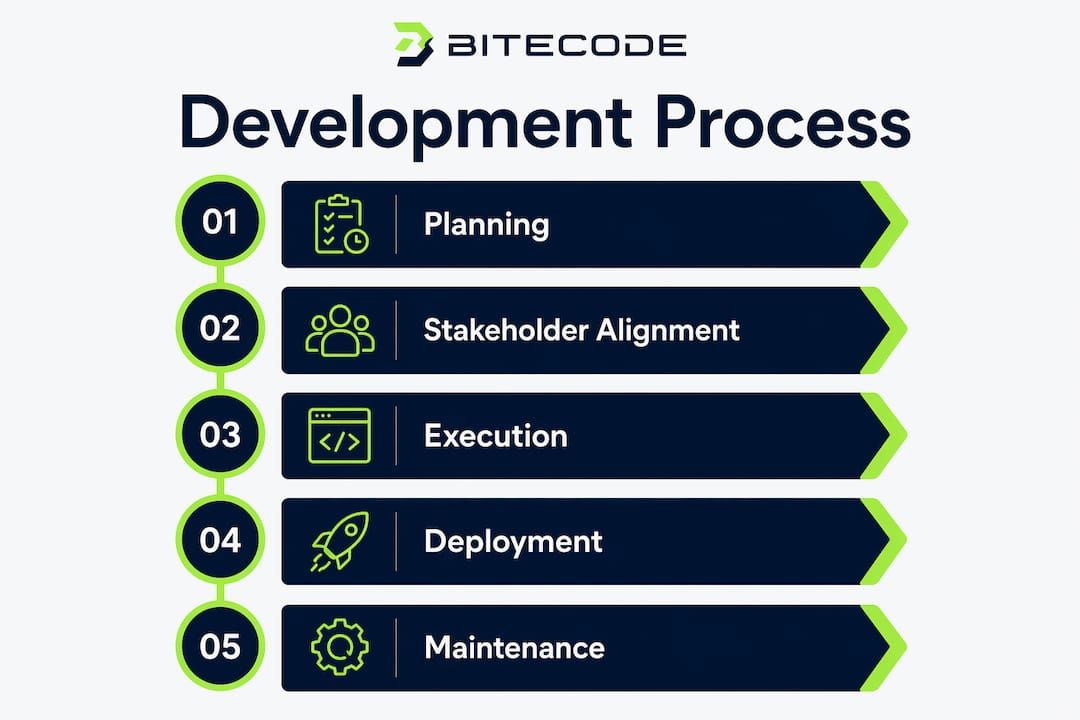
Agile methodology works well for custom projects, but only with disciplined scope management. Teams that adopt Agile without clear acceptance criteria often mistake velocity for progress. The discipline comes from defining what “complete” means for each feature before a single line of code is written.
Key questions to answer before development begins:
- What specific business problem does this software solve, and how will you measure success?
- Which existing systems must the new software connect to?
- What are the non-negotiable security and compliance requirements?
- Who owns the product roadmap after launch?
- What is the realistic budget for both build and ongoing maintenance?
Pro Tip: When a stakeholder requests a new feature mid-project, require a trade-off: remove or defer a feature of equal size. This keeps scope visible and makes the cost of additions concrete rather than abstract.
How to execute development with best practices that ensure quality, security, and scalability?
Security by design is the most cost-effective approach to building safe software. Embedding automated vulnerability scanning and access controls directly into CI/CD pipelines maintains compliance continuously rather than treating security as a final audit. Patching vulnerabilities after launch costs significantly more than preventing them during development. Teams that adopt DevSecOps practices, where security checks run alongside every code commit, catch issues when they are cheapest to fix.

Technical debt is a business risk, not just a coding inconvenience. Unaddressed debt slows feature delivery, increases defect rates, and eventually forces expensive rewrites. High-performing teams track debt explicitly, allocate sprint capacity to address it, and treat it with the same urgency as a financial liability. Continuous integration and continuous delivery pipelines reduce deployment errors and give teams real-time observability into code quality.
Architecture decisions made early have long-term consequences. Microservices and cloud-native designs adapt to growing user loads far more easily than monolithic systems. An API-first approach also makes future integrations straightforward, which matters when the business adds new tools or acquires other systems. Choosing the right database structure and API contracts in week two of a project is far cheaper than refactoring them in month twelve.
Integrating cloud security best practices from the architecture phase protects data in transit and at rest without requiring bolt-on solutions later.
| Best practice | Common pitfall |
|---|---|
| Security embedded in CI/CD pipeline | Security review only at project end |
| Technical debt tracked and budgeted | Debt ignored until delivery slows |
| API-first architecture from day one | Integrations added as afterthoughts |
| Automated testing at every build | Manual testing only before release |
| Staging environment mirrors production | Testing only in development environment |
| Code reviews with documented standards | Code merged without peer review |
Pro Tip: Load testing should happen before launch, not after the first traffic spike. Simulate peak usage in your staging environment and set performance thresholds that trigger alerts before users notice degradation.
What are effective deployment and post-launch maintenance strategies for custom software?
Software deployment is the process of moving a validated build from development through testing and staging into production, then monitoring it continuously. Each stage serves a distinct purpose. Development environments are for building and unit testing. Testing environments validate functional behavior. Staging environments replicate production conditions to catch integration issues. Production is where real users interact with the system. Skipping any stage increases the probability of a live incident.
Comprehensive testing before deployment prevents major issues in production. Staging environments that replicate production conditions are the single most effective tool for validating new releases. Teams that skip staging consistently experience higher incident rates at launch.
Deployment strategies determine how new code reaches users:
- Blue-green deployment: Two identical environments run in parallel. Traffic switches from the old version to the new one instantly. Rollback is immediate if issues appear.
- Canary deployment: New code releases to a small percentage of users first. The team monitors for errors before expanding the rollout.
- Rolling deployment: Updates replace instances gradually across the server pool. Reduces downtime but makes rollback more complex.
Automated rollback mechanisms reduce downtime when a release fails. Manual rollback under pressure is slow and error-prone. Automation removes the human bottleneck at the worst possible moment.
Post-launch, continuous monitoring is the difference between catching a problem before users notice and reading about it in a support ticket. Tools that track performance metrics and alert teams proactively maintain reliability without requiring constant manual checks. Effective deployment directly supports business continuity by minimizing downtime and keeping updates predictable.
How to select and collaborate with the right development partner?
Vendor selection is a decision that shapes every phase of the project. The wrong partner does not just slow delivery. It relocates complexity into the vendor relationship, where it is harder to manage and more expensive to resolve. Domain expertise and proactive communication correlate strongly with project success. A vendor that understands your industry asks better questions and anticipates problems before they become blockers.
Evaluate potential partners on these criteria:
- Discovery process: Does the vendor run a structured discovery phase, or do they move straight to estimates? A vendor that skips discovery is putting risk into your budget.
- Assumption challenging: Good partners push back on requirements that are technically risky or misaligned with stated goals. Vendors that simply agree to everything are not adding value.
- Scope change process: Ask specifically how they handle mid-project feature requests. A clear, documented process signals maturity.
- Post-launch support: Understand what maintenance and monitoring look like after go-live. Many projects fail not at launch but in the months that follow.
- Communication cadence: Weekly status updates, defined escalation paths, and transparent reporting are baseline expectations, not premium features.
Bitecode’s guide on choosing a software house outlines the specific questions that separate capable vendors from those who overpromise. For teams building their first custom system, the article on going from idea to software covers the full scoping and budgeting process in practical terms.
Key Takeaways
Successful custom software development requires disciplined planning, security embedded from the start, and a vendor relationship built on clear communication and documented processes.
| Point | Details |
|---|---|
| Discovery sprint is non-negotiable | A two-to-four-week discovery phase prevents costly rework and misaligned features. |
| Security belongs in the pipeline | Embed vulnerability scanning in CI/CD from day one to avoid expensive post-launch patches. |
| Technical debt is a financial risk | Track and budget for debt explicitly, or it will slow delivery and force rewrites. |
| Deployment strategy determines rollback speed | Blue-green and canary deployments reduce downtime and make rollbacks faster and safer. |
| Vendor selection shapes every phase | Choose partners who run structured discovery, challenge assumptions, and document scope changes. |
What most guides on custom software get wrong
The most common failure mode in custom software projects is not a technical one. It is a planning one. Teams spend weeks debating technology stacks while the actual business requirements remain vague. The architecture debate is a proxy for the harder conversation about what the software must actually do and for whom.
From Bitecode’s experience working with medium and large organizations, the projects that succeed share one trait: the business leader stays involved past the kickoff meeting. Not in the code reviews, but in the weekly scope reviews, the trade-off decisions, and the post-launch monitoring conversations. Software that drifts from business intent during development rarely recovers without expensive rework.
Technical debt awareness is the second underrated factor. Most decision-makers understand it conceptually but treat it as the development team’s problem. It is not. Unmanaged debt shows up as slower feature releases, higher defect rates, and eventually a system that costs more to maintain than to replace. Treating debt as a line item in the project budget, not a vague technical concern, changes how teams prioritize it.
The vendor relationship deserves more scrutiny than most organizations give it. A vendor that challenges your assumptions early is more valuable than one that agrees to everything. Disagreement in week two is cheap. Disagreement in month eight is a crisis.
— Bitecode
How Bitecode helps teams build custom software that lasts
Bitecode builds custom web applications for medium and large organizations that need tailored systems without the overhead of a greenfield build from scratch. Projects start with up to 60% of the baseline system pre-built through modular, ready-made components, which compresses timelines and reduces the boilerplate risk that slows traditional development. For organizations that need to reduce manual workload, Bitecode’s AI process automation service integrates directly into existing workflows. Teams looking to move from concept to working software without accumulating long-term technical debt can read more about Bitecode’s approach to building without debt before starting a conversation.
FAQ
What is custom software development?
Custom software development is the process of designing and building digital applications tailored to a specific organization’s workflows, data requirements, and business rules. Unlike packaged software, it is built to fit the business rather than requiring the business to adapt.
How long does a custom software project typically take?
Timelines vary by complexity, but a structured discovery sprint of two to four weeks is standard before development begins on mid-size projects. Full delivery timelines depend on scope, team size, and how clearly requirements are defined at the outset.
What is the biggest risk in custom software development?
Scope creep is the most common cause of budget and timeline overruns. Requiring a trade-off for every new mid-project feature request keeps scope visible and costs predictable.
What deployment strategy is safest for a first major release?
Blue-green deployment is the safest option for high-stakes releases because it allows instant traffic switching and immediate rollback if the new version has issues.
How do I evaluate a custom software development vendor?
Assess whether the vendor runs a structured discovery phase, documents their scope-change process, and provides post-launch support. Vendors that challenge your assumptions early and communicate proactively are the strongest indicators of a productive partnership.