TL;DR:
- A custom finance module automates and centralizes financial processes within an enterprise system to improve accuracy and compliance. Implementing it in phased stages, starting with general ledger and accounts payable/receivable, ensures early ROI and data validation. Embedding the module in a unified database and enforcing mandatory configuration from the start reduces long-term risks and maintenance costs.
A custom finance module is a tailored software component embedded within an enterprise system that automates and centralizes financial processes to drive accuracy, compliance, and operational efficiency. Unlike generic accounting packages, these modules are built around your specific chart of accounts, organizational structure, and reporting requirements. Following a solid custom finance module guide from the start separates projects that deliver measurable ROI from those that stall in scope creep. Custom ERP finance projects range from $10,000 for starter systems to over $2,000,000 for complex enterprise builds. That range reflects the real cost of getting architecture decisions wrong at the beginning.
What are the essential components of a custom finance module?
A custom finance module is not a monolithic build. The industry term for this approach is modular ERP finance architecture, and it describes a system where discrete financial functions operate as connected components within a unified database. The core functions include General Ledger (GL), Accounts Payable (AP), Accounts Receivable (AR), budgeting, and multi-currency management.
The architectural choice that matters most is whether your finance module lives inside a unified database architecture or connects to the core system through external integrations. Tight coupling with the core ledger reduces reliability risks. Bolt-on integrations create data silos that undermine financial accuracy over time.
Modular, component-based design is the preferred approach for enterprise builds. Successful projects combine unique business logic with existing, tested financial components. Building entirely from scratch is a misconception that adds cost without adding reliability.

Accounting dimensions are the structural backbone of any finance module. Fields like project code, business unit, and cost center define how transactions are classified and reported. These must be configured as mandatory from day one.
Key components to define before development begins:
- General Ledger: The central record for all financial transactions, including journal entries and period-end close workflows.
- AP and AR: Automated invoice matching, payment scheduling, and aging reports that reduce manual processing.
- Budgeting and forecasting: Period-based budget allocation with variance reporting against actuals.
- Multi-currency management: Real-time exchange rate feeds and revaluation workflows for organizations operating across borders.
- Accounting dimensions: Mandatory classification fields that segment transactions by project, department, or business unit.
Pro Tip: Define your fiscal year variants and group currencies before any entity is confirmed in the system. In platforms like SAP S/4HANA, these settings are effectively immutable after initial setup. Changing them later requires a full system rebuild.
How to sequence your finance module implementation for ROI
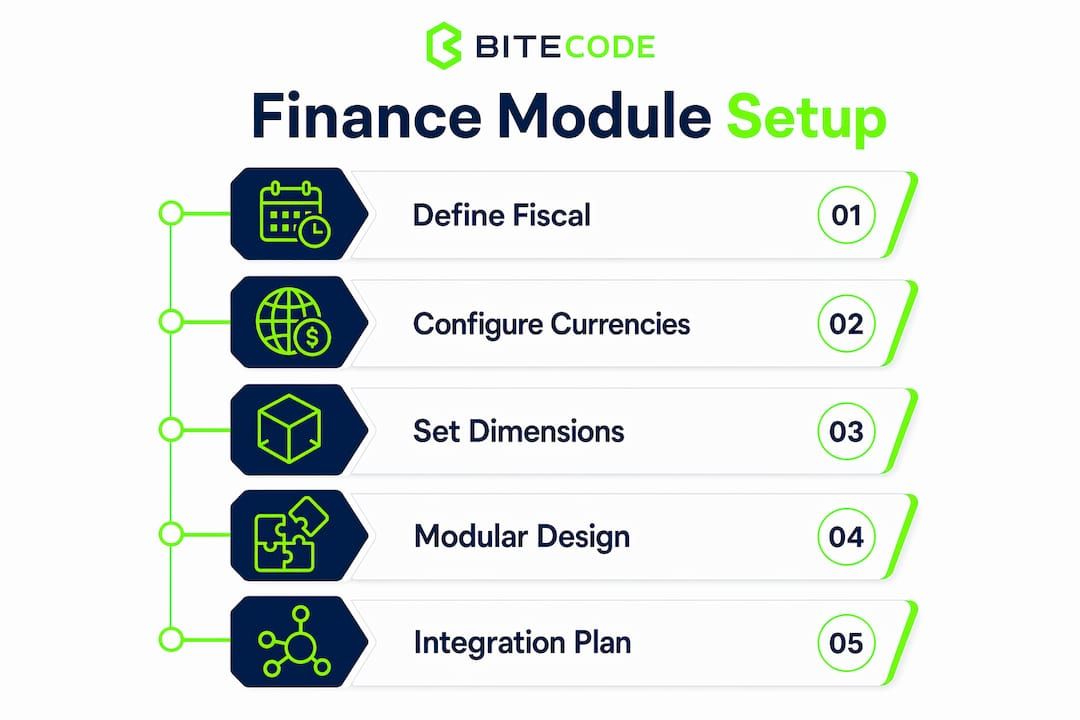
Phased delivery is the most reliable path to a successful finance module setup. Teams that try to build GL, inventory, CRM, and analytics simultaneously almost always overextend their budget and delay go-live. The correct sequence starts with the modules that generate the most financial visibility fastest.
A phased modular delivery approach starting with GL and AP/AR, followed by inventory and analytics, delivers value early and avoids project bloat. Each phase proves ROI before the next phase begins. This approach also gives finance teams time to validate data quality before adding complexity.
A proven implementation sequence:
- GL and chart of accounts setup. Establish the foundational ledger, account structure, and period-end close process before any other module goes live.
- AP and AR automation. Automate invoice processing, payment runs, and collections workflows. These deliver measurable time savings within the first quarter.
- Budgeting and reporting. Build budget templates and management reporting dashboards once the ledger is clean and reconciled.
- Inventory and supply chain integration. Connect stock movements to the GL only after the financial foundation is stable.
- CRM and revenue analytics. Layer in customer-facing financial data and revenue recognition once operational modules are proven.
- Payroll, ecommerce, and logistics. Integrate external systems last, after internal data flows are validated.
Parallel planning for integrations matters here. Payroll providers, ecommerce platforms, and logistics systems each require their own data mapping. Designing those interfaces early, even if you build them later, prevents costly rework.
Pro Tip: Use design sprints at the end of each phase to review what the module delivered against original requirements. Finance teams frequently discover new reporting needs once they see real data. Capturing those requirements between phases is far cheaper than retrofitting them.
What configuration best practices apply to custom finance modules?
Configuration discipline separates a self-maintaining ledger from one that generates mispostings at scale. ERPNext’s accounting system demonstrates this clearly: well-designed setup automates journal entry posting from operational documents, while poor setup creates cascading errors as transaction volume grows.
The chart of accounts must reflect your actual business structure, not a generic template. Account codes should map directly to your management reporting hierarchy. Retrofitting account structures after months of live transactions is expensive and disruptive.
Critical configuration decisions and their implications:
| Configuration Area | What to Decide Upfront | Risk if Deferred |
|---|---|---|
| Fiscal year variants | Calendar year vs. 52/53-week year | Immutable after entity confirmation in SAP S/4HANA |
| Group currency | Functional currency for consolidation | Cannot be changed after initial setup |
| Accounting dimensions | Mandatory fields per transaction type | Backfilling dimensions is time-consuming and error-prone |
| Organizational structure | Company codes, business units, cost centers | Restructuring mid-project disrupts all dependent modules |
| Multi-currency revaluation | Revaluation method and frequency | Inconsistent FX treatment creates audit exposure |
Fiscal year variants and group currency settings are foundational and immutable after setup. This is not a configuration preference. It is a hard system constraint in platforms like SAP S/4HANA Cloud. Getting these wrong requires rebuilding the organizational structure from scratch.
Accounting dimension setup deserves equal attention. Finance dimensions like project code and business unit should be mandatory from day one. Backfilling these fields after months of operation is highly time-consuming and error-prone. The cost of enforcing them upfront is trivial compared to the cost of cleaning up unclassified transactions later.
Pro Tip: Use an accounting setup manager or configuration template to document every setting decision with the business rationale. This creates an audit trail for future system changes and gives new finance team members a reference point.
How to avoid common mistakes in finance module implementation
The most common failure mode in finance module projects is the bolt-on integration trap. Teams connect a finance module to an existing system through APIs rather than embedding it within a unified database. Integration-heavy finance modules bolted onto external systems create data silos and reliability risks that undermine financial accuracy. The ledger ends up with multiple partial sources of truth instead of one.
Incomplete dimension and fiscal year setups are the second most common source of problems. These gaps do not surface immediately. They appear months later when management reports cannot be reconciled or when an audit requires transaction-level detail that was never captured.
Common mistakes and how to address them:
- Skipping reconciliation checkpoints. Run GL-to-subledger reconciliations at the end of every sprint, not just at go-live.
- Delaying audit trail configuration. Audit logging must be active from the first transaction. Retroactive logging does not satisfy most compliance frameworks.
- Underestimating multi-entity complexity. Each legal entity requires its own chart of accounts mapping, currency settings, and intercompany elimination rules.
- Treating testing as a final phase. Finance module testing should run in parallel with development, using real transaction scenarios from the business.
Finance and IT teams must collaborate throughout the entire implementation, not just at requirements gathering and go-live. The configuration decisions made in the middle of a project, such as adding a new dimension or changing a revaluation method, have downstream effects that only finance professionals can evaluate.
Pro Tip: Assign a dedicated finance analyst to the project team for the full implementation duration. This person bridges the gap between technical configuration choices and their accounting implications, and catches problems before they reach the ledger.
How to choose tools, frameworks, and partners for your finance module
The technology choice for a custom finance module sits on a spectrum from open-source frameworks to proprietary enterprise platforms. Each option relocates complexity into a different part of the project.
| Criteria | Open-source (e.g., ERPNext) | Vendor platform (e.g., SAP, Oracle) |
|---|---|---|
| Upfront cost | Lower; community edition is free | Higher license and implementation fees |
| Customization depth | High; full source code access | Limited to configuration within vendor boundaries |
| Support model | Community plus paid partners | Vendor-backed SLA with certified partners |
| IP ownership | Full ownership of custom code | Custom code sits on top of vendor-owned platform |
| Long-term cost | Maintenance depends on internal capability | Vendor upgrades can force configuration rework |
Open-source solutions like ERPNext give teams full control over the codebase and accounting logic. The trade-off is that maintenance responsibility falls entirely on the internal team or implementation partner. Vendor platforms like SAP S/4HANA and Oracle Fusion provide tested financial engines with strong compliance frameworks, but customization depth is constrained by what the vendor permits.
Partnering with a modular architecture specialist reduces both upfront development time and long-term maintenance risk. Specialists bring pre-built financial components that cover boilerplate functions like GL posting, period-end close, and tax calculation. Teams then focus development effort on the business-domain complexity that actually differentiates their system.
Key criteria for evaluating a development partner or vendor:
- Demonstrated experience with your target platform (ERPNext, SAP, Oracle, or custom stack)
- Clear IP ownership terms for any custom code developed
- Modular delivery methodology with defined phase gates
- Finance-specific testing protocols, including reconciliation and audit trail validation
- Transparent pricing for ongoing support and version upgrades
AI and automation tools add measurable value to finance module workflows. Bitecode’s AI assistant module reduces manual data entry in areas like invoice processing and expense categorization, which are the highest-volume, lowest-value tasks in most finance teams.
Key Takeaways
A successful custom finance module requires unified database architecture, mandatory dimension setup from day one, and phased delivery starting with GL and AP/AR before expanding to inventory or analytics.
| Point | Details |
|---|---|
| Unified architecture first | Embed the finance module in a shared database to avoid data silos and reliability risks. |
| Immutable settings require upfront rigor | Fiscal year variants and group currency cannot be changed after initial setup in platforms like SAP S/4HANA. |
| Phase delivery for early ROI | Start with GL and AP/AR, prove value, then expand to inventory, CRM, and analytics. |
| Mandate accounting dimensions | Enforce project codes and business units from the first transaction to avoid costly backfilling. |
| Partner selection determines long-term cost | IP ownership, modular methodology, and finance-specific testing protocols are non-negotiable criteria. |
What experience actually teaches about finance module projects
The projects that go wrong share a pattern. Teams underestimate configuration complexity and overestimate how much can be fixed after go-live. The assumption is that the ledger can be cleaned up later. It cannot, at least not without significant cost and reputational risk to the finance function.
Phased delivery is not just a project management preference. It is a risk management tool. When you deliver GL and AP/AR first and run them in production for 60 to 90 days before adding inventory or analytics, you surface data quality problems while the system is still simple enough to fix them. Adding complexity on top of an unvalidated ledger accelerates work without accelerating accuracy.
The configuration decisions that feel minor during setup, such as whether a dimension field is mandatory or optional, become major problems at audit time. Finance leaders who have lived through a retroactive dimension backfill do not make that mistake twice. The discipline required upfront is far less painful than the remediation work later.
Cross-functional involvement is the factor most often treated as optional and most often cited as missing when projects fail. Finance teams understand the accounting logic. IT teams understand the system constraints. Neither group alone can make the right configuration decisions. The organizations that get this right treat the finance module project as a joint program, not an IT delivery with finance sign-off at the end.
The choice between open-source and vendor platforms is real, but it is secondary to the quality of the implementation. A well-configured ERPNext instance outperforms a poorly configured SAP deployment every time. The platform sets the ceiling. The implementation determines where you actually land.
— Bitecode
How Bitecode can accelerate your finance module build
Bitecode starts custom finance module projects with up to 60% of the baseline system pre-built, covering GL, AP/AR, audit trails, and subscription management through ready-made modular components. That pre-built foundation means your team focuses development effort on the business-domain logic that actually differentiates your system, not on boilerplate financial infrastructure.
The Bitecode AI assistant module integrates directly with finance workflows to reduce manual data entry in invoice processing, expense categorization, and period-end reporting. For finance teams managing high transaction volumes, that reduction in manual work translates directly into faster close cycles and fewer reconciliation errors. Contact Bitecode to discuss a phased implementation plan for your organization.
FAQ
What is a custom finance module in an ERP system?
A custom finance module is a tailored software component within an ERP that automates GL, AP, AR, budgeting, and reporting processes aligned to a specific organization’s structure. It differs from off-the-shelf accounting software by embedding directly into the enterprise’s unified database.
How much does it cost to build a custom finance module?
Custom ERP finance projects range from $10,000 for starter systems to over $2,000,000 for complex enterprise builds. Mid-market implementations typically fall in the $40,000 to $120,000 range depending on scope and integration requirements.
Why are accounting dimensions so critical to configure early?
Backfilling accounting dimensions like project codes and business units after months of live transactions is highly time-consuming and error-prone. Enforcing them as mandatory fields from the first transaction eliminates this risk entirely.
Can fiscal year settings be changed after a finance module goes live?
In platforms like SAP S/4HANA, fiscal year variants and group currency are immutable after the organizational structure is confirmed. Changing them requires rebuilding the entity structure from scratch.
What is the biggest risk in finance module implementation?
Integration-heavy bolt-on modules that connect to the core system through external APIs create data silos and undermine financial accuracy. Embedding the finance module within a unified database is the most reliable way to maintain a single source of truth.