The main API monetization models are pay-per-use, subscription, tiered, freemium, credit-based, revenue share and hybrid. Most mature API products end up on a hybrid: a base subscription that includes a quota, plus metered charges above it. The right choice depends on three things: how predictable your customers’ usage is, how closely the unit you charge for tracks the value they receive, and whether your billing stack can meter that unit accurately.
This guide explains each model, shows where each one fits, and covers the billing and metering decisions that are expensive to reverse once customers are live.
TL;DR
- API monetization is either direct (customers pay to call the API) or indirect (the API drives revenue elsewhere). Decide which applies before you pick a price.
- Pay-per-use suits discrete, measurable transactions. Subscriptions suit predictable usage. Hybrid or overage pricing is the most common default for new API products.
- Charge for a unit customers understand and that tracks their value, such as an email sent or a lookup completed, rather than a raw request count.
- Metering, quotas and invoicing must be designed together with pricing. Keep pricing definitions in one system and metering independent of any single plan.
- Track adoption, conversion, churn and margin, not only revenue.
What API monetization actually means
API monetization is the process of converting the value of an API into money. Microsoft’s Azure API Management documentation sorts the approaches into four strategies: free access that supports business-to-business integration, consumer pays, consumer gets paid (for example, a consumer embeds advertising and receives a share of revenue), and indirect monetization, where revenue comes from other sources the API facilitates.
In practice, teams split this into two broad categories. In direct monetization the API is the product, and customers pay per call, per subscription or per usage tier. In indirect monetization the API widens distribution, attracts partners or lowers the cost of integration, and the revenue shows up elsewhere in the business, as Axway’s guide to API monetization models describes.
When a free API is the better business decision
Not every API should carry a price tag. Google Cloud’s Apigee team notes that the knee-jerk reaction is to charge, yet more often value is extracted indirectly. Its example is a photo-printing API that a retailer offered free so third-party apps could use its stores as a printing venue, extending the retailer’s photo services into many apps and handsets.
The same guidance says direct charging becomes attractive when substitution risk is low: the value proposition is rare, valuable and not competed against by indirect competitors. A store-locator API is easy to give away. Unique, hard-to-replicate data is a stronger candidate for a price. A useful test: if a customer could get 80 percent of the outcome elsewhere for free, charge indirectly. If your data or capability is genuinely scarce, charge directly.
The main API monetization models
Vendors name these differently, but the underlying patterns are consistent. Stripe’s overview lists pay-as-you-go, subscription, freemium, quota-based, transaction fee, revenue sharing and enterprise licensing, with indirect monetization and data sharing as additional routes. The table below groups them by how they behave in practice.
| Model | How it charges | Fits best | Main risk |
|---|---|---|---|
| Pay-per-use | A unit rate for every call or unit processed | Discrete, measurable transactions such as messages, lookups or inference | Variable invoices make customer budgeting hard |
| Subscription | Recurring fee for a defined access level | Predictable, steady usage | Light users feel overcharged, heavy users strain your costs |
| Tiered | Different rates or allowances by volume band | Customers whose volume grows over time | Tier cliffs that punish customers just over a threshold |
| Freemium | Free entry tier, paid upgrade | Developer-led adoption | Free usage that never converts and still costs you |
| Credit-based | Prepaid credits consumed per operation | Mixed operations with different costs, AI workloads | Expiry and balance rules need clear communication |
| Revenue share or transaction fee | A percentage of value flowing through the API | Payment, lending and marketplace APIs | Revenue depends on your customers’ success |
| Hybrid | Base subscription plus metered overage | Most growing API products | More complex to explain and bill |
Pay-per-use
Customers pay a rate for each request, message or unit of data processed. Nordic APIs notes that consumption billing can come out cheaper or more expensive than a subscription depending on volume. It aligns price with consumption, but API7’s guide points out it works best when the unit is understandable, reliably measured and related to customer value or provider cost.
If you want a deeper walk-through of the mechanics, our article on how usage-based billing works covers metering, rating and invoicing in detail.
Subscription
Customers pay a recurring monthly or annual fee for a defined tier, typically including a quota, service-level commitments and premium features. Subscriptions give both sides predictability. The provider’s job is to model customers whose usage sits far above or below the average, because those accounts decide whether the plan is profitable.
Subscriptions also require solid payment plumbing: renewals, failed payments, upgrades and downgrades. Our guide to subscription billing integration with tokenized flows walks engineers through that part.
Tiered and volume pricing
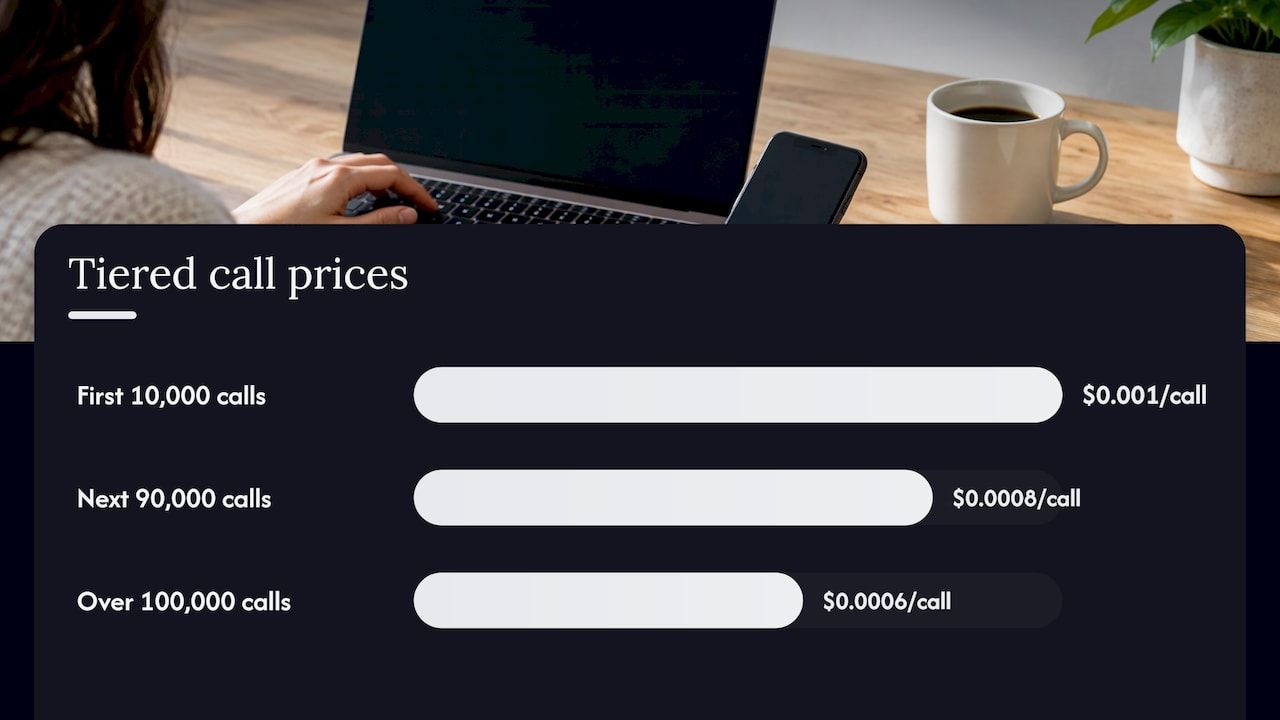
Tiered pricing bins usage into bands with different unit prices. Kong’s metered billing guide gives an example: the first 10,000 calls at $0.001 each, the next 90,000 at $0.0008, and everything above 100,000 at $0.0006. It also describes the volume variant, where all usage is priced at the tier the customer reaches, which rewards high-volume customers.
The distinction matters for invoices. Graduated tiers price each band separately, so bills rise smoothly. Volume tiers reprice everything at once, which is simpler to explain but can create odd incentives near a boundary. If you are designing usage tiers and volume pricing, model a few real customer profiles against both versions before you commit.
Freemium
A free tier lowers the barrier to a first successful call, and the paid tier captures customers whose needs grow. The Axway comparison associates freemium with developer-led growth, as with email delivery, mapping and search APIs. The discipline is cost control: cap the free tier on volume and features so it supports evaluation without becoming a permanent, unprofitable way to run production traffic.
Credit-based pricing
Customers buy credit packs, and each operation consumes a set number of credits. This lets you price very different operations on one balance. It is increasingly relevant for AI workloads, where cost per request varies widely. A related design is the prepaid wallet, where customers deposit dollars and each call deducts its real cost in real time, as described in Commet’s API billing guide.
Revenue share and transaction fees
If your API moves money or brokers transactions, charging a percentage of the value processed aligns your income with your customer’s. The Axway table maps this model to payment, lending and marketplace APIs. Because revenue tracks customer volume, forecasting depends on their business, not just your adoption.
Hybrid and overage
Hybrid pricing combines a subscription floor with usage charges above a threshold. Zuplo’s 2026 guide calls the base-plus-overage structure the default for most API products, since it secures baseline revenue while protecting infrastructure from abuse. Apiable’s guide suggests flat-rate plus overage is often the best starting point for teams new to API monetization. That is sensible advice: it is easier to loosen a quota later than to retrofit limits onto an unlimited plan.
How to choose the right model
Start from the customer, not the pricing page. Three questions do most of the work.
Is customer usage predictable?
API7’s guidance recommends tiered subscriptions for predictable usage and pay-as-you-go for unpredictable usage, with revenue share or transaction fees for transactional APIs. Add a freemium tier for broad adoption, or an enterprise contract for large, negotiated accounts.
Does your cost scale with each call?
If each request carries meaningful marginal cost, as with AI inference, a flat subscription can lose money on heavy users. Credyt’s overview frames the choice as pass-through (pay-per-call or prepaid credits) versus absorb (tiered subscription or freemium), and calls it the primary filter when inference costs run from $0.05 to $0.50 per request. If your costs are near zero per call, absorbing them inside a subscription is simpler.
Can you measure the unit that carries value?
Charging per raw API call is easy to meter but often disconnected from outcomes. The API Course guide argues for unit-based pricing closer to business value, such as per email sent, per minute transcoded or per geocoding lookup. Customers understand those units, which makes invoices easier to defend and expansion easier to sell.
Map the customer journey
Microsoft’s documentation advises mapping the journey from investigation and implementation through preview, initial production, growth, scale and global growth, then analyzing the value delivered at each stage and estimating lifetime usage. It also recommends keeping the revenue model simple and transparent, and making sure total lifetime value covers total cost of ownership plus margin. It adds that the most successful APIs have onboarding that is largely self-service, so acquisition cost approaches zero as adoption grows.
Metering, quotas and billing: where monetization is won or lost
A pricing model is only as good as the system that enforces and invoices it. Teams that choose a model first and discover its technical demands later often rebuild.
The billing pipeline
Commet’s guide describes a three-stage pipeline. Every billable request emits a usage event carrying a feature code, customer, value and a stable event identifier, so retries never double-bill. A billing engine then aggregates events per customer, feature and period, netting out included allowances and computing overage. Finally, aggregated usage becomes invoice line items at period end, or in real time for prepaid models.
Decide the edge cases early
Apache APISIX’s guide says metering must be accurate, real-time and attributable to individual consumers. It also flags questions the pricing page rarely answers: do failed requests count, do cached responses count, and how is burst traffic rated? Write those rules into your terms of service before the first invoice goes out, because each one changes what customers pay.
Enforcement versus pricing
Commercial terms translate into separate technical controls. Endpoint access becomes entitlement and scope at the authorization layer. Included usage becomes an allowance per meter and period. Burst limits become short-window rate policy at the gateway, and sustained quotas become longer-window budgets. Rate limiting in particular deserves design attention: our piece on production decisions for API rate limits with Redis and Lua covers the trade-offs engineers face.
Keep pricing separate from metering
Speakeasy’s best-practices guide recommends three habits: hold pricing definitions in a single authoritative system, treat pricing plans as immutable so changes ship as new versioned plans, and keep metering centralized and pricing-agnostic. That last point pays off later, because historical usage records can be reused to launch new plans without re-instrumenting the API. The guide also frames monetization as an organization-wide project that touches the bottom line, so engineering, product and finance need to decide together.
Metrics that show whether the model works
Revenue alone hides problems. A balanced scorecard covers:
- Adoption: time to first successful API outcome. A long path to that first call usually predicts weak conversion.
- Usage: active applications and billable units.
- Commercial: free-to-paid conversion, expansion, churn and gross margin.
- Metering quality: duplicate, rejected, delayed and corrected events.
- Support: billing disputes and integration support time.
This breakdown follows API7’s metrics guidance. Review metering quality and billing disputes with the same seriousness as churn. A model that customers cannot predict or verify generates support load and erodes trust, even when the headline numbers look healthy.
Common mistakes to avoid
- Pricing a unit nobody understands. If customers cannot forecast their own bill, they will cap usage or leave.
- Launching with no overage or quota rules. Unlimited plans invite abuse and leave infrastructure costs uncovered.
- Hard-coding plans into the product. Prices will change. Versioned plans and pricing-agnostic metering keep changes cheap.
- Ignoring the finance side. Invoices, refunds, dunning and usage dashboards are part of the product customers experience.
- Treating monetization as a late add-on. Retrofitting metering and entitlements onto a live API costs far more than designing them in.
Our perspective
We see the same pattern across API and SaaS projects: the pricing model is rarely the hard part. The hard part is everything underneath it, meaning metering, entitlements, multi-currency invoicing, audit trails and the admin tooling finance teams need to trust the numbers.
That is why we argue for a modular foundation. Starting a project with up to 60% of the baseline system already built means billing, accounting, user management and workflow components are in place before the first pricing debate. Teams can then spend their time on the decisions that differentiate the product, such as which unit to charge for and how plans should evolve, instead of rebuilding invoicing from scratch.
A monetized API also changes what the business must be able to prove. Audit-ready records, controlled access and, where required, self-hosted modules keep usage data and customer billing under the client’s own control. Our view is that a hybrid model backed by clean, centralized metering gives most organizations the best balance of predictability and growth, and that the foundation should be built so the model can change without a rewrite.
Bitecode
Building the billing layer without starting from zero
If you are planning a monetized API, we can help you stand up the billing and usage infrastructure on a modular baseline. Our Financial Module covers accounting, audit trails and subscriptions, and our custom business software service builds the portal and admin tooling around it.
For teams designing the API itself, our article on shipping API-first design in three to six months explains how a modular baseline shortens the path, and our overview of SaaS business models helps place API pricing inside the wider product model. To discuss your project, start at bitecode.tech.
FAQ
What is the most common API pricing model?
Hybrid pricing, a base subscription with a quota plus charges for overage, is widely described as the default for new API products. It guarantees baseline revenue and protects infrastructure from runaway usage. Pure pay-per-use and pure subscription still fit narrower cases, such as discrete transactions or very predictable workloads.
Should every API be monetized directly?
No. Some APIs create more value for the business when they are free, because wider adoption drives sales or partnerships elsewhere. Direct charging makes the most sense when the data or capability is rare and hard to replace. Decide whether the API is a product or a distribution channel before setting prices.
How do usage-based and tiered billing differ?
Usage-based billing charges a flat unit rate for every call or unit processed. Tiered billing changes the unit rate or the included allowance as volume grows, either by pricing each band separately (graduated) or by repricing all usage at the band reached (volume). Tiers reward growth and can make forecasting easier.
What should we have in place before launching paid API plans?
You need accurate, per-customer metering with idempotent events, rules for failed and cached requests, quota and rate enforcement at the gateway, and an invoicing process that turns usage into line items. Keep plan definitions in one system and metering independent of any plan so you can add or change plans later.
Which metrics matter most after launch?
Track time to first successful call, free-to-paid conversion, churn, expansion and gross margin, plus metering quality and billing disputes. Together they show whether customers adopt the API, whether the model is profitable, and whether the billing experience is trustworthy.
Sources
- Monetization with Azure API Management (Microsoft Learn)
- 4 ways to maximize API value (Google Cloud Blog)
- API Monetization Models and Strategies that Work (Axway)
- What is API monetization? (Stripe)
- 9 Types of API Monetization Models (Nordic APIs)
- API Monetization: Models, Metering, Billing, and Metrics (API7.ai)
- Metered Billing for APIs (Kong)
- API Monetization in 2026 (Zuplo)
- What is API Monetization? The Complete Guide (Apiable)
- The 5 API monetization models (Credyt)
- API Monetization: Usage-Based Billing, Metering, and Pricing Models (API Course)
- API Billing: How to Meter and Charge for API Calls (Commet)
- API Monetization: Models, Strategies & Implementation Guide (Apache APISIX)
- Monetization Best Practices in REST API Design (Speakeasy)
- Pricing (Touchmark)