Continuous control monitoring (CCM) is the use of automated technology to test, near-continuously, whether the controls a company relies on are still operating as designed. Instead of sampling a few transactions once a quarter, a CCM program reads system data on a schedule, compares it with a defined rule, and raises an exception when a control fails. It is the engine behind what many teams call continuous compliance monitoring, and it is where most compliance automation efforts either pay off or stall.
This guide covers what CCM is, how it differs from periodic testing, what a working example looks like, how to implement it without drowning in alerts, and where a custom-built approach makes sense.
TL;DR
- CCM automates control testing on a high-frequency schedule, so failures surface when they happen rather than at the next audit cycle.
- It complements periodic testing; it does not remove the need for professional judgment on certain control components.
- Start with a short list of high-risk, data-rich, volatile controls (access, configuration, approval thresholds), not the whole control library.
- Alarm design matters as much as the tests: unrouted alerts become noise, and noise ends programs.
- Off-the-shelf tools fit standard frameworks; bespoke processes and in-house systems often need a modular, custom build.
What continuous control monitoring actually is
ISACA describes CCM as technology-enabled, near-continuous or high-frequency monitoring of the operating effectiveness of controls, with tests run close to when transactions or processes occur. The same source places CCM inside a wider family called continuous assurance, alongside continuous data assurance and continuous risk monitoring. CCM is the part that asks a narrow question: did this control work, today, on the data we can see?
Three ideas sit inside that definition.
- A control. A rule or safeguard the business depends on: two approvers for large payments, multifactor authentication on privileged accounts, encryption on storage holding customer data.
- An assertion. A precise, testable statement about that control, such as “every payment above the approval threshold has two distinct approvers.”
- An automated test. A query or script that checks the assertion against system data on a defined schedule and records the result.
The result of each run is evidence. Over time, those results form a continuous record rather than a snapshot.
CCM and continuous compliance monitoring
The two phrases overlap heavily, and teams use them interchangeably. A useful distinction: monitoring is the automated gathering and analysis of data, while compliance is the comparison of that data with a regulatory or framework requirement. CCM is the mechanism; continuous compliance is the outcome you report to auditors, regulators, and customers. A control test written against your own policy is CCM. The same test mapped to a SOC 2 criterion or a SOX control objective becomes continuous compliance evidence.
How CCM differs from periodic and sample-based testing
Traditional control testing is periodic. An internal audit team or external auditor selects a sample, inspects it, and concludes whether the control worked during the period. That approach is well understood, but it has two structural weaknesses: the sample covers a small fraction of activity, and the conclusion arrives long after the event.
CCM changes both variables. It tests a much larger share of the population, often all of it where the data is available, and it tests soon after the activity. ISACA lists the resulting benefits as increased test coverage, timely testing, reduced costs, and greater visibility.
| Dimension | Periodic, sample-based testing | Continuous control monitoring |
|---|---|---|
| Coverage | A sample of transactions or systems | Full population where data is available |
| Timing | Weeks or months after the activity | Close to the activity, on a schedule |
| Evidence | Point-in-time snapshot | Ongoing record of test results |
| Effort pattern | Spikes before audits | Steady, mostly automated |
| Best at | Judgment-heavy control components | Rule-based, data-rich controls |
| Failure mode | Problems found late | Alert fatigue, false positives |
The last row of that table is the honest part. CCM is not a replacement for periodic assurance. Some control components need professional judgment, and some key risk indicators produce false positives that a person has to review. Periodic manual testing stays part of the overall assurance program; CCM changes how much of it you need and where you spend it.
Evidence collection is not monitoring
A common misreading is that a platform that gathers screenshots and exports on a schedule is already doing CCM. Collecting a file proves a control existed at the moment the file was pulled. Monitoring reads that evidence afterward and validates that the control keeps performing. A configuration export taken in March says nothing about what changed in April.
The difference shows up in approval flows too. A document approval workflow with traceable controls gives auditors a record of who approved what. CCM adds the next layer: a standing test that flags the approval that skipped a step, rather than waiting for someone to sample the log.
Examples of continuous control monitoring
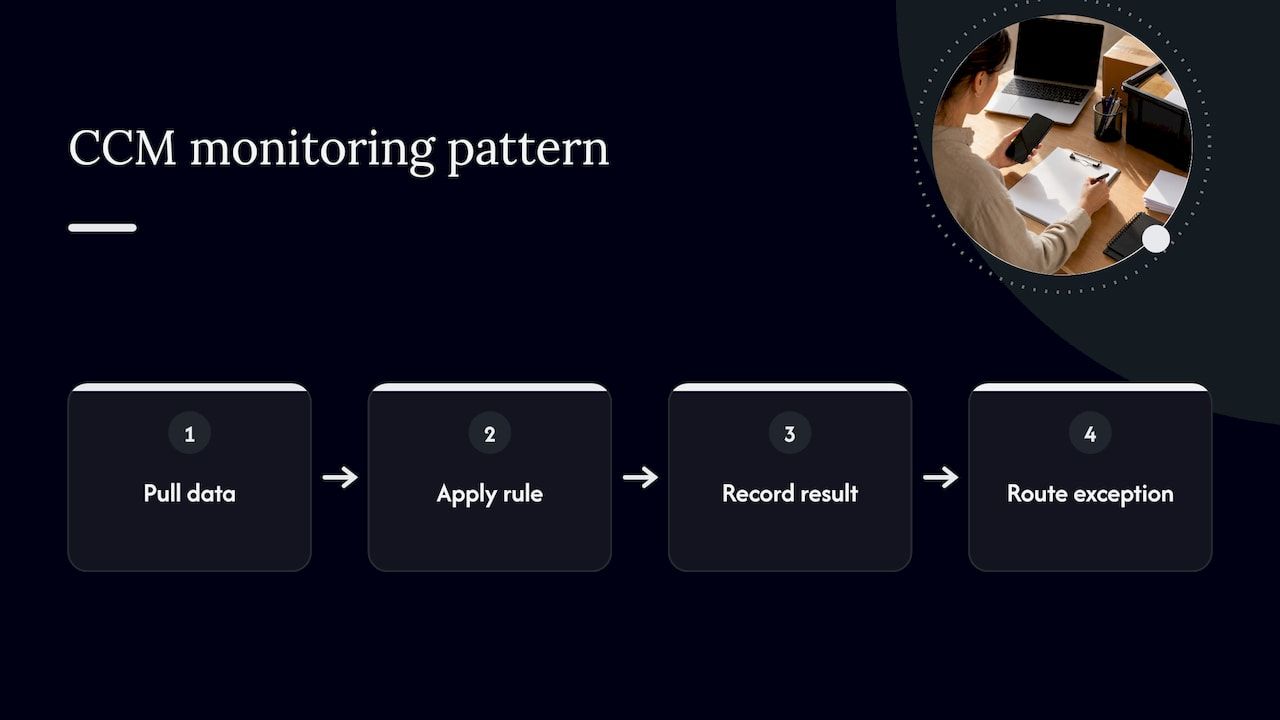
Abstract definitions only go so far. These examples show the pattern: pull data, apply a rule, record the result, route the exception.
A pharmaceutical company monitoring SAP jobs
A well-documented case is Eli Lilly’s use of SAP Process Control. According to a Mastering SAP case study, a daily automated check examined the status of SAP job steps and email processing, recorded each control execution as audit evidence, and opened a workflow issue when a job was released but never executed or ended in an error state. Scheduled executions were documented as evidence without user intervention unless an exception appeared.
The same case shows a useful reporting idea: a control-health dashboard in which monitoring that ran for 100 days and found an issue on one of them reported 99% health. The routine successes generate evidence on their own, and people spend their attention on failed checks and remediation. That exception-focused model is the real value of CCM.
Finance: approval thresholds
In a financial control, the test might read ERP transaction logs and look for payments above an approval limit that lack the required second sign-off. The assertion is simple, the data is structured, and the full population can be tested every night. A human reviews only the exceptions. Teams in payments and lending build similar logic for transaction screening, which we cover in our piece on transaction monitoring system design.
Identity and access
Access management is the most common starting point. The test compares employee status and role from the HR system with the permissions in a target system, then flags accounts whose access does not match role, level, or employment status. A terminated employee with an active account is the classic hit. Teams that test application permissions during acceptance can also add a role-based access control test matrix to confirm that the permissions defined on paper are the permissions that ship.
Configuration and change management
Cloud configuration is volatile, so it benefits most from frequent checks: storage encryption settings, logging enabled, security groups unchanged. Server baselines belong here too, and practices such as Windows Server hardening define the configuration state that a monitor can then verify continuously rather than once at build time.
Which controls are worth monitoring continuously
Not every control belongs in a CCM program. ISACA’s guidance is that CCM can cover prioritized business and IT controls where system data is available, and that suitability depends on risk, data availability, and ease of implementation. Score candidates on those three axes.
- Risk. What is the impact if this control fails unnoticed for a month?
- Data availability. Does a system record the evidence in a structured, accessible form?
- Implementation ease. Can the test be expressed as a clear rule without heavy integration work?
Controls that score high on all three are your first wave. Controls that depend on interviews, observation, or nuanced interpretation stay in the periodic program.
Frequency follows volatility. A cloud configuration that engineers change daily needs near-constant checks. A quarterly access recertification does not. DigitalXForce makes the same point: the frequency of checks is determined by how often the governing environment changes, and it suggests starting with frequently changing controls that appear in most frameworks, such as multifactor authentication and privileged access.
How to implement CCM: five steps
The ISACA approach is a useful skeleton: identify critical controls, define objectives and assertions, set automated tests and frequencies, then build alarm management and remediation. In practice that becomes five steps.
- Pick a narrow first scope. Five to ten controls tied to a real audit or regulatory pressure. Map them to your frameworks so each test later serves more than one purpose. Our enterprise security compliance checklist and SaaS security compliance checklist help with that inventory.
- Write assertions before queries. If the assertion is vague, the test will be too. “Access is appropriate” is not testable; “no active account belongs to a user marked terminated in HR for more than 24 hours” is.
- Connect the data sources. Identity provider, HR system, ERP, cloud accounts, ticketing. Expect this to take longer than the tests themselves.
- Set schedules and thresholds. Match frequency to volatility. Define what counts as an exception, and who owns it.
- Build the exception workflow. Each failure needs an owner, a ticket, a deadline, and a recorded resolution that closes the loop as audit evidence.
If you want a broader view of how to wire this into engineering without slowing releases, see our guide to automating software compliance without slowing delivery.
Defining indicators that work
When CCM uses key risk indicators, they should be specific, sensitive to early warning signals, and quantifiable, as Vanta advises. An indicator such as “percentage of privileged accounts without MFA” meets all three. “General security posture” meets none.
Challenges to plan for
Most CCM programs fail for organizational reasons rather than technical ones. ISACA names data-access approvals, sourcing delays, scarce expertise, integration costs, and coordination among teams as the recurring hurdles. Data owners rarely refuse outright; they simply take months to grant read access to a production system.
The second risk is alarm design. The Siemens continuous-auditing pilot, published by Emerald, argues that alarm management and avoiding alarm floods are critical implementation issues. Automated monitoring is useful only when alerts are structured and routed to the right owners. A dashboard that turns red every morning teaches everyone to ignore it.
Practical countermeasures:
- Tune thresholds on a pilot period before alerts reach owners.
- Route each exception to a named role, not a shared inbox.
- Review false positives monthly and retire or rewrite noisy tests.
- Keep a human review step for controls that require judgment.
- Document test logic so auditors can understand and rely on it.
Governance of the automation itself is a control too. If scripts and workflows can change without review, the monitor becomes a new risk. Our IT automation governance checklist covers ownership, change control, and audit trails for automated processes.
Perspective: where we see CCM programs succeed or stall
We build custom business systems from modular, ready-made components, and a pattern repeats in compliance work. Teams buy a monitoring tool built around a standard control library, then discover that their most important controls live in a bespoke approval flow, an internal ledger, or a settlement process the tool cannot read. The library covers the generic controls well. The business-domain controls, the ones auditors care about most in a payments or fintech setting, remain manual.
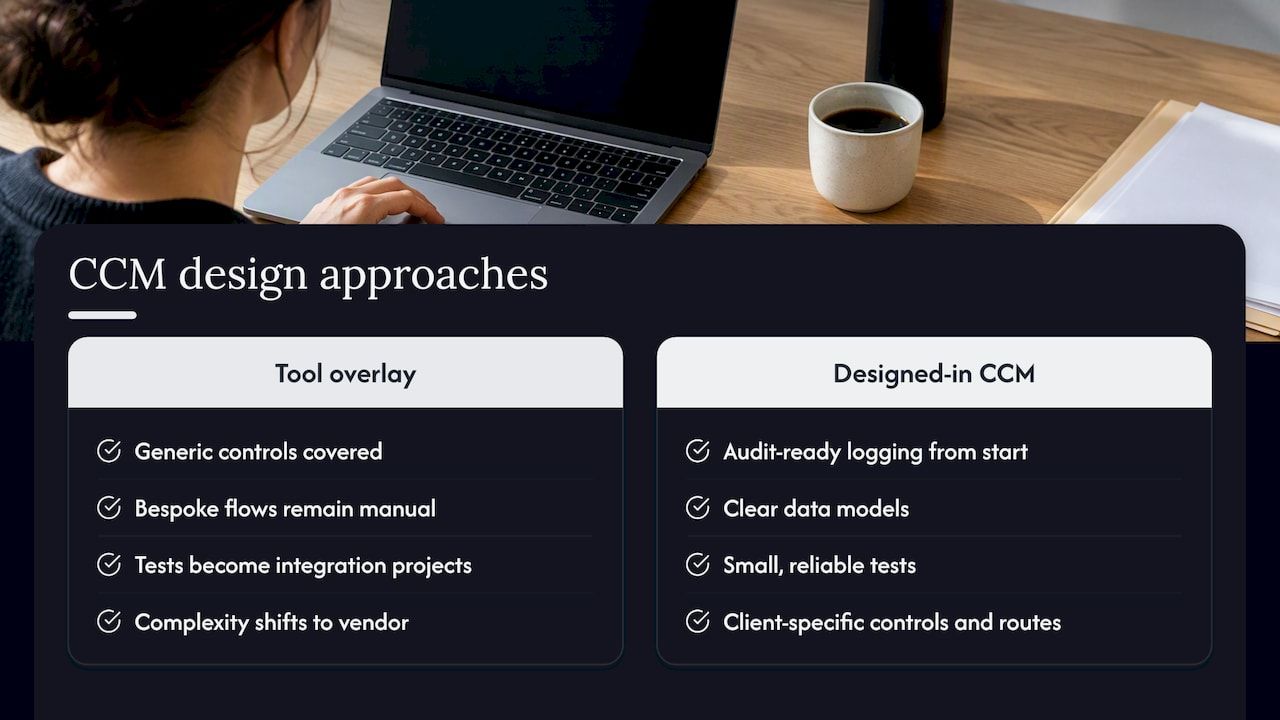
Our view is that CCM should be treated as part of the system’s design rather than an overlay added afterward. When approvals, ledgers, and workflows are built with audit-ready logging and clear data models from the start, the tests become small and reliable. When they are not, every test is an integration project that relocates complexity into the vendor relationship.
That is why we start projects from a modular foundation, with up to 60% of the baseline system pre-built, and spend the saved time on the parts specific to the client: the controls, thresholds, and exception routes that make the system theirs. Where data residency or control over hosting matters, self-hosted modules keep the evidence and the monitoring inside the client’s own boundary. We would rather help a team accelerate work without accelerating chaos, and that means choosing a small set of controls, testing them well, and expanding deliberately.
— Bitecode
Build or buy: choosing a starting point
There is no single right answer, and the honest comparison depends on where your controls live.
| Situation | Likely best fit |
|---|---|
| Standard SaaS controls mapped to common frameworks | A packaged monitoring product |
| Controls inside ERP suites such as SAP | The suite’s native control-monitoring capability |
| Controls inside proprietary workflows, ledgers, or settlement logic | Custom or modular build with monitoring designed in |
| Strict data residency or self-hosting requirements | Self-hosted or custom approach |
| SOX scope with bespoke financial systems | Hybrid: packaged for IT general controls, custom for business controls |
For SEC registrants, our SOX IT controls playbook explains which IT general controls auditors tend to examine, and where automation helps most. If residency is the constraint, see three-level data residency controls for cloud teams.
Where Bitecode fits
When the controls you need to monitor sit inside your own systems, we build the monitoring with the system. Our AI business process automation workflows cover exception routing, ticketing, and evidence capture, and our Financial Module provides multi-currency, audit-ready accounting foundations that make financial control tests straightforward to write. For internal systems that need a purpose-built approval flow, see our custom business software service. Pricing is scoped per engagement, so the quickest way to test fit is to describe your three most critical controls and the systems they run on. For more on structuring the workflow side, read our guides to automated compliance workflow solutions and compliance automation with custom solutions.
Where AI helps, and where it does not
AI tools can continuously analyze user activity and configuration changes and generate audit-friendly logs, as IBM notes. That is valuable for triage: grouping related alerts, summarizing an exception, drafting a remediation ticket. It does not remove the need for a clear assertion behind every test. A model that flags “unusual” activity without a defined control objective gives you a signal an auditor cannot rely on. Use AI to reduce the effort around exceptions, and keep the pass-or-fail logic of key controls deterministic and documented.
FAQ
What is continuous control monitoring?
It is the automated, near-continuous testing of whether security, compliance, and risk controls operate effectively. A schedule runs rule-based tests against system data, records the results as evidence, and raises exceptions for people to resolve. It replaces much of the manual sampling that periodic audits depend on.
Can you give an example of continuous control monitoring?
Yes. A daily check of SAP job steps that records each execution as evidence and opens a workflow issue when a job fails to run is one documented case. Another common example is comparing HR status with system permissions to flag accounts that no longer match an employee’s role or employment status.
Does CCM replace internal audit?
No. CCM increases coverage and timeliness for rule-based controls, but periodic testing remains part of the assurance program, especially for control components that need professional judgment. Internal audit also evaluates the monitoring design itself, including test logic and alarm handling.
How often should controls be monitored?
It depends on how quickly the underlying system changes. Volatile controls such as cloud configurations and privileged access justify near-constant checks, while stable controls can be tested daily or weekly. Set frequency by risk and rate of change, then adjust after a pilot period.
What is the first step to start?
Choose five to ten high-risk controls with accessible data, write a precise assertion for each, and agree on an owner for every exception. Expanding after that pilot is far easier than launching across the whole control library at once.
Sources
- ISACA Journal: A Practical Approach to Continuous Control Monitoring
- Mastering SAP: How Eli Lilly Increased Transparency and Efficiency Using SAP Process Control
- Emerald Publishing: Continuous Monitoring of Business Process Controls, a Pilot Implementation
- IBM: What is Continuous Compliance?
- DigitalXForce: Continuous Control Monitoring Definition and Guide
- Vanta: Continuous controls monitoring use cases and steps