AI guardrails are layered safety controls, spanning input filters, processing constraints, and output validation, that stop unsafe or noncompliant model behavior before it reaches a user or downstream system. Their value is straightforward: they turn a probabilistic model into something an enterprise can actually put into production, because they catch hallucinations, sensitive-data leakage, and policy violations before those failures become incidents. What follows maps the layers, the pipeline placement, the standards, and a practical rollout sequence.
TL;DR:
- Input layer filtering is essential to catch prompt injections and sensitive data leaks before reaching the model, preventing bypassing downstream controls.
- Guardrails should be implemented at every stage of the production pipeline, including input validation, context scoping, inference, and output validation, to avoid security gaps.
- Continuous monitoring of incident logs, drift signals, and false-positive rates is critical for maintaining guardrail effectiveness as models and threats evolve over time.
- Building risk-based, multidisciplinary guardrails with metrics like filter accuracy and hallucination rates helps target real vulnerabilities, not just theoretical threats.
- A modular, enterprise-grade approach to guardrails accelerates deployment, facilitates updates, and supports scaling AI responsibly while reducing engineering overhead.
What Are AI Guardrails, Exactly?
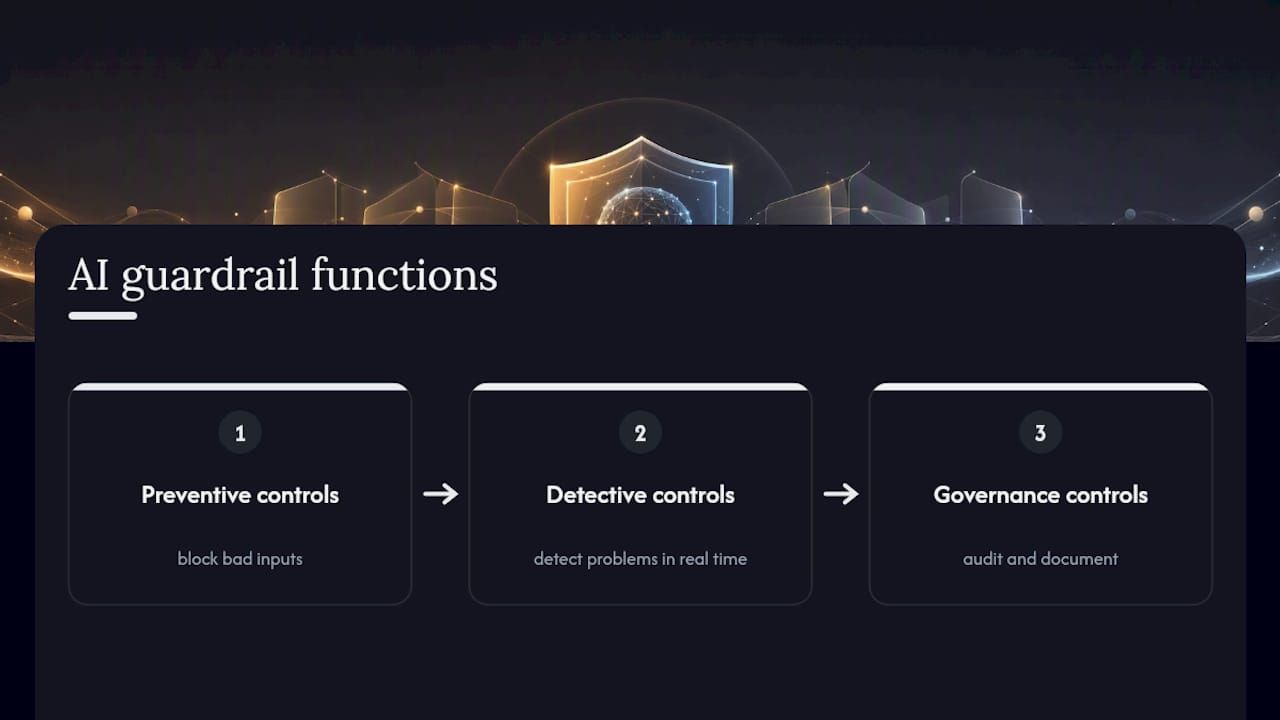
IBM frames AI guardrails as safeguards spanning policy, technical controls, and monitoring that keep a system operating inside defined boundaries. That framing matters because it separates guardrails into three functions: preventive controls that block bad inputs before they reach the model, detective controls that catch problems in real time, and governance controls that document what happened for audits later.
Guardrails are not the same as training-time fixes like fine-tuning or reinforcement learning from human feedback. Those change the model itself, which is slow, expensive, and never fully predictable. Guardrails sit outside the model as a runtime layer, which means a team can update policy in hours instead of retraining for weeks.
Three objectives drive most guardrail programs: safety, compliance, and privacy and brand alignment, aiming respectively to stop harmful outputs, enforce regulatory boundaries, and keep sensitive data contained consistent with organizational policy.
What Are the Layers of AI Guardrails?
Guardrails cluster into three layers, and each one catches a different class of failure. Skipping any single layer leaves a gap an attacker or an unlucky prompt will eventually find.
- Input guardrails screen what enters the system. This includes prompt-injection detection, scanning for sensitive data in user submissions, and structural validation of the request itself. A financial services chatbot, for instance, might reject any prompt containing account numbers before it ever reaches the model.
- Processing guardrails constrain what the model can access and do mid-task. Retrieval-augmented generation systems need allowlists that limit which documents a query can pull from, identity and access management scoping that ties permissions to the requesting user, and tool allowlists that require human approval before an agent executes a write action like updating a database record.
- Output guardrails check what comes back before it reaches the user. Toxicity filters, hallucination detectors, and PII redaction sit here, along with block-or-rewrite logic that either stops a response outright or sends it back through a correction pass.
Pro Tip: Do not treat output filtering as your only line of defense. A prompt-injection attack that succeeds at the input layer can bypass output checks entirely if the injected instruction alters how the model interprets its own guardrail logic downstream.
The OWASP Top 10 for LLMs lists prompt injection as the top risk category for exactly this reason: it can compromise every layer that comes after it if the input layer misses it.
How Do Guardrails Fit Into a Production Pipeline?
A request in a governed LLM system moves through six stages, and guardrail logic belongs at each junction rather than bolted on at the end.
- Ingress: the request arrives and passes through input validation and injection screening.
- Context construction: retrieval-augmented generation pulls documents, scoped by the allowlists and IAM rules set in the processing layer.
- Inference: the model generates a response using the constrained context.
- Tool execution: if the agent needs to act, like sending an email or writing to a database, that action passes through a tool allowlist and, for anything with real consequences, a human approval step.
- Output validation: the response is checked for toxicity, hallucination, and PII before release.
- Logging: every decision, block, and approval gets recorded for audit and drift analysis.
The most consequential engineering decision is where validation sits relative to side effects. Placing a check immediately next to the function that executes a payment or writes a record, rather than relying only on a global input or output filter, closes gaps that filters operating further away in the pipeline tend to miss, according to OpenAI’s guidance on guardrails and approvals.
Streaming responses complicate human-in-the-loop approvals. When an agent pauses mid-task to wait for sign-off, the system needs to serialize and persist its execution state so the process resumes exactly where it left off. Without that, users get forced back to square one every time an approval is required, which defeats the purpose of having an approval step at all.

How Do You Design Guardrails That Actually Hold Up?
Effective guardrails start with a use-case map and a threat model, not a generic filter library pulled off a shelf. Each use case gets scored on risk, typically severity multiplied by likelihood, so a customer-facing chatbot answering product questions gets a different guardrail budget than an agent authorized to move money.
Metrics matter here more than most teams initially budget for:
- Filter accuracy: false positive and false negative rates on your actual traffic, not a generic benchmark.
- Hallucination rate: measured against a ground-truth or retrieval-verified baseline.
- Incident frequency: how often a guardrail catches something versus how often something slips through.
- Model drift indicators: signals that the underlying model’s behavior is shifting away from what your guardrails were tuned for.
Testing has to go beyond unit tests. Red-teaming, scenario-based adversarial tests, and synthetic datasets built to surface rare edge cases give teams a way to quantify failure modes before an attacker or an unhappy customer does it for them, a method research on LLM safety evaluation backs specifically for catching low-frequency failures that normal test suites miss.
There is a real trade-off between safety and friction: aggressive filtering blocks more legitimate requests, and a governance document that records which risks leadership has knowingly accepted is what keeps that trade-off from becoming an unmanaged liability. A position paper on LLM guardrails makes the case plainly: current tooling is fairly basic, and closing the gap requires a systematic, multidisciplinary approach rather than a single filter library.
Which Standards and Frameworks Should Guide Your Guardrails?
Four references show up repeatedly in serious governance programs, and each serves a different purpose.
- The NIST AI Risk Management Framework gives a lifecycle structure for identifying and managing AI risk, useful as the backbone of an internal governance program.
- The OWASP Top 10 for LLMs lists the specific technical threats, like prompt injection and insecure output handling, that your input and output layers need to defend against.
- The IFAIS AI Safety and Risk Management Framework offers a structured model for classifying risk severity and mapping controls to that classification, which pairs well with NIST’s lifecycle view.
- The International AI Safety Report synthesizes evidence across the field and lands on a consistent recommendation: layered mitigations and continuous monitoring, not single-point fixes.
Keep the artifacts these frameworks generate, risk classifications, test results, incident logs, on file. Regulators are paying closer attention to how firms govern and disclose AI-related risk, and the SEC’s own guidance signals that documentation gaps are becoming a real regulatory exposure, not just an internal best practice.
What Does a Guardrail Rollout Actually Look Like?
Most teams overthink the starting point. The sequence below gets a minimum viable guardrail program into production without waiting for a perfect long-term architecture.
- Map every AI use case in the organization and classify each by risk severity and likelihood.
- Add input filters for prompt injection and sensitive-data detection on the highest-risk use cases first.
- Scope retrieval-augmented generation access and IAM permissions so the model only touches data it needs.
- Add output checks for toxicity, hallucination, and PII before responses reach users.
- Require human approval for any tool call with a side effect, like a payment or a database write.
- Stand up monitoring dashboards and an incident response playbook before scaling to more use cases.
Pro Tip: Build the minimum viable guardrail set first and resist the urge to chase neural-symbolic or formally verified controls out of the gate. Those investments pay off later, once you know which failure modes actually show up in your traffic.
Ownership matters as much as the sequence. Someone, often a Chief AI Safety Officer or the model-risk function, needs to own the risk classifications; SRE owns the monitoring and alerting; product owns the friction trade-offs users actually experience. Splitting these across three teams with no single accountable owner is how governance programs stall a few months.
How Does Bitecode Approach Guardrails in Enterprise Systems?
A low-code, modular approach treats validation and approval logic as reusable components rather than one-off code written per project. That matters in practice: when a client needs RAG allowlists, role-based approval workflows, or a secure data enclave for sensitive processing, those patterns already exist as pre-built modules rather than requiring a build from scratch.
That modularity shows up directly in rollout speed. Adding a payment-approval workflow, for example, does not require custom middleware written for that one integration. It can compose of existing validation and approval components, then wire in whatever policy logic the use case requires. For organizations aiming to move from pilot to production without inheriting a black-box platform they can’t audit, that combination of speed and inspectability illustrates the practical case for a modular foundation over a from-scratch build.
What Actually Goes Wrong With AI Guardrails?
Guardrails fail in fairly predictable ways, and most of the failures trace back to treating them as a one-time install rather than an ongoing system.
The biggest limitation is coverage gaps. Filters trained to catch known attack patterns miss novel ones, and prompt injection techniques evolve faster than most filter libraries get updated. A guardrail tuned against last quarter’s attack patterns offers real but incomplete protection against this quarter’s.
Latency is the second recurring problem. Every additional check, especially retrieval-based hallucination detection or a second model pass for toxicity scoring, adds time to the response. Teams that stack five sequential checks on every request often find users abandoning the product before the guardrails even finish running.
False positives create a quieter but equally damaging failure: legitimate requests get blocked often enough that users route around the system entirely, using unsanctioned tools instead. A guardrail that is too aggressive doesn’t just frustrate users, it pushes risky behavior outside the monitored perimeter altogether, which is worse than no guardrail at all.
There is also a coordination problem. Input, processing, and output guardrails are frequently built by different teams on different timelines, and nobody owns the seams between them. An attacker who understands that the input filter and the output filter were built independently, and tested independently, can sometimes find the gap between them.
Finally, guardrails built without adversarial testing tend to work well against the scenarios their designers imagined and poorly against everything else. That is precisely why red-teaming and synthetic edge-case testing matter more than most rollout plans initially budget for.
Why Does Continuous Monitoring Matter More Than the Initial Build?
A guardrail configuration that works well at launch degrades over time, and the reasons are structural, not incidental. Model providers update underlying models without warning. User behavior shifts as people learn what the system will and won’t allow. Attackers iterate on injection techniques specifically because a known filter exists to defeat.
The International AI Safety Report makes this point directly: layered mitigations and continuous monitoring are necessary risk-management techniques, not optional add-ons, precisely because no static configuration holds up indefinitely against an evolving threat landscape.
Effective monitoring tracks a handful of signals continuously rather than checking in quarterly. Drift in model output distribution flags when the underlying model has changed behavior in ways that might invalidate existing filter thresholds. Incident frequency, tracked over time rather than as a single snapshot, shows whether a guardrail’s effectiveness is holding or eroding. False-positive rates reported by frustrated users reveal friction building up before it turns into workaround behavior.
The operational discipline that works best pairs automated dashboards with a scheduled human review, typically quarterly, where someone actually reads the incident log rather than just watching a dashboard stay green. Static thresholds set once and never revisited are one of the most common reasons guardrail programs that looked solid at launch quietly stop catching real problems within a year.
Updating guardrails also means retiring the ones that no longer serve a purpose. A filter built for a threat pattern that stopped appearing six months ago still adds latency and false positives with no offsetting benefit. Monitoring isn’t just about catching new failures. It’s about knowing when to remove old rules that have outlived their usefulness.
What Happens Without Guardrails? Real Failure Patterns
The clearest way to understand why guardrails matter is to look at what happens without them, and the pattern repeats across industries: a system performs well in testing, then encounters a real-world input nobody anticipated, and the failure becomes public before anyone internally notices.
Customer-facing chatbots without output validation have generated responses that contradicted stated company policy, sometimes committing companies to terms or promises the underlying business never authorized. Once a chatbot’s response is treated as a binding statement from the company, the absence of an output check that would have flagged or blocked that specific claim becomes a legal and reputational problem, not just a technical one.
Agentic systems given tool access without approval gates for side-effectful actions have executed unintended write operations, sending duplicate communications, updating records incorrectly, or triggering downstream automations based on a hallucinated premise. The common thread in these incidents is not that the model was unusually bad. It’s that nothing sat between the model’s decision and the action it triggered.
Retrieval-augmented generation systems without proper access scoping have surfaced information the requesting user was never authorized to see, because the retrieval layer pulled from a document store without checking permissions at query time rather than trusting a downstream filter to catch it. That is precisely the kind of gap the OWASP Top 10 for LLMs categorizes under insecure output handling and excessive agency: the system did what it was technically capable of doing, not what it was authorized to do.
None of these failures required a sophisticated attacker. Most involved an ordinary user hitting an edge case nobody tested for, which is exactly the scenario layered guardrails and adversarial testing exist to catch before it reaches production.
Do Guardrails Slow Down the Model or the User?
Every guardrail adds some cost, and pretending otherwise sets teams up for an unpleasant surprise at launch. The honest framing is a trade-off, not a free win: guardrails reduce risk, and in exchange they add latency, occasionally block legitimate requests, and require ongoing engineering investment to keep tuned.
Latency is the most measurable cost. A response that requires input screening, RAG retrieval with access checks, model inference, and output validation takes longer than raw inference alone, sometimes noticeably so if hallucination detection requires a second model call to verify claims against source documents. Teams that skip latency budgeting for guardrails often discover the problem only after users start complaining about response times.
User experience takes a different kind of hit when false positives block legitimate requests. A well-tuned filter with a low false-positive rate is barely noticeable; a poorly tuned one becomes the main thing users remember about the product. This is why the metrics work described earlier, tracking filter accuracy on real traffic rather than a generic benchmark, matters as much for user experience as for security.
The counterintuitive finding is that well-designed guardrails can actually improve perceived model performance rather than just constraining it. Hallucination detection that catches and corrects a wrong answer before the user sees it produces a system that feels more reliable, even though the underlying model didn’t change at all. Users notice consistency and trustworthiness more than raw response speed in most enterprise contexts, which means the latency cost of guardrails often buys back more trust than it spends in patience.
The right target isn’t zero friction. It’s friction proportional to risk, heavy scrutiny on actions with real consequences, and a lighter touch on low-stakes interactions where speed matters more than an extra verification pass.
Can Guardrails Themselves Be Biased or Unfair?
Guardrails are built by people, trained or tuned on specific datasets, and every one of those choices can bake in bias that the guardrail then enforces at scale. A toxicity filter trained predominantly on one dialect or cultural context can flag legitimate speech from other communities as violations, while missing genuinely harmful content phrased in patterns the training data didn’t include.
This creates a specific ethical tension: the same filter meant to protect users from harm can systematically disadvantage some of those users if its training data wasn’t representative. A content moderation guardrail tuned mostly on American English patterns, for instance, may over-flag dialects or non-native phrasing as suspicious, effectively silencing exactly the users least equipped to appeal the decision.
There’s a governance dimension too. Decisions about what counts as an acceptable risk, and who gets to approve an override when a guardrail blocks something legitimate, encode a set of values. Whoever sets those thresholds is making an ethical judgment, whether or not anyone frames it that way, and organizations that treat guardrail configuration as purely technical often miss that they’re also making policy.
The most defensible response is a multidisciplinary design process, not a purely technical fix. Legal, compliance, and product perspectives need a seat at the table alongside engineering when guardrail thresholds get set, precisely because the trade-offs involve judgment calls a purely technical team isn’t positioned to make alone. That’s the same conclusion the position paper on LLM guardrails reaches from a different angle: systematic, multidisciplinary design isn’t a nice-to-have, it’s what closes the gap between guardrails that look complete and guardrails that actually hold up across the full range of users they’ll encounter.
Auditing guardrails for disparate impact across user groups, the same way fair-lending audits check credit models, is still rare in practice but increasingly necessary as these systems reach broader and more diverse user bases.
Why Guardrails Are Infrastructure, Not Overhead
Guardrails get treated as a compliance tax more often than they should be. The more accurate framing is infrastructure: they are what let an organization scale AI usage across more use cases and more users without the reputational and regulatory exposure growing at the same pace. Without them, every new deployment is a fresh bet on a model behaving exactly as tested, indefinitely, against inputs nobody has seen yet.
The organizations getting this right treat guardrails as a standing program, not a launch checklist. That means naming an owner, whether that’s a Chief AI Safety Officer or an existing risk function, scheduling governance reviews on a real quarterly cadence, and keeping an incident response playbook current rather than written once and filed away. Skip that structure and the guardrails installed at launch quietly stop matching the risks the system actually faces within a year.
— Bitecode
How Bitecode Helps Enterprises Build Guardrails Without the Rebuild
This approach offers an alternative to a from-scratch build for enterprises that need guardrails integrated into existing workflows fast, without spending months writing validation middleware from zero. Because projects can start with a substantial share of the baseline system already built, adding input filters, RAG access scoping, or human-approval workflows for side-effectful actions can happen through configuration and integration, not a ground-up engineering sprint.
A modular foundation can cover patterns such as role-based approval gates for tool execution, secure data enclaves for sensitive processing, and audit-ready logging that supports governance artifacts regulators and procurement teams increasingly expect. Whether the need is a custom software integration to wire guardrails into an existing enterprise system or automation workflows that need approval gates built in from day one, the modular approach means less time spent on boilerplate and more time spent tuning the controls that actually matter for your risk profile. Teams weighing this against pure workflow automation platforms can also look at how intelligent automation fits alongside governed AI deployments.
Reach out to Bitecode for a project scope conversation on integrating guardrails into your production AI systems.