Human-in-the-loop automation is a workflow design that pauses at defined decision points so a person can verify, correct, or approve an AI or automated system’s output before it proceeds. This exists because full automation fails silently at exactly the moments that matter most: financial transactions, medical triage, legal filings, published content. HITL trades some speed for accuracy, accountability, and a continuous feedback loop that makes the underlying model or process better over time. The rest of this guide covers how to build it correctly.
TL;DR:
- Human-in-the-loop workflows lower error costs and improve compliance by routing uncertain or high-risk cases to human reviewers before final decisions.
- Establishing clear thresholds, routing rules, and trace IDs enables efficient review management and consistent audit trails.
- Staffing, queue policies, and performance metrics must be carefully planned to prevent review bottlenecks and reviewer fatigue.
- Modular, low-code components accelerate pilot deployment by providing reusable UI, routing, and logging tools instead of custom-building from scratch.
- Combining RPA with AI in modular systems offers faster, more effective automation with continuous improvement from human-generated feedback.
What Human-in-the-Loop Automation Is (and Isn’t)
Human-in-the-loop automation, often shortened to HITL, is a hybrid workflow pattern where a human provides judgment at specific checkpoints rather than reviewing everything or nothing. IBM defines it as a workflow where people participate in operation, supervision, or decision-making to protect accuracy, safety, and accountability, typically implemented through wait nodes or API callbacks that pause a process and resume it once a reviewer acts.
That’s a meaningfully different concept from a few adjacent terms decision-makers tend to conflate:
- Full automation runs end to end with no checkpoint, appropriate only when errors are cheap and reversible.
- Human-on-the-loop (sometimes called supervisory control) lets automation run continuously while a person monitors dashboards and intervenes only on exception, rather than approving each case.
- Risk-aware autonomy shifts the review threshold dynamically based on confidence scores, so low-risk cases skip review entirely while borderline ones escalate.
Production examples make the distinction concrete. A support ticket triage system might auto-close simple password resets but route billing disputes to a human. An invoice-extraction pipeline might auto-post entries under a dollar threshold while flagging anything unusual for verification. A content-approval workflow might let an AI draft marketing copy but require sign-off before publication touches a public channel.
Why Decision-Makers Choose HITL Over Full Automation
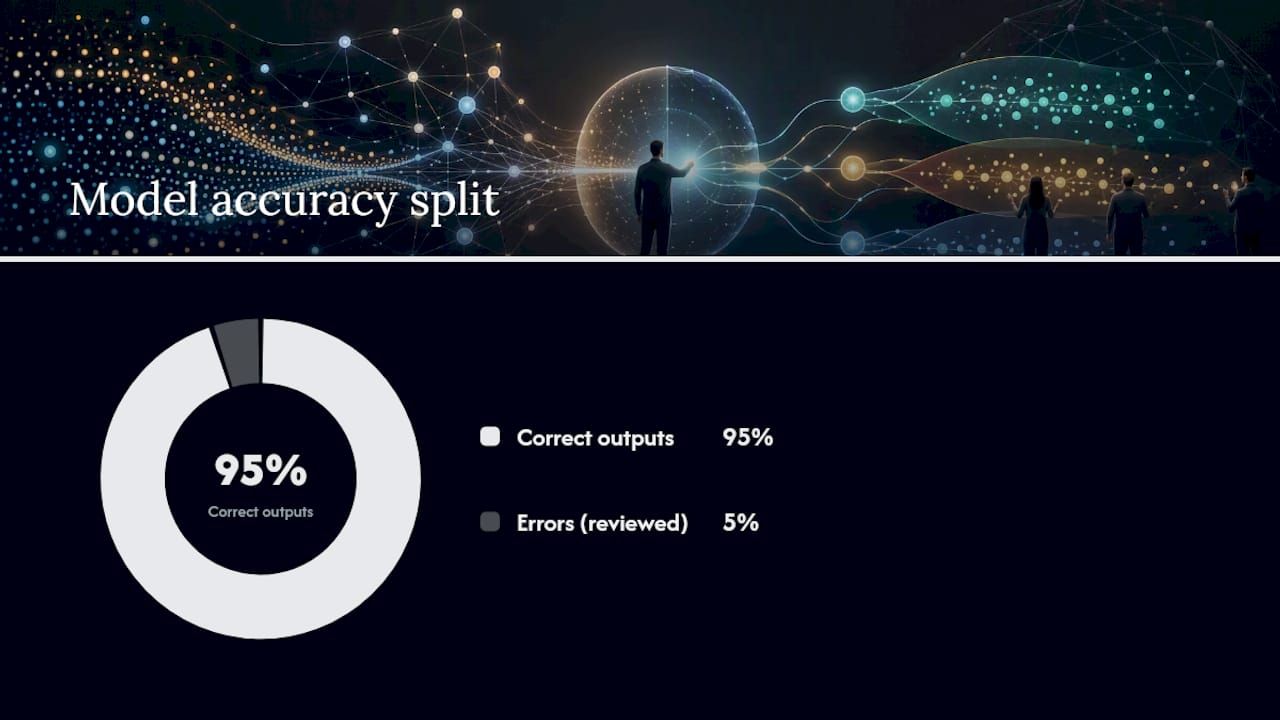
The business case rests on three pillars: error reduction, compliance, and speed to deployment. A model that’s 95% accurate still produces errors at scale, and in regulated or customer-facing workflows, the 5% is where the cost lives. Routing that fraction to a reviewer, rather than accepting it, catches expensive mistakes before they reach a customer or a ledger.
Compliance is the second driver. Auditors and regulators increasingly expect a documented chain of custody for automated decisions, not just an output. HITL builds that trail into the workflow itself instead of bolting it on afterward.
The data flywheel is the part most teams underestimate. Every human correction is a labeled example. Feed those corrections back into training or into a rules engine and the system needs fewer interventions over time, a pattern DistilledPatterns frames as designing human work into the normal production workflow rather than treating it as a temporary crutch.
- Faster time-to-value: ship a partial system now instead of waiting for full autonomy.
- Lower error cost: catch mistakes at the checkpoint, not after the fact.
- Continuous improvement: corrections become training data automatically.
- Auditable accountability: every decision has a name, a timestamp, and a reason attached.
The Technical Anatomy of a HITL Workflow
Two architectural patterns govern how review actually happens. Blocking review halts the workflow entirely until a human acts, implemented through wait nodes that pause execution and resume on a signal. Non-blocking review lets the process continue on a provisional path while a human review happens in parallel, useful when a wrong-but-reversible action is cheaper than a delay. n8n’s implementation guide recommends reserving these checkpoints for irreversible or high-risk moments: publishing, financial transfers, deleting records.
Here’s how a typical checkpoint gets built:
- Set a confidence threshold. Anything below it triggers review; anything above it proceeds automatically.
- Define routing rules. Send the case to the right reviewer or queue based on type, risk category, or customer tier.
- Build the reviewer interface. A dashboard where a human sees the input, the model’s proposed output, and enough context to decide quickly.
- Stamp a trace ID. Every reviewed record needs a trace ID, an annotator identifier, and a timestamp, a practice Delinea’s HITL overview calls essential for gating merges and building golden evaluation sets later.
- Capture the decision and feed it back. Route approvals, edits, and rejections into your audit log and, where relevant, your training pipeline.
- Set an escalation path. Define what happens when a reviewer is unavailable, unsure, or overruled by a second reviewer.
Integration with orchestration platforms and agent frameworks usually happens through the same webhook or callback pattern that triggers the pause. The workflow engine holds state, the reviewer UI writes back through an API, and the engine resumes from where it left off.
Pro Tip: Route reviewer notifications to tools people already use, like Slack or email, instead of a separate portal. n8n’s research found this cuts context-switching and speeds approvals more than any UI redesign does.
Governance That Keeps Human Review From Becoming a Bottleneck
Reliable HITL operations depend on three defined roles: the performer who takes the first action, the verifier who checks it, and the auditor who reviews samples of already-approved work to catch drift. Blurring these into one job title is the fastest way to lose the accountability HITL is supposed to provide.
Sampling policy determines what gets reviewed and how the annotation budget gets spent. A workable mix, as Jatin Bansal’s feedback loop guidance describes, splits the budget between random sampling to catch unknown failure modes and targeted or negative-feedback sampling to focus effort where errors already cluster.
- Random sampling: a fixed percentage of all cases, regardless of confidence score.
- Negative sampling: cases where downstream signals (complaints, reversals, edits) suggest an error.
- Targeted sampling: cases matching a known risk pattern, new feature, or recent model change.
Treat human work as a normal operating mode, not a fallback. Build the review interface, the routing logic, and the feedback pipeline into the product from day one, the same way you’d build any other core feature.
Operational SLAs need explicit numbers: a latency budget per review tier, a queue cap that triggers auto-escalation or a safe default action, and agreement metrics between reviewers to catch calibration drift before it reaches customers.
A Step-by-Step Checklist for Piloting HITL
Start by deciding your automation boundary before you evaluate any tool. Write down, in plain language, which decisions the system makes alone and which require a human, and attach a success metric to each: accuracy rate, latency, cost per case.
- Choose blocking or non-blocking review for each decision point, based on whether a wrong action is reversible.
- Build a staffing plan that matches reviewer throughput to expected case volume, including coverage for peak periods and absences.
- Set queue and aging policies so cases don’t sit unreviewed indefinitely; define what happens when a queue breaches its cap.
- Instrument everything: trace IDs, audit logs, and a clear path for how approved or corrected labels route into evaluation sets or retraining data.
- Run a scoped pilot with a hard boundary on volume and case type, and set guardrails (a maximum error rate, a minimum reviewer agreement score) that must hold before you expand it.
- Plan the migration path toward greater automation as confidence and data volume grow, rather than treating the pilot’s manual level as permanent.
Pro Tip: Pick your pilot’s success metrics before you pick a vendor or platform. Teams that reverse this order tend to select tools that look impressive but don’t measure what actually matters for their specific risk profile.
Reviewer platforms and adapters exist for both patterns; open frameworks like Humancheck demonstrate the routing and dashboard features a build-versus-buy evaluation should compare against.
Where HITL Pilots Go Wrong
Human bandwidth is finite, and the most common failure is treating review capacity as elastic. Cases pile into a queue, latency climbs, and a system built for accountability starts producing worse outcomes than full automation would have.
A related trap: ad-hoc human intervention that started as a temporary patch becomes a permanent, unbudgeted headcount cost nobody planned for. DistilledPatterns makes the point directly. Without a staffing plan, instrumentation, and a connection to actual improvement, human review becomes a bottleneck instead of a safety feature.
- Watch for reviewer fatigue driving agreement scores down over time.
- Check whether privacy or contractual terms restrict reusing human decisions as training data.
- Treat a consistently low escalation rate as a signal you can safely automate more, not less.
- Audit queue aging weekly; a growing backlog is the earliest warning sign of an under-resourced pilot.
Why Modular, Low-Code Foundations Change the HITL Timeline
Most HITL pilots stall on the same thing: building a reviewer interface, trace capture, and audit logging from scratch before the actual workflow logic ever gets tested. That’s infrastructure work, not differentiation, and it consumes months a pilot doesn’t have.
Bitecode approaches this from a modular foundation. Review dashboards, routing logic, and audit-trail capture are the kind of components that don’t need to be rebuilt for every client, which is exactly the argument for starting a pilot from pre-built pieces rather than a blank codebase. A fintech team adding a transaction-approval checkpoint, or a healthcare operation adding a triage review step, faces the same underlying need: a UI, a trace ID, a feedback route back into the system. Modular components handle that scaffolding so engineering time goes toward the business logic that actually differentiates the workflow, not the plumbing every HITL system eventually needs anyway.
— Bitecode
Start a Human-in-the-Loop Pilot Without the Six-Month Build
Our platform provides a faster route to a working HITL pilot compared to a from-scratch build.
Bitecode’s AI business process automation service is built around exactly this pattern: wait nodes, callback routing, confidence thresholds, and audit-ready trace IDs, wired into workflows for financial processing, compliance review, and content approval. Teams that need a custom reviewer interface or a bespoke integration layer on top of that automation can pair it with Bitecode’s custom business software development service, which handles the specific UI and data model each industry needs. Enterprise teams evaluating build-versus-buy tradeoffs for automation programs have found that combining RPA and AI components, rather than committing to one or the other, tends to produce better procurement outcomes, a pattern also reflected in reported productivity gains from AI-assisted workflows.
If you’re scoping a pilot, the next step is a conversation about your automation boundary and success metrics. Reach out through Bitecode to request a pilot scope and quote.
Sources
- What Is Human In The Loop (HITL)?
- Human-in-the-Loop | DistilledPatterns
- Human in the loop automation: Build AI workflows that keep humans in control – n8n Blog
- Human-in-the-Loop feedback loops for LLM systems | Jatin Bansal