SOC 2 is an AICPA attestation that proves your controls meet chosen Trust Services Criteria, not a government certification. A licensed CPA firm examines your controls and issues a report; Security is mandatory for every engagement, and you select the remaining criteria (availability, processing integrity, confidentiality, privacy) based on what your services actually promise customers. The immediate decision that follows is scope, not paperwork.
- Type I confirms your controls are designed correctly as of a specific date.
- Type II confirms those same controls operated effectively over a defined observation window, typically three to twelve months.
- Most enterprise buyers in the United States treat Type II as the real signal; Type I is a bridge, not a destination.
- SOC 2 compliance is contractual leverage, not a legal mandate. Nobody will fine you for skipping it. Your prospects’ procurement teams will simply stop the deal at the security questionnaire.
Key Takeaways
SOC 2 compliance succeeds when the system boundary is defined honestly, evidence generation is automated before the observation period starts, and the report type matches what your actual buyers expect to see.
| Point | Details |
|---|---|
| Security is mandatory | Every SOC 2 report includes Security; add Availability, Processing Integrity, Confidentiality, or Privacy only where contracts require them. |
| Type II carries more weight | U.S. enterprise buyers generally prefer Type II because it proves controls worked over months, not just on paper. |
| Scope drives buyer trust | A precise system boundary statement matters as much to procurement as the report type itself. |
| Evidence beats policy | Auditors need provisioning tickets, MFA logs, and change records, not just written policies. |
| Automate early | Automated evidence export shortens readiness timelines and reduces manual labor during the observation window. |
Where to Go for the Primary Sources
- AICPA’s SOC 2 and Trust Services Criteria pages remain the authoritative reference for the actual audit standard.
- Microsoft’s Service Trust Portal guidance explains how cloud platforms scope their own SOC 2 attestations.
If you’re mapping out which controls to automate before your next audit cycle, Bitecode’s custom software development services build evidence generation directly into the modular systems your team already runs, and the AI-driven automation services extend that same logic to evidence exports and policy workflows so your compliance team spends less time chasing screenshots and more time closing deals.
What SOC 2 Compliance Actually Means for U.S. Companies
SOC 2 is not a checklist you complete and file with a regulator. It is an attestation, a formal opinion issued by a licensed CPA firm after examining whether your controls meet the AICPA’s Trust Services Criteria. That distinction trips up a lot of first-time buyers: there is no government body granting “SOC 2 certification,” and no badge you earn once and keep forever. Every report has an expiration built into it, because the audit only speaks to the period it examined.
The American Institute of Certified Public Accountants maintains the criteria and the audit standard (AT-C Section 105 and 205), but the actual attestation work is performed by an independent CPA firm your organization hires. That firm reviews your policies, tests your controls, and either issues a report with no material exceptions or flags the gaps it found. Nothing about this process is voluntary in a legal sense. Nothing about it is optional in a commercial sense either, once your buyers start asking for it.
Procurement teams at mid-size and enterprise companies request SOC 2 reports for a few recurring reasons:
- Vendor risk management policy compliance. Many enterprises will not sign with a vendor that handles customer data without a current SOC 2 report on file.
- Cyber insurance underwriting. Insurers increasingly ask whether a vendor holds SOC 2 or an equivalent attestation before extending favorable terms.
- Faster security review cycles. A current report answers 80% of a typical vendor security questionnaire before anyone opens a spreadsheet.
- Board and audit committee assurance. Public companies and their subsidiaries often require SOC 2 from any vendor touching financial or customer data as part of their own control environment.
None of this makes SOC 2 mandatory the way a data breach notification law is mandatory. It makes it commercially unavoidable if your buyers are large enough to have a vendor security function, which, for most B2B SaaS companies selling into the U.S. mid-market and up, they are.
What Do the Trust Services Criteria Actually Require?
The five Trust Services Criteria are not abstract principles. Each one maps to specific, testable controls an auditor will ask to see evidence of, and Security is the only one every SOC 2 report must include.
- Security. This is the baseline every organization gets audited against: multi-factor authentication on privileged accounts, least-privilege access models, firewall and network segmentation rules, and centralized logging that captures who accessed what and when. Auditors want to see MFA enforcement logs, not just a policy document stating MFA is required.
- Availability. Relevant for anyone with an uptime commitment. Expect auditors to review your SLA language, infrastructure redundancy (failover regions, backup systems), and whether you actually monitor uptime with alerting rather than waiting for customer complaints.
- Processing integrity. This one matters most for platforms that process transactions, calculations, or data transformations, think payment processors or billing engines. Controls here include input validation rules, reconciliation processes, and documented change management so a code deployment cannot silently alter how data is processed.
- Confidentiality. Encryption at rest and in transit, role-based access controls, and data classification policies that determine who can see what. This criterion overlaps heavily with security but focuses specifically on protecting information designated as confidential under a contract or NDA.
- Privacy. The narrowest and most specific criterion, covering how personal information is collected, used, retained, and disposed of, tied to a published privacy notice. Companies handling health data, financial data, or consumer PII at scale usually include this one; a B2B infrastructure tool with no consumer data often skips it entirely.
Pro Tip: Don’t default to including all five criteria because it “looks more thorough.” Every criterion you add is more evidence your team has to produce and more surface area for an auditor to find an exception. Match the criteria to what your contracts actually promise, nothing more.
Auditors don’t grade these criteria against a universal standard. They test whether your own documented controls, the ones you claim to run, actually operated as described. A company with three controls that work consistently will pass more cleanly than one with fifteen controls and gaps in the evidence trail.
Choosing Type I, Type II, and the Right System Boundary
The Type I versus Type II decision comes down to what your buyers actually need to see. A Type I report evaluates control design at a single point in time, while Type II evaluates whether those controls operated effectively across an observation period, usually three to twelve months.
- Type I is faster to obtain and often used as a first step to unblock a deal while a Type II observation period runs in parallel.
- Type II carries far more weight with enterprise procurement, because it demonstrates the controls held up under real operating conditions, not just on paper.
- Sophisticated buyers increasingly treat Type I as a placeholder and will ask when your Type II is expected.
Scope matters just as much as report type. Your system boundary statement defines exactly which systems, data flows, and services are covered by the audit, and buyers read this section closely. A vendor claiming SOC 2 compliance for its “platform” while the report only covers one subsystem is a common source of friction during due diligence. Define your boundary around the actual product or service your customers are contracting for, and be explicit about what is excluded (a staging environment, a legacy module, a third-party subprocessor).
Selecting which Trust Services Criteria to include should follow directly from your contractual commitments. If your master service agreements promise 99.9% uptime, Availability belongs in scope. If you process payments, Processing Integrity does too. Adding criteria you can’t contractually justify just inflates audit cost without adding sales value.
Does Your Organization Actually Need a SOC 2 Report?
SOC 2 makes the most sense for organizations whose product or service directly touches customer data and whose buyers have formal vendor risk processes. Three profiles come up constantly:
- SaaS companies selling to mid-market and enterprise buyers, where security questionnaires are a standard part of the sales cycle.
- Cloud-hosted B2B services that store, process, or transmit customer data on infrastructure the buyer doesn’t control directly.
- Data processors and platforms handling sensitive categories, financial records, health information, or authentication credentials, where a breach carries outsized reputational and contractual risk.
The benefits follow a predictable pattern once the report exists. Deals that used to stall for weeks on security review move faster, because the report answers most of the questionnaire up front. Buyers extend more trust to a vendor with independent third-party validation than one asking them to take security claims on faith. And the audit process itself tends to surface control gaps, weak offboarding, unlogged admin access, no centralized change tracking, that were quietly increasing breach risk regardless of whether a customer ever asked about them.
SOC 2 is not automatically the right first move for every early-stage company. If you have fewer than a handful of enterprise prospects actively requesting it, the six-figure-adjacent cost and internal disruption of a full audit cycle can outpace the commercial benefit. A reasonable alternative for very early companies is to run a security questionnaire response kit and a documented internal policy set first, then commit to SOC 2 once enterprise deal flow justifies it.
How Long Does a SOC 2 Audit Take and What Does It Cost?
The path to a SOC 2 report runs through four stages, and skipping the first one is the most common reason audits run long.
- Scoping. You define your system boundary, select applicable Trust Services Criteria, and identify which teams own which controls. This stage typically runs two to four weeks and sets the ceiling on everything that follows.
- Readiness assessment and remediation. A readiness review (often run internally or with a consultant) identifies gaps between your current controls and what the criteria require, before an auditor ever looks at anything. This is where most of the real work happens: writing missing policies, turning on MFA everywhere, standing up centralized logging. Expect four to twelve weeks depending on how mature your controls already are.
- The audit itself. For Type I, the auditor tests control design at a single point and the fieldwork usually wraps in two to four weeks. For Type II, the observation period runs three to twelve months before fieldwork even begins, since the auditor needs a real window of operation to test against.
- Report drafting and delivery. After fieldwork, auditors typically need two to six weeks to draft, review, and finalize the report.
Put together, a first-time Type I report often lands three to four months after kickoff. A first-time Type II report, including the observation period, commonly takes nine to fifteen months start to finish.
Cost varies more than most vendors admit publicly, but three factors drive the range: the number of Trust Services Criteria in scope, the maturity of your existing controls (a company starting from zero pays far more in remediation labor than one with decent hygiene already), and whether you use manual evidence collection versus automated tooling. Automation platforms materially cut the manual evidence-gathering burden that otherwise consumes weeks of engineering and compliance time chasing screenshots and log exports.
Before engaging an auditor, most organizations benefit from working through a readiness checklist:
- Documented information security policy, access control policy, and incident response plan.
- Centralized, exportable logs covering authentication, privileged access, and system changes.
- A change management record showing tickets, approvals, and testing for every production deployment in the observation window.
- An up-to-date vendor and subprocessor inventory with their own compliance attestations on file.
- Evidence that offboarding actually revokes access within a defined window, not just a policy saying it should.
A SaaS security compliance checklist built around these categories before you ever talk to an auditor tends to shave weeks off the readiness stage.
Turning Controls Into Evidence an Auditor Can Actually Use
Auditors don’t take your word for it. Every control you claim needs a corresponding artifact, and the gap between “we have a policy” and “we have proof the policy was followed” is where most first-time audits lose time.
Access management is the clearest example. A policy stating you follow least-privilege access means nothing without provisioning tickets showing who approved each access grant, MFA enforcement logs proving it was actually turned on for every account, and deprovisioning records showing access was revoked within a defined window after someone left. Auditors will sample specific employees and ask you to produce the paper trail for each one.
Change management works the same way. Every production deployment during the observation period needs a ticket, an approval from someone other than the person who wrote the code, and evidence the change was tested before release. Teams that rely on ad-hoc Slack approvals instead of a tracked system usually discover this gap during the readiness assessment, not before.
Logging and retention settings deserve particular attention because auditors check both existence and duration. A SIEM or centralized log aggregator needs to capture authentication events, privileged actions, and system-level changes, retained long enough to cover the full observation window. CISA’s guidance on ransomware preparedness recommends the same baseline: durable logging, tested incident response, and verified backups, all of which happen to satisfy SOC 2’s Security criterion at the same time.
Vendor management rounds out the evidence set. You need an inventory of subprocessors and third-party tools that touch in-scope data, along with their own SOC 2 reports or equivalent attestations. If you run on a major cloud platform, confirm exactly which services their SOC 2 Type II report covers, since cloud providers scope their attestations to specific services and you may need a bridge letter to cover gaps.
- Provisioning and deprovisioning tickets with timestamps and approver names.
- MFA enforcement logs across all privileged and administrative accounts.
- Change tickets linked to code review approvals and test results.
- Centralized log exports covering the full observation period, not just recent activity.
- Subprocessor attestations and a documented vendor risk review cadence.
Pro Tip: Build your evidence exports as a recurring automated job, not a manual scramble the week before fieldwork starts. An auditor who receives clean, timestamped exports on request moves faster and finds fewer reasons to expand testing. A practical automation approach to compliance evidence pays for itself the moment your second audit cycle begins.
SOC 2 vs. ISO 27001: Which One Do U.S. Buyers Actually Want?
SOC 2 and ISO 27001 answer different questions for different audiences, and the choice between them usually comes down to who is buying, not which framework is objectively “better.” SOC 2 is a U.S.-centered attestation focused on specific operational controls, while ISO 27001 is an internationally recognized certification of your broader information security management system.
- Audience fit. If your buyers are primarily U.S. enterprises, SOC 2 is what their procurement teams expect to see and know how to read.
- Geographic reach. If you sell into Europe, the Middle East, or government contracts abroad, ISO 27001 carries more recognition and is often a prerequisite rather than a nice-to-have.
- Audit output. SOC 2 produces a narrative report describing your specific controls and testing results; ISO 27001 produces a certification confirming your management system meets the standard, backed by a separate Statement of Applicability.
- Combining both. Many mid-size and larger organizations pursue both once they sell across regions, ISO 27001 covers the governance and risk management layer, while SOC 2 demonstrates that day-to-day operational controls actually function.
A reasonable rule of thumb: prioritize SOC 2 when your primary buyers are U.S.-based enterprises, and add ISO 27001 when international sales or government procurement enter the picture. Chasing both from day one rarely makes sense for a company still closing its first handful of enterprise deals.
Where SOC 2 Audits Go Wrong
Most audit delays trace back to the same handful of mistakes, and they’re avoidable if you catch them during scoping instead of during fieldwork.
- Scope drift. Adding new systems or services mid-observation-period without updating the boundary statement forces auditors to reassess coverage and often extends the timeline.
- Ad-hoc evidence gathering. Document dumps assembled the week before fieldwork tend to have gaps auditors flag as exceptions rather than oversights.
- Unresolved incidents. Open security incidents or unpatched vendor issues discovered mid-audit routinely become qualified opinions or delayed reports.
- Weak vendor documentation. Missing subprocessor attestations force additional testing and follow-up requests that stretch fieldwork by weeks.
Procurement teams reviewing your report, meanwhile, skip straight to three things: the scope and system boundary statement, whether it’s a Type II rather than Type I, and how cleanly your controls map to the specific criteria their own risk policy requires.
How Bitecode Approaches SOC 2 Readiness Differently
Most of the audit delay described above comes from evidence that doesn’t exist yet when the auditor asks for it.
- Pre-built modules ship with structured logging and access controls already producing evidence, not requiring retrofits.
- Automated evidence export routines pull provisioning, MFA, and change records without manual screenshot chasing.
- Policy templates and workflow automation modules cut the readiness-stage documentation gap that stalls most first-time audits.
Editorial Take: What Actually Moves the Needle on SOC 2
The conventional advice on SOC 2 spends too much time on the badge and not enough on the boundary statement. A Type II report with a vague, overbroad scope tells a sophisticated buyer less than a Type I report with a tight, honest boundary, and most procurement teams figure that out within thirty seconds of reading the cover page.
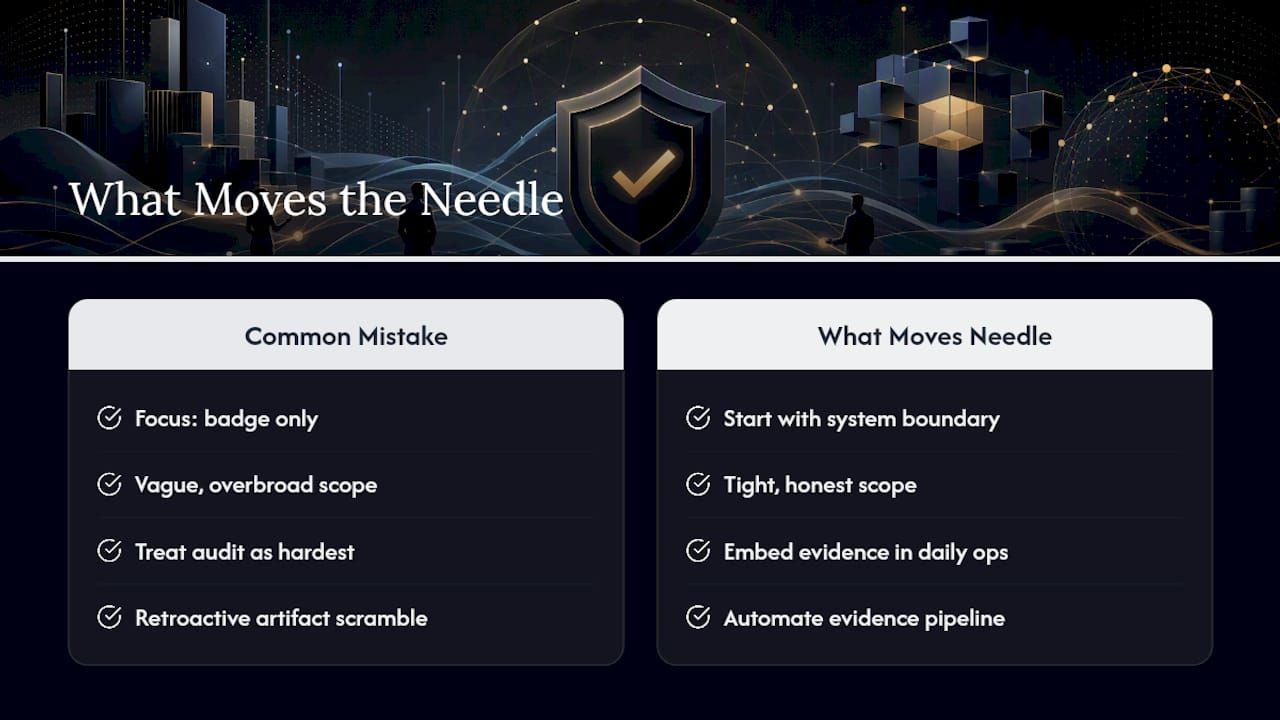
Where most organizations waste time is treating the audit as the hard part. It isn’t. The hard part is building evidence generation into daily operations early enough that the observation period simply captures what already exists, rather than triggering a scramble to retroactively document six months of access changes nobody logged consistently. Automation isn’t a convenience here; it’s the difference between an audit that takes three weeks of fieldwork and one that takes three months of back-and-forth over missing artifacts.
If you’re deciding where to start, start with the system boundary and the evidence pipeline, not the criteria selection. Everything else follows from those two decisions.
— Bitecode
Sources
- AICPA — SOC 2 report and Trust Services Criteria
- Microsoft — Azure and Office 365 SOC 2 Type 2 attestation guidance
- Drata — SOC 2 beginner’s guide